The best choice among standard hardcover book sizes is the smallest format that presents your content comfortably and works with your sales channel. For text-led trade books, 6 × 9 inches (152 × 229 mm) is the safest starting point. Consider 5.5 × 8.5 inches for a more intimate novel or memoir, 7 × 10 inches for instructional nonfiction, 8 × 10 or 8.5 × 11 inches for illustrated books, and 9 × 12 inches or a landscape format for art and photography. Final dimensions should be confirmed only after testing the page design, paper, binding, packing, and distribution requirements together.
Hardcover Book Sizes: Quick Answer
| Book type | Strong starting sizes | Typical reason |
|---|---|---|
| Novel, memoir, narrative nonfiction | 5.5 × 8.5 in; 6 × 9 in | Comfortable reading, familiar shelf proportions, efficient text layout |
| Business, education, reference | 6 × 9 in; 7 × 10 in; 8.5 × 11 in | Room for tables, charts, callouts, and instructional structure |
| Children’s picture book | 8 × 8 in; 8 × 10 in; 10 × 8 in | Shared reading and full-spread illustration |
| Art or photography book | 8 × 10 in; 9 × 12 in; 10 × 10 in | Larger images, visual pacing, and display value |
| Coffee-table or portfolio book | 9 × 12 in; 11 × 8.5 in; custom large format | High visual impact and premium presentation |
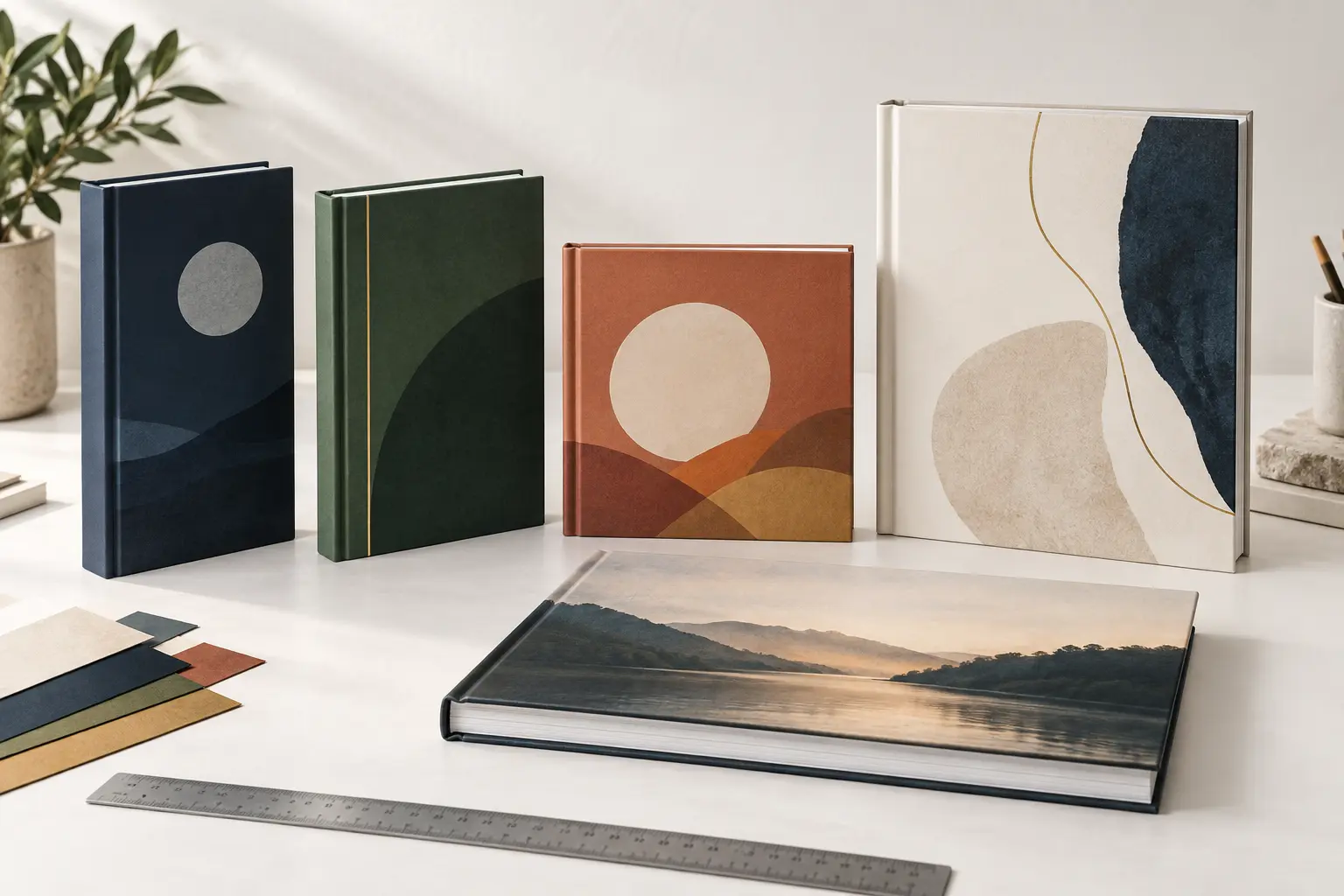
Compact, square, portrait, and landscape hardcovers create different reading, production, and shipping outcomes.
- What Hardcover Trim Size Means
- Standard Hardcover Book Sizes
- Best Size by Content Type
- How Size Changes Printing Cost
- Size, Page Count, and Spine Width
- Press-Sheet Efficiency and Custom Sizes
- Distribution, Packing, and Shipping
- Artwork, Bleed, and Case Dimensions
- Practical Production Scenario
- Seven-Step Decision Process
- Frequently Asked Questions
What Does Hardcover Book Trim Size Mean?
Trim size is the final width and height of the interior pages after printing, folding, binding, and three-side trimming. It is written width first, then height. A 6 × 9-inch portrait book is therefore six inches wide and nine inches high.
The outside case is larger than the trimmed book block. Board overhang, hinge width, spine construction, covering material, and the printer’s case-making standard all affect its final dimensions. Consequently, a designer should never enlarge an interior-page template and assume it is a correct case-cover template.
“Standard” does not mean that every printer, print-on-demand platform, warehouse, or market supports the same list. Amazon KDP currently calls 6 × 9 inches the most common US trim size, while IngramSpark publishes its own hardcover size ranges and trim matrix. A custom offset printer can often make formats outside those POD menus, but feasibility and cost still depend on equipment and material utilization.
Standard Hardcover Book Sizes in Inches and Millimeters
The following dimensions are practical starting points, not universal rules. Always confirm the exact final trim size with the printer before typesetting or creating the cover.
| Trim size (inches) | Approx. millimeters | Format | Common applications |
|---|---|---|---|
| 5 × 8 | 127 × 203 mm | Compact portrait | Short fiction, poetry, spiritual titles |
| 5.5 × 8.5 | 140 × 216 mm | Digest portrait | Novels, memoirs, literary editions |
| 6 × 9 | 152 × 229 mm | US trade portrait | General fiction, nonfiction, business books |
| A5 | 148 × 210 mm | International portrait | Novels, journals, guides, European and Asian markets |
| 7 × 10 | 178 × 254 mm | Large portrait | Workbooks, manuals, reference, illustrated nonfiction |
| 8 × 8 | 203 × 203 mm | Square | Children’s books, gift books, visual concepts |
| 8 × 10 | 203 × 254 mm | Portrait | Children’s books, cookbooks, photography |
| 8.5 × 11 | 216 × 279 mm | Letter portrait | Textbooks, manuals, educational and corporate books |
| 9 × 12 | 229 × 305 mm | Large portrait | Art books, photography, museum publications |
| 11 × 8.5 | 279 × 216 mm | Landscape | Portfolios, architecture, panoramic photography |
| 10 × 10 | 254 × 254 mm | Large square | Premium gift books, art, brand books |
Do not convert inches to millimeters and then round casually. Six inches equals 152.4 mm, not exactly 152 mm. A printer may quote the rounded metric convention or the true converted dimension; that 0.4 mm difference must be resolved before artwork is built.
How to Choose Hardcover Book Sizes by Content
Novels and memoirs
For uninterrupted reading, 5.5 × 8.5 and 6 × 9 inches are dependable choices. The smaller format feels personal and compact; 6 × 9 gives longer lines, more words per page, and a more substantial physical presence. Judge both using the same typeface, font size, leading, margins, and sample chapter—not by comparing empty rectangles.
Business, academic, and instructional books
Charts, sidebars, equations, footnotes, and tables need usable width. A 7 × 10-inch format can be a good compromise between portability and layout flexibility. Letter-size 8.5 × 11 works for manuals and course materials but may feel more institutional than a trade book.
Children’s picture books
Square and near-square pages support centered characters and balanced double-page spreads. Portrait 8 × 10 works well for vertical scenes; landscape 10 × 8 suits wide environments and group scenes. Account for the gutter before placing faces or essential details across a spread.
Art, photography, and coffee-table books
Choose orientation from the dominant image set. Portrait artwork forced into a landscape book creates unused space, while wide photographs in a narrow portrait format become small or require aggressive cropping. Before selecting 9 × 12 or larger, make a full-size printed mock-up and test its weight, opening behavior, shelf fit, and shipping carton.
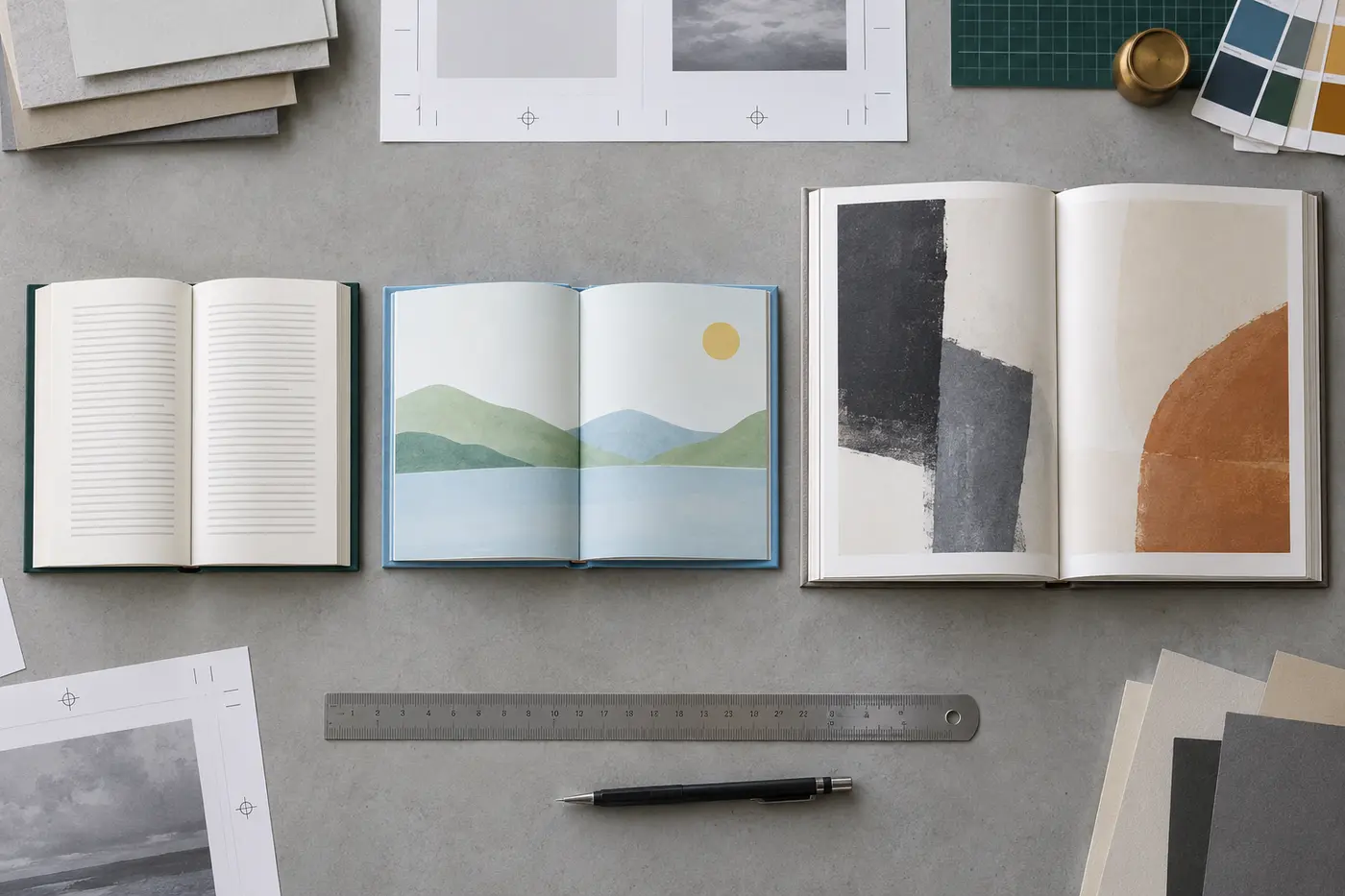
The best trim size should be evaluated with real page layouts, not only a list of dimensions.
Planning a custom hardcover? Send two candidate sizes, page count, paper choice, quantity, binding, and delivery market. Prikoro can compare production implications before you finalize the layout.
How Hardcover Book Size Changes Printing Cost
However, increasing hardcover book sizes does not create a simple proportional price increase. Cost changes in steps because printers impose pages on standard press sheets. A slightly larger trim can reduce the number of pages that fit on each sheet, create more waste, require a larger press, or change the available laminating, case-making, and binding route.
| Cost driver | Why size matters | What to ask the printer |
|---|---|---|
| Paper area | Larger pages consume more stock, but nesting efficiency determines actual waste. | Which nearby size gives the best press-sheet yield? |
| Page count | A larger page may fit more content and reduce signatures; a smaller page may add pages. | Compare both sizes using the same designed sample chapter. |
| Cover materials | Larger boards, cover paper, cloth, lamination, and jackets use more material. | Does the case fit standard board and covering-sheet formats? |
| Binding equipment | Very small, square, landscape, or oversized books may need a different line or more handwork. | Can the chosen size run on the normal case-binding line? |
| Packing and freight | Large books increase unit weight, carton size, pallet utilization, and dimensional freight. | Request carton dimensions, gross weight, and units per carton. |
A supplier’s old price table cannot reliably predict your project. Paper grade, page count, color coverage, binding, endsheets, cover style, finishing, quantity, packing, and destination must remain constant when comparing sizes.
How Trim Size Affects Page Count and Spine Width
For example, the same manuscript can produce different page counts across hardcover book sizes. A wider and taller text area usually holds more words per page, but the result depends on font, leading, paragraph spacing, margins, headings, images, and chapter openings. Page count then affects paper consumption, signature planning, binding thickness, spine width, weight, and cover artwork.
For image-led books, enlarging the trim may not reduce page count because visual pacing often remains one image—or one designed spread—at a time. In that case, size adds impact but also directly adds paper and cover material.
Never finalize the hardcover spine from a generic calculator. The production spine must be based on the selected paper’s actual caliper, page count, folding plan, endpapers, sewing or adhesive structure, and the printer’s compression allowance.
Press-Sheet Efficiency: Why a Custom Size Can Cost More
In commercial offset printing, hardcover book sizes influence how multiple pages fit on a large sheet, which is later folded into a signature. The economical result depends on the press sheet, gripper and trim allowances, grain direction, folding scheme, and bindery limits. Moving one edge by a few millimeters can change the imposition or waste percentage.
This does not mean every custom size is a bad decision. A distinctive art book or collector edition may justify a unique format. However, the size should create commercial value that exceeds its production penalty. Ask for an “optimized nearby size” alongside your preferred format; the alternative may preserve the visual concept while improving material yield.
Distribution, Packing, and Shipping Considerations
Moreover, hardcover book sizes that look impressive on screen can be awkward in a warehouse. Confirm shelf expectations, fulfillment packaging, maximum parcel dimensions, pallet pattern, and retailer requirements. Oversized books also need stronger export cartons and may suffer more corner damage because their weight produces greater impact during handling.
If the book will be sold through print-on-demand as well as an offset edition, select a trim supported by both workflows before designing. IngramSpark states that white-paper hardcovers span 5 × 8 through 8.5 × 11 inches, while its crème and groundwood hardcover range is narrower. KDP publishes a separate menu and currently notes five hardcover trim sizes. Platform limits can change, so verify them for your exact paper, color, binding, and marketplace.
For direct-to-consumer premium books, test the complete shipment: book, dust jacket or slipcase, protective wrap, mailer, and courier label. The final packed object—not the trim size alone—determines fulfillment cost and damage risk.
Interior Artwork, Bleed, and Hardcover Case Dimensions
Meanwhile, full-bleed interiors for different hardcover book sizes extend beyond the trim line so minor cutting variation does not leave a white edge. Both KDP and IngramSpark publish platform-specific setup instructions; IngramSpark’s current file guide specifies 0.125 inch (3 mm) bleed for many interior applications and a different wrap requirement for case-laminate covers. Use your selected printer’s template rather than transferring one platform’s dimensions to another.
- Build the interior document at the confirmed trim size.
- Add the required bleed only on sides specified by the printer.
- Keep text, folios, faces, and essential details inside the safety area.
- Allow extra inner margin for thick books and binding curvature.
- Do not design the case, dust jacket, or foil die before the final spine is supplied.
- Export print-ready PDFs using the agreed color and image-resolution workflow.
Review Prikoro’s prepress artwork guidance, book paper guide, and hardcover book printing options before releasing final files.
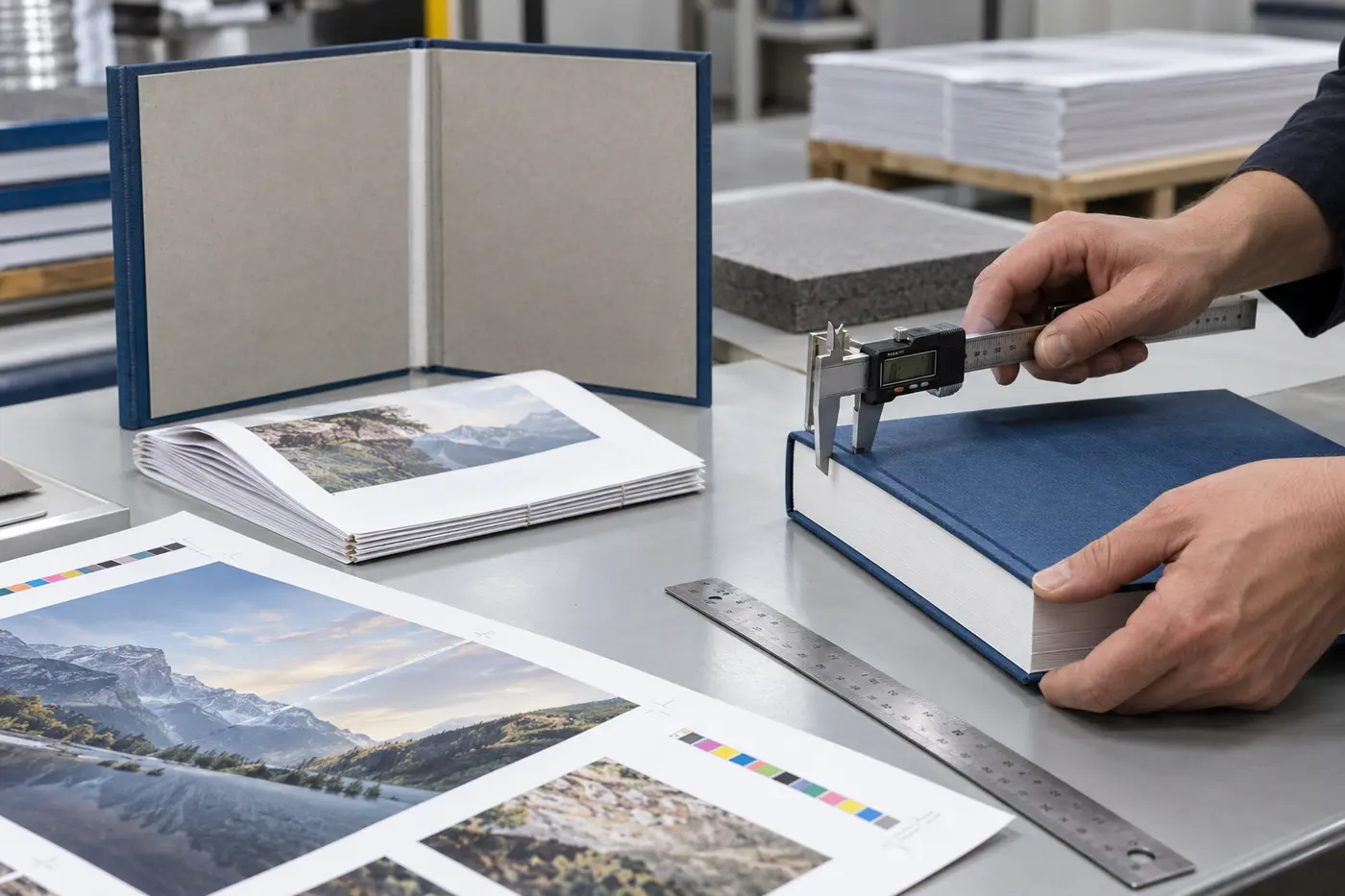
A full-size dummy verifies handling, case overhang, spine, paper bulk, and packing before mass production.
Need a production-ready template? Confirm the final trim, paper, page count, binding, and cover construction first. Then request the exact interior and case templates for your project.
Practical Production Scenario: 6 × 9 vs. 7 × 10 Inches
Consider a publisher preparing 2,000 full-color hardcover training books with diagrams and short case studies. This is a transparent planning scenario, not a claimed Prikoro customer project.
At 6 × 9 inches, the book is portable and familiar, but wide diagrams may need to rotate or shrink, and the manuscript may create more pages. At 7 × 10 inches, tables and callouts fit more naturally, potentially reducing pages, but each sheet and case is larger. The correct comparison is therefore not “larger costs more.” It is total manufacturing cost, readability, packed weight, carton efficiency, and the value of clearer diagrams.
The publisher should typeset the same representative 16 pages in both formats, print them at 100%, bind simple dummies with the intended paper, and obtain matched quotations. This test reveals whether the larger format genuinely improves instruction enough to justify its production and freight impact.
A Seven-Step Hardcover Size Decision Process
- Define the reader and channel. Bookstore, school, museum shop, crowdfunding reward, direct sale, and POD each create different constraints.
- Shortlist two or three familiar sizes. Start with genre expectations before considering a custom shape.
- Design representative pages. Include dense text, a chapter opener, the widest table, and a full-spread image.
- Estimate the complete page count. Reflow the manuscript; do not scale an existing PDF.
- Ask for production optimization. Compare paper yield, signature plan, binding route, and nearby economical dimensions.
- Build physical dummies. Test weight, opening, reading distance, shelf fit, and packing.
- Freeze the specification. Only then finalize the cover, spine, dust jacket, foil, slipcase, and shipping carton.
Ready to compare formats? Send Prikoro your manuscript page estimate, two preferred trim sizes, binding style, paper, quantity, and delivery postcode for a side-by-side specification review.
Frequently Asked Questions
What is the most common hardcover book size?
For US trade publishing, 6 × 9 inches is the safest general starting point and is identified by Amazon KDP as its most common US trim size. Genre, content, and market may make another format better.
Is 5.5 × 8.5 or 6 × 9 better?
Choose 5.5 × 8.5 for a compact, intimate reading experience. Choose 6 × 9 for more page area, potentially fewer pages, and a familiar trade-nonfiction format. Compare typeset samples before deciding.
What size should a children’s hardcover book be?
Common starting points include 8 × 8, 8 × 10, and 10 × 8 inches. The artwork’s orientation, reading age, spread design, and intended handling matter more than a universal standard.
What size is best for a hardcover art book?
Eight × 10 and 9 × 12 inches are practical portrait starting points; 10 × 10 suits square compositions, while 11 × 8.5 supports landscape work. Match the format to the dominant artwork and test a full-size dummy.
Does a larger trim size always cost more?
Usually it increases material and freight, but not in a perfectly linear way. A larger page can reduce page count, while a small size change can improve or damage press-sheet yield. Request matched quotations.
Can hardcover books use custom sizes?
Yes, many offset printers can produce custom dimensions within their equipment limits. Custom sizes may increase waste, handwork, tooling, packing complexity, or lead time, so ask for a nearby optimized option.
Is hardcover trim size the same as cover size?
No. Trim size describes the finished interior pages. The rigid case is larger and must include board overhang, hinges, spine construction, and covering wrap based on the printer’s template.
When should I finalize the cover template?
After the trim size, final page count, paper, endpapers, and binding method are confirmed. These variables determine the book-block thickness and production spine.
Final Recommendation
For most text-led projects, shortlist 5.5 × 8.5 and 6 × 9 inches. For instructional content, compare 6 × 9 with 7 × 10. For children’s, art, and photography books, let the dominant image orientation and viewing distance guide the format. Use standard hardcover book sizes when they serve the content; choose a custom size only when its reader or commercial value is measurable.
Most importantly, evaluate size as part of a complete system: typography, page count, paper, spine, case, finishing, packing, distribution, and freight. A physical dummy and matched production quotation are more reliable than an online size list.
Sources and Further Reading
- Amazon KDP: Print Options — current trim-size classifications and the platform’s commonly used US size.
- Amazon KDP: Hardcover Requirements — hardcover format and page-count limitations.
- IngramSpark: Book Trim Size Options — published hardcover ranges by paper type.
- IngramSpark File Creation Guide — bleed, margins, and hardcover file preparation.
- Contact Prikoro — request a project-specific trim and production comparison.