Standard Printer Paper Size: Global Reference Guide
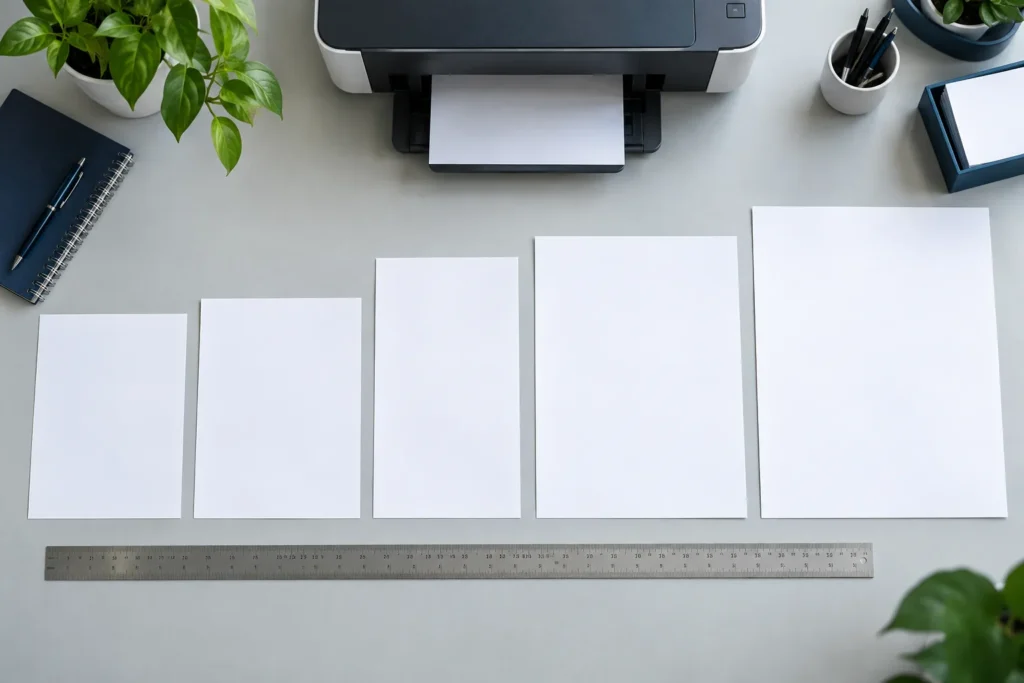
The standard printer paper size depends on location and purpose. In the United States and Canada, everyday office paper is usually US Letter at 8.5 × 11 in (215.9 × 279.4 mm). In most other markets, it is A4 at 210 × 297 mm (8.27 × 11.69 in). For example, Legal is 8.5 × 14 in, while Tabloid and Ledger use the same 11 × 17 in sheet in different orientations. For commercial printing, however, the final trimmed size is only one part of the specification: bleed, printer margins, imposition, grain direction and the parent sheet also matter.
Key Takeaways
- US Letter: 8.5 × 11 in, or exactly 215.9 × 279.4 mm.
- ISO A4: 210 × 297 mm, or approximately 8.27 × 11.69 in.
- A4 is 6 mm narrower and 17.6 mm taller than Letter; the two sizes are similar but not interchangeable.
- Tabloid is normally described as 11 × 17 in portrait; Ledger is the same physical sheet described as 17 × 11 in landscape.
- Paper size is not the same as printable area. However, most office printers cannot print to every edge unless borderless printing is specifically supported.
- For production work, specify finished size, bleed, safe area, paper, grain direction, quantity and finishing—not just “standard paper.”
Table of Contents
- Standard Sizes at a Glance
- US Letter vs. A4
- ISO A-Series Sizes
- North American Sizes
- ANSI and ARCH Sizes
- B-Series and C-Series Uses
- Paper Size in Pixels
- How to Print the Correct Size
- Office vs. Commercial Printing
- Documented Cross-Border Case
- Paper-Size Decision Table
- Common Mistakes
- What to Send a Printer
- Frequently Asked Questions
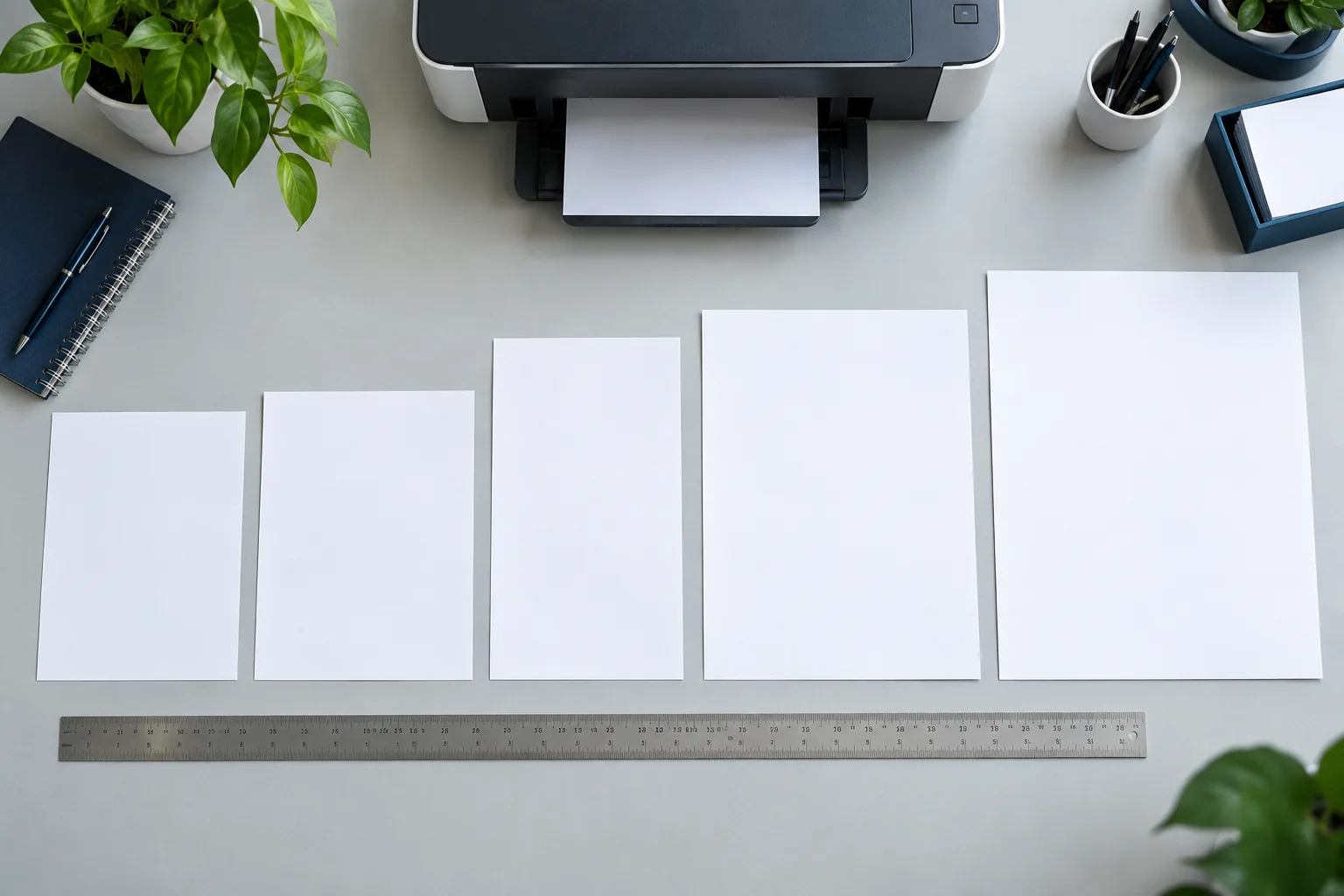
Standard Printer Paper Size Chart
For example, The table below covers the sizes most buyers encounter in office and general commercial work. In practice, dimensions are stated width × height in portrait orientation unless noted. Because inch-to-millimetre conversions can be rounded in informal guides, production files should use the defining unit for that system: millimetres for ISO sizes and inches for traditional North American formats.
| Paper size | Inches | Millimetres | Typical use |
|---|---|---|---|
| US Letter / ANSI A | 8.5 × 11 | 215.9 × 279.4 | North American office documents, forms and letters |
| US Legal | 8.5 × 14 | 215.9 × 355.6 | Contracts, forms and documents requiring extra length |
| Tabloid | 11 × 17 | 279.4 × 431.8 | Newsletters, posters, diagrams and folded Letter pieces |
| Ledger | 17 × 11 | 431.8 × 279.4 | Wide spreadsheets, plans and landscape documents |
| A3 | 11.69 × 16.54 | 297 × 420 | Diagrams, posters and two-up A4 work |
| A4 | 8.27 × 11.69 | 210 × 297 | International office documents and correspondence |
| A5 | 5.83 × 8.27 | 148 × 210 | Notepads, leaflets, booklets and inserts |
| A6 | 4.13 × 5.83 | 105 × 148 | Postcards, invitations and compact handouts |
If someone asks for “regular printer paper” without naming a market, clarify whether they mean Letter or A4 before creating artwork or ordering stock.
Standard Printer Paper Size: US Letter vs. A4
In addition, Letter and A4 serve the same everyday role, but their aspect ratios differ. Specifically, Letter is 5.9 mm wider and 17.6 mm shorter than A4. Therefore, an A4 page printed at 100% on Letter paper can lose content at the top or bottom, while a Letter document printed at 100% on A4 can lose content near the left or right edge if margins are tight.
| Comparison | US Letter | ISO A4 |
|---|---|---|
| Exact size | 8.5 × 11 in | 210 × 297 mm |
| Metric equivalent | 215.9 × 279.4 mm | Approximately 8.27 × 11.69 in |
| Aspect ratio | Approximately 1:1.294 | Approximately 1:1.414 |
| Primary market | United States and Canada | Most international markets |
| 100% cross-print risk | May crop width on A4 | May crop height on Letter |
However, For general documents, “Fit to printable area” is usually the safest option. For rulers, labels, patterns, technical drawings and dielines, scaling may invalidate the work. In those cases, select the correct paper and “Actual size” or 100%, then verify a known measurement on the printed sheet.
Standard Printer Paper Size in the ISO A Series
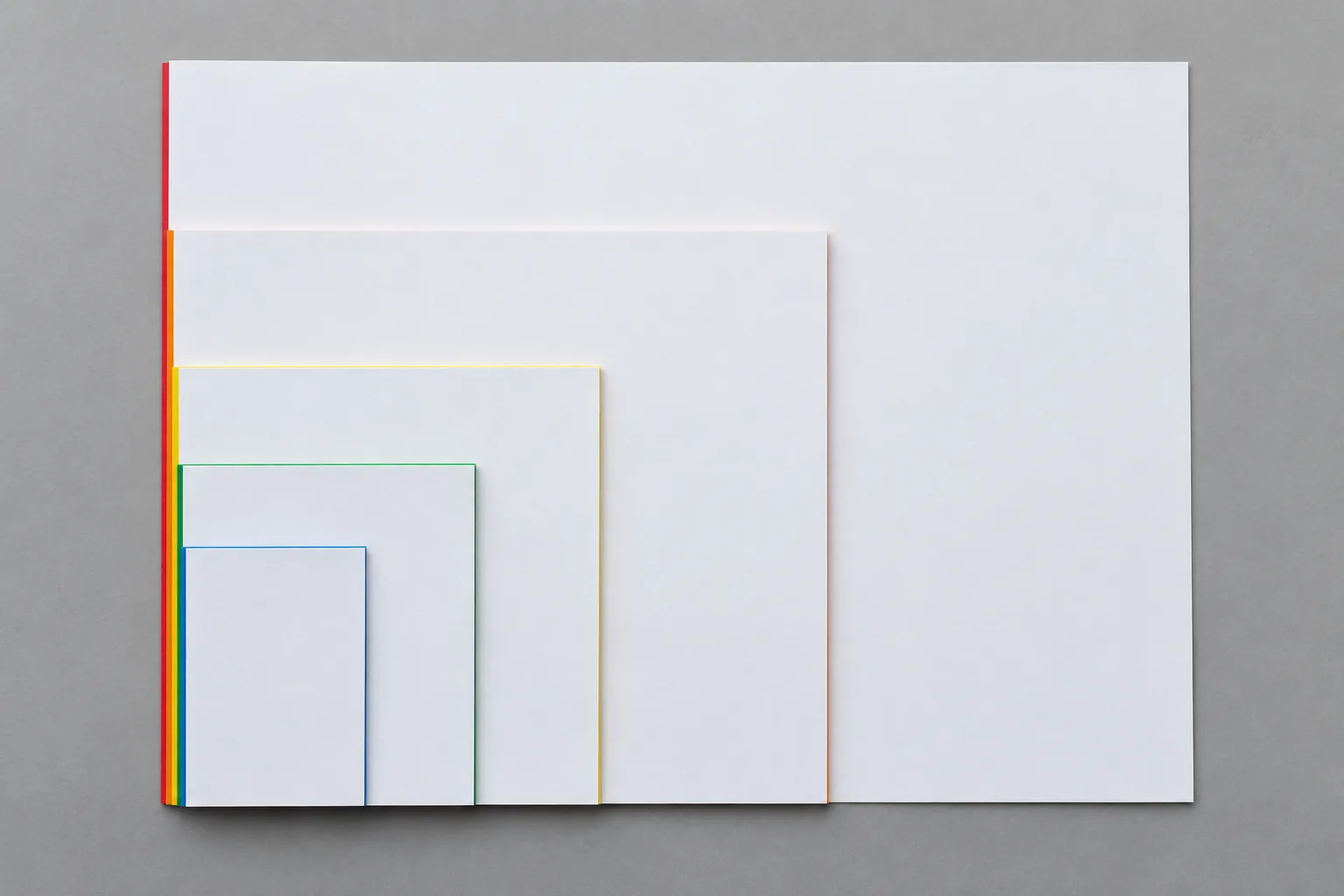
Therefore, ISO 216 defines the internationally familiar A series. In addition, its key advantage is a constant aspect ratio of 1:√2. As a result, cutting a sheet in half parallel to its shorter side produces the next size without changing proportions. For example, A0 has an area of one square metre; A1 is half of A0, A2 is half of A1, and the sequence continues.
| ISO size | Millimetres | Approx. inches | Common application |
|---|---|---|---|
| A0 | 841 × 1189 | 33.11 × 46.81 | Large posters, technical displays |
| A1 | 594 × 841 | 23.39 × 33.11 | Posters, drawings and plans |
| A2 | 420 × 594 | 16.54 × 23.39 | Posters, diagrams and calendars |
| A3 | 297 × 420 | 11.69 × 16.54 | Charts, menus and two A4 pages |
| A4 | 210 × 297 | 8.27 × 11.69 | Office documents and letters |
| A5 | 148 × 210 | 5.83 × 8.27 | Booklets, notepads and leaflets |
| A6 | 105 × 148 | 4.13 × 5.83 | Postcards and compact inserts |
| A7 | 74 × 105 | 2.91 × 4.13 | Small cards and tickets |
| A8 | 52 × 74 | 2.05 × 2.91 | Labels and miniature cards |
As a result, Because the proportions remain constant, A3 can be reduced to A4 at approximately 70.7%, while A4 can be enlarged to A3 at approximately 141.4%. Nevertheless, printers may display rounded values such as 71% and 141%.
Standard Printer Paper Size in North America
Meanwhile, North American office formats do not share one constant aspect ratio. Meanwhile, Letter is the everyday default, Legal adds three inches of height, and Tabloid doubles the area of Letter. Tabloid and Ledger are often misunderstood: they describe the same 11 × 17 in sheet with width and height reversed according to orientation.
Furthermore, The ANSI engineering series builds upward from ANSI A (Letter). ANSI B is 11 × 17 in, ANSI C is 17 × 22 in, ANSI D is 22 × 34 in and ANSI E is 34 × 44 in. Therefore, each larger format can contain two sheets of the preceding size, which supports engineering drawing workflows.
ANSI and ARCH Paper Sizes
| Series | Size name | Dimensions | Typical context |
|---|---|---|---|
| ANSI | A | 8.5 × 11 in | Small drawings and documents |
| ANSI | B | 11 × 17 in | Drawings, diagrams and spreads |
| ANSI | C | 17 × 22 in | Engineering drawings |
| ANSI | D | 22 × 34 in | Large technical drawings |
| ANSI | E | 34 × 44 in | Full-size engineering plans |
| ARCH | A | 9 × 12 in | Architectural drawings |
| ARCH | B | 12 × 18 in | Architectural sets |
| ARCH | C | 18 × 24 in | Medium plans |
| ARCH | D | 24 × 36 in | Common construction drawings |
| ARCH | E | 36 × 48 in | Large architectural plans |
In practice, ASME states that its Y14.1 standard defines sheet sizes and formats for engineering drawings in both metric and decimal-inch systems. Therefore, design and construction teams should follow the project’s specified drawing standard rather than assuming office Letter or A4.
Beyond A4: ISO B and C Series
For example, The B series fills size gaps between A-series sheets and is widely encountered in books, posters and publishing. However, regional book formats and production standards vary, so an ISO B size should be stated numerically. Therefore, the C series primarily defines envelopes: C4 accommodates A4 unfolded, C5 accommodates A4 folded once to A5, and C6 accommodates A4 folded twice to A6.
| Document | Fold | Matching ISO envelope | Result |
|---|---|---|---|
| A4 | Unfolded | C4, 229 × 324 mm | Full-size document enclosure |
| A4 | Folded once to A5 | C5, 162 × 229 mm | Common correspondence format |
| A4 | Folded twice to A6 | C6, 114 × 162 mm | Compact mailing format |
Standard Printer Paper Size in Pixels
In addition, Paper has physical dimensions, not a fixed pixel count. Because pixels depend on resolution. To calculate them, convert the paper dimensions to inches and multiply by pixels per inch (ppi). For example, Letter at 300 ppi is 2550 × 3300 pixels. A4 at 300 ppi rounds to 2480 × 3508 pixels.
| Size | 72 ppi | 150 ppi | 300 ppi |
|---|---|---|---|
| US Letter | 612 × 792 | 1275 × 1650 | 2550 × 3300 |
| US Legal | 612 × 1008 | 1275 × 2100 | 2550 × 4200 |
| Tabloid | 792 × 1224 | 1650 × 2550 | 3300 × 5100 |
| A4 | 595 × 842 | 1240 × 1754 | 2480 × 3508 |
| A5 | 420 × 595 | 874 × 1240 | 1748 × 2480 |
However, These pixel values are useful for raster artwork, but professional page-layout files should still be created at physical size. Vector text and graphics remain resolution-independent, while photographs must have enough effective resolution at their final placed size.
How to Print the Correct Standard Printer Paper Size
- Check the document’s page size in the originating application or PDF properties.
- Load the matching physical sheet into the correct printer tray.
- Set the driver or print dialog to the same paper size and orientation.
- Choose “Actual size” for dimension-critical work; choose “Fit” only when scaling is acceptable.
- Check the preview for clipped headers, footers, page numbers and edge graphics.
- Print one test sheet and measure any dimension that must remain exact.
Therefore, If the printer repeatedly requests the wrong tray, the application, driver and physical tray may disagree. Correct all three settings instead of forcing the printer to continue. Also remember that duplex settings can change binding edge and reverse-side orientation.
Safe scaling between A4 and Letter
As a result, There is no single perfect scale factor because the aspect ratios differ. To fit an A4 page completely inside Letter, the limiting dimension is height: 279.4 ÷ 297 ≈ 94.1%. To fit Letter completely inside A4, the limiting dimension is width: 210 ÷ 215.9 ≈ 97.3%. These calculations explain the approximately 94% and 97% recommendations in Gordon Flesch Company’s guide. Margins will change, so inspect the result rather than relying on the percentage alone.
Office Paper Size vs. Commercial Print Size
Meanwhile, Office printers normally accept finished sheets. Commercial printers often print several pages or products on a larger parent sheet, then trim and fold them. Consequently, the finished paper size does not reveal the required press sheet. Bleed, colour bars, gripper allowance, imposition, binding and finishing need additional area.
| Term | Meaning | Why buyers must specify it |
|---|---|---|
| Finished size | Final trimmed dimensions | Defines what the customer receives |
| Flat size | Open dimensions before folding | Controls artwork and material area |
| Bleed size | Artwork extending beyond trim | Prevents unintended white edges |
| Printable area | Area a specific device can image | Office printers may have non-printable margins |
| Parent sheet | Larger production sheet holding multiple items | Affects yield, cost and grain direction |
| Grain direction | Dominant fibre alignment | Affects folding, stiffness and binding behaviour |
Furthermore, For books and marketing products, review Prikoro’s printing paper types guide, custom brochure printing and booklet printing service.
Documented Case: Cross-Border A4-to-Letter Printing
In practice, This is more than an office inconvenience. International publishers, manufacturers and procurement teams can lose signatures, footer notes, barcodes or approval marks when a receiving office silently substitutes paper. Therefore, state the page size in the filename or artwork specification, embed the correct media box in the PDF and warn recipients when documents contain scale-sensitive elements.
For example, The transferable lesson is simple: standard paper size is a supply-chain decision. Document creation, printer configuration, physical stock and recipient market must agree.
Which Standard Printer Paper Size Should You Choose?
| Need | Recommended starting size | Reason |
|---|---|---|
| US/Canada office document | Letter | Matches common trays and filing systems |
| International office document | A4 | Widely used under ISO practice |
| Long contract or form | Legal, only if required | Adds vertical space but reduces international compatibility |
| Wide spreadsheet | Ledger or A3 landscape | Provides more horizontal space |
| Folded four-page Letter piece | Tabloid folded to Letter | Creates four Letter-size panels |
| International folded leaflet | A4 folded to A5 or DL-style format | Efficient ISO workflow |
| Booklet | A5, 5.5 × 8.5 in or custom | Choose by market, content and production method |
| Engineering drawing | Specified ANSI/ISO sheet | Preserves scale and project standards |
Common Paper-Size Mistakes
- Calling A4 “8.5 × 11.” A4 is 210 × 297 mm; Letter is 8.5 × 11 in.
- Assuming Tabloid and A3 are interchangeable.
- Confusing page size with the printer’s smaller printable area.
- Using “Fit” on labels, rulers, dielines or technical drawings that must stay at 100%.
- Building bleed inside the finished size instead of outside the trim boundary.
- Supplying only pixel dimensions without physical size and resolution.
- Ordering “80 gsm standard paper” without specifying exact dimensions, shade, finish and grain.
- Ignoring folded size, envelope size, postal rules or binding requirements.
What to Send a Commercial Printer
In addition, For a reliable quotation, provide finished size, flat size, orientation, page or panel count, bleed, paper type and weight, print colours, quantity, finishing, packing and delivery destination. For books, also provide binding, cover specification and page count. Submit the details through the Prikoro contact page, or explore more production guidance on the Prikoro printing blog.
Frequently Asked Questions
What is the standard printer paper size?
However, It is usually US Letter, 8.5 × 11 in, in the United States and Canada. In most other markets, it is A4, 210 × 297 mm.
Is standard printer paper A4 or Letter?
Therefore, Both are standards in different markets. A4 is the international office standard, while Letter is the everyday North American format.
Is A4 the same as 8.5 × 11?
As a result, No. A4 is 210 × 297 mm, while 8.5 × 11 in Letter is 215.9 × 279.4 mm. In contrast, Letter is wider and shorter.
What size is Legal paper?
Meanwhile, US Legal paper measures 8.5 × 14 in, or 215.9 × 355.6 mm.
What is 11 × 17 paper called?
Furthermore, In portrait orientation it is commonly called Tabloid. Therefore, the same physical sheet described as 17 × 11 in landscape is commonly called Ledger; it also corresponds to ANSI B.
Is A3 the same as 11 × 17?
In practice, No. A3 is 297 × 420 mm, approximately 11.69 × 16.54 in. Tabloid is exactly 11 × 17 in.
What pixel size is Letter paper at 300 ppi?
For example, US Letter at 300 ppi is 2550 × 3300 pixels.
What pixel size is A4 at 300 ppi?
In addition, A4 at 300 ppi is approximately 2480 × 3508 pixels.
Should I print at Actual Size or Fit?
Therefore, use Actual Size for dimension-critical files. However, use Fit when preserving all content matters more than exact physical scale, such as an A4 document printed on Letter.
Does borderless printing change the paper size?
However, No. In addition, it changes the printable area, not the physical sheet dimensions. Borderless capability depends on the printer, paper type and driver setting.
Final Recommendation
Therefore, use Letter for routine North American documents and A4 for international compatibility, but never rely on the word “standard” in a production specification. State dimensions and units, match the document, driver and physical tray, and choose scaling deliberately. For commercial printing, add finished size, flat size, bleed, safe area, grain direction and finishing. Those details prevent cropping, unwanted scaling, wasted paper and expensive reprints.
Sources and Further Reading
- Gordon Flesch Company: Understanding Printer Paper Sizes Made Easy
- ANSI Blog: Standard Paper Sizes—ISO and ANSI Formats
- ASME Y14.1: Drawing Sheet Size and Format
- Microsoft Globalization: Paper Sizes
- Prikoro: Printing Paper Types