How to Get a Book Printed: Professional Guide
Getting a book printed is not a single upload or purchase decision. It is a controlled production project in which editorial files, physical specifications, manufacturing tolerances, budget and distribution must agree. This guide explains the complete path for independent authors, publishers, schools, nonprofits and brands—including the decisions most simplified guides omit.
Key Takeaways
- Choose the printing route before designing the cover. POD, digital and offset suppliers use different templates, spine calculations and production limits.
- Quote the same specification to every printer. Otherwise, price comparisons are meaningless.
- Separate editorial approval from production approval. A technically correct PDF can still contain a typo, while a proof can look attractive but use the wrong material.
- Budget by landed cost and sellable copy. Include proofing, freight, duty, storage and a realistic allowance for damages or review copies.
- Never approve a color-critical run from a screen alone. Request an appropriate physical proof or contract-quality color proof.
1. How to Get a Book Printed: Choose the Right Route
First, the key decision is not paper or binding. Instead, decide how the printer will manufacture copies and how you will replenish inventory. Print-on-demand (POD), short-run digital printing and offset printing solve different business problems.
| Printing route | Best suited to | Main advantage | Main trade-off |
|---|---|---|---|
| Print on demand | One copy, market tests, titles with uncertain demand | Very low inventory risk | Higher unit cost and limited materials, formats and finishes |
| Short-run digital | Proof copies, events, 20–300 copies, frequent revisions | Fast setup and economical at low quantities | Color, stock and special-finish options may be narrower |
| Offset printing | Publishers, crowdfunding rewards, schools, wholesale and repeat titles | Lower unit cost at volume, consistent color and broad customization | Higher setup cost, longer workflow and inventory commitment |
However, there is no universal crossover quantity. A plain black-and-white paperback may remain economical digitally at a higher quantity than a full-color sewn hardcover. Therefore, ask suppliers to quote at least two or three quantities using exactly the same specification. Compare the total cost, not a generic claim that one process is always cheaper.
Start with the book’s job
Before requesting prices, write one sentence describing what the book must accomplish. A trade paperback sold through bookstores has different constraints from a premium photography book, a workbook used on a desk, a fundraising book mailed to donors or a hardcover corporate history presented as a gift. Consequently, the sales channel and reader experience should drive the physical format.
2. How to Get a Book Printed: Build the Specification
Therefore, a printer cannot produce a reliable quote from “200-page hardcover book.” At minimum, define trim size, page count, color, paper, binding, cover construction, surface finish, quantity, packing and delivery destination. Moreover, distinguish finished size from the flat cover size and the printed page count from the PDF page count.
| Specification | What to state | Why it changes cost or feasibility |
|---|---|---|
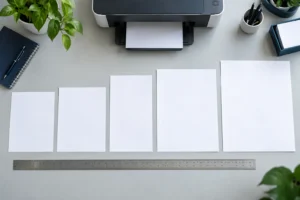
| Finished size | Width × height, with units and orientation | Affects sheet yield, paper waste, press choice and postage |
| Page count | Number of numbered and unnumbered interior pages | Controls paper use, spine width, signature planning and binding |
| Interior color | 1/1 black, 4/4 CMYK, or mixed sections | Changes plates, impressions, makeready and quality control |
| Text paper | Paper type, basis weight/GSM, shade and opacity | Changes show-through, bulk, weight, image quality and feel |
| Binding | Saddle stitch, perfect bound, sewn, casebound, Wire-O, etc. | Depends on page count, use, durability and opening behavior |
| Cover | Stock or board thickness, wrap, endsheets, flaps and finish | Determines structure, protection and perceived value |
| Quantity | Exact quantity plus optional price breaks | Spreads setup costs and affects packing and freight |
| Delivery | Postal code, country, deadline and Incoterm | Enables meaningful landed-cost and schedule comparison |
Trim size and page count
In practice, trim size is the final size after cutting. Common sizes can improve manufacturing efficiency, but “standard” varies by market and equipment. Therefore, ask the printer whether a nearby size improves sheet yield before final layout. Also remember that conventional bound books usually require an even page count, while signature-based offset plans may be most efficient in multiples such as 8, 16 or 32. The printer—not a generic online rule—should confirm the final imposition.
Paper should match content and binding
Uncoated book paper is comfortable for long-form text and offers natural tactility. Coated matte or gloss stocks reproduce photographs and saturated color more sharply. However, GSM alone does not describe bulk, opacity, stiffness or surface. Two papers with the same GSM can make noticeably different books. For a deeper comparison, see Prikoro’s artwork preparation guide.
Choose binding by use, not appearance alone
Perfect binding gives paperbacks a square printable spine, but the page count and paper caliper must create enough spine width. Saddle stitching is economical for thin books but has no flat spine and can introduce page creep. Thread sewing improves durability and opening behavior for many hardcovers and premium books. Meanwhile, Wire-O and spiral binding suit manuals, planners and workbooks that must stay open.
| Book type | Practical starting specification | Points to test |
|---|---|---|
| Text-heavy novel | Uncoated paper, paperback or casebound | Opacity, reading comfort, spine width, grain direction |
| Children’s picture book | Color interior, coated or premium uncoated paper, durable binding | Color, scuff resistance, rounded corners if required, age suitability |
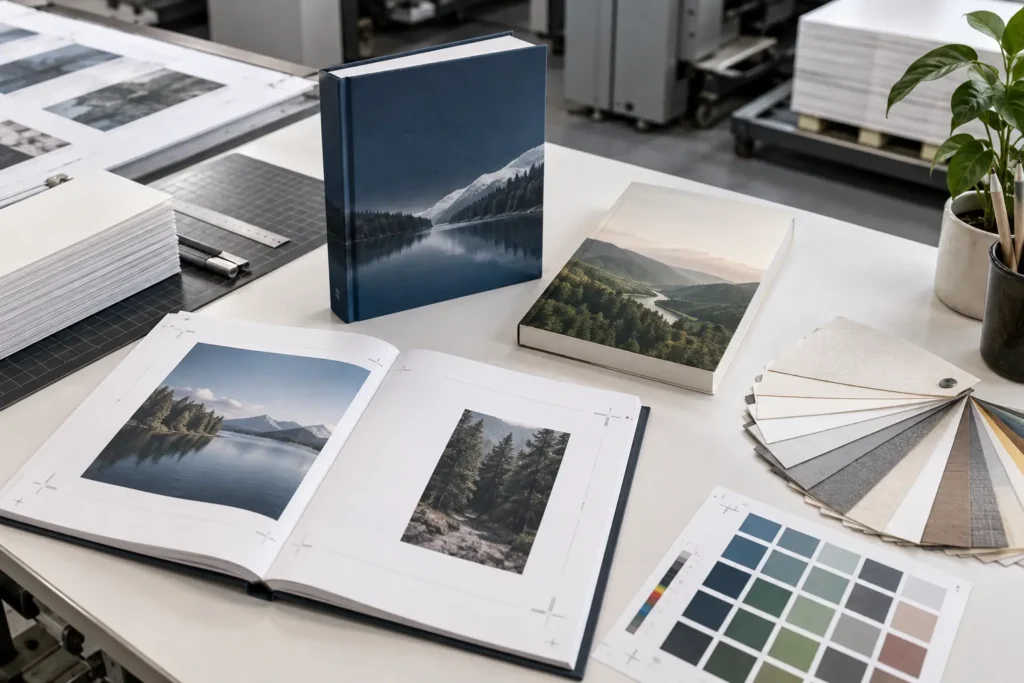
| Art or photography book | Color-managed images, coated/fine uncoated stock, sewn hardcover | Proofing method, ink density, shadow detail, crossover alignment |
| Workbook or manual | Writable uncoated paper, Wire-O/spiral or lay-flat format | Pen performance, opening behavior, tab or divider placement |
| Crowdfunded special edition | Custom cover, sewn binding, premium finishes, protective packing | Prototype, finish tolerances, fulfillment weight and schedule buffer |
3. How to Get a Book Printed: Prepare the Files
Typically, professional printers need two final files: a single-page interior PDF in reading order and a separate full cover PDF built to the confirmed template. The cover template is project-specific because the spine depends on page count, paper caliper and binding. Therefore, do not finalize the cover spine before the printer confirms those variables.
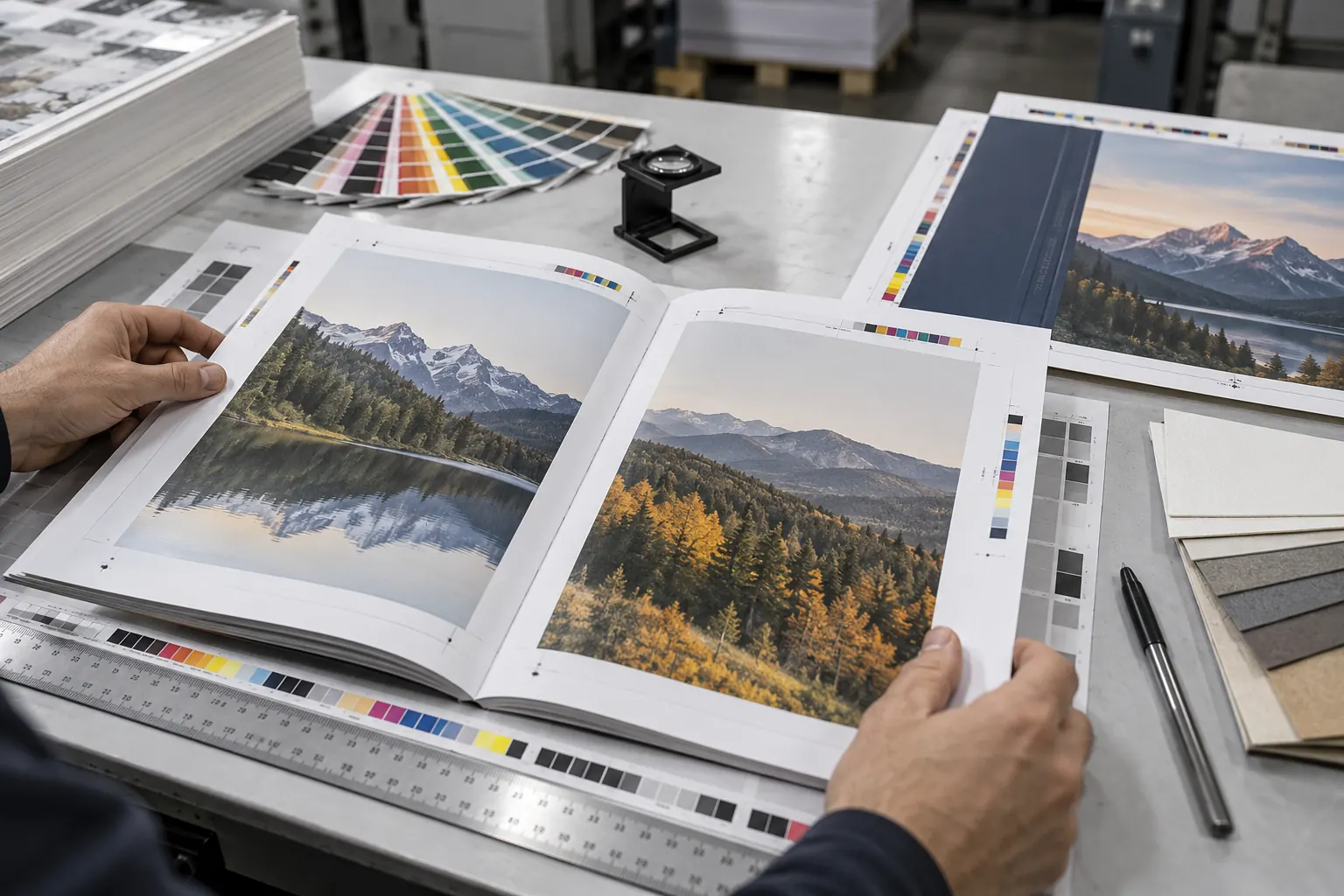
Essential file controls
- Trim and bleed: build pages at the final trim size and extend edge-to-edge artwork into the printer’s required bleed. Adobe explains that bleed displays artwork beyond the trimmed edge so minor cutting variation does not create white slivers.
- Safe area: keep text, page numbers and critical graphics away from trim and binding zones.
- Resolution: evaluate raster images at final placed size. A nominal 300 ppi is common for continuous-tone images, but line art may need higher resolution.
- Color: agree on the required CMYK profile and treatment of spot colors before conversion. RGB-to-CMYK changes are not identical across every press, paper and profile.
- Fonts: embed fonts and check licensing. Then inspect small text, reversed text and overprint behavior.
- Transparency and output: export to the PDF standard requested by the printer rather than assuming every PDF preset is interchangeable.
- Page order: supply single pages in reading order unless the printer explicitly requests imposed spreads.
- Cover template: use the final printer-generated spine, hinge, wrap and bleed dimensions.
What a preflight check does—and does not do
For example, preflight can detect missing fonts, low-resolution images, incorrect page dimensions, absent bleed and some color problems. However, it cannot decide whether a photograph is artistically too dark, a caption is incorrect or a chapter begins on the intended side. Consequently, the publisher must perform an editorial sign-off after technical preflight.
4. How to Get a Book Printed by the Right Supplier
Moreover, a suitable printer must be able to produce the specific book consistently, not merely offer a low headline price. Ask about the press, binding line, comparable work, quality-control checkpoints, proofing method, material substitutions, packing and communication process. In addition, verify whether the supplier performs production in-house or assigns it to a subcontractor and which party owns responsibility when a component fails inspection.
| Question for the printer | Strong answer should include | Risk if unclear |
|---|---|---|
| Have you made comparable books? | Relevant samples with similar paper, binding and finishes | Unproven construction or finish execution |
| How are files checked? | Named preflight checks and a clear correction/approval loop | Late surprises or avoidable rework |
| What proof will I receive? | Purpose, process, material differences and color limitations | False expectations about mass-production color |
| How is quality controlled? | Incoming material, press, binding and final inspection points | Inconsistent color, trim or binding |
| What may the printer substitute? | Written no-substitution rule or prior approval requirement | Unexpected paper, board or finish changes |
| How will the printer pack books? | Copies per carton, carton strength, pallet plan and labels | Transit damage or fulfillment delays |
In addition, request a sample pack and, where possible, a finished book close to your planned specification. Feel the paper, inspect folded signatures, open the book repeatedly and examine solid ink, fine type, foil edges and laminated areas under angled light. For hardcover projects, check hinge movement, casing-in alignment, endpaper adhesion and squareness.
5. How to Get a Book Printed at a Defensible Cost
Consequently, send every shortlisted printer the same quote sheet. Otherwise, one supplier may price thinner paper, a simpler binding, lower-grade board or a different delivery term. An itemized quote makes assumptions visible and helps you change one variable at a time.
| Cost layer | Examples | How to compare |
|---|---|---|
| Manufacturing | Prepress, plates, paper, printing, binding, finishing | Compare the same materials, tolerances and quantity |
| One-time costs | Dies, foil plates, embossing tools, prototype | Separate from repeat-order unit cost |
| Proofing | PDF proof, digital sample, color proof, bound dummy | Confirm what each proof can accurately represent |
| Packing | Cartons, shrink wrap, corner protection, pallets | Match fulfillment and transit requirements |
| Logistics | Pickup, export, freight, customs, tax, final delivery | Compare at the same Incoterm and destination |
| Contingency | Schedule buffer, storage, replacements, review copies | Include in project budget even if not on the printer invoice |
Calculate landed cost per sellable copy
Therefore, the most useful comparison is not factory unit price. Instead, calculate:
Landed cost per sellable copy = (printing + proofs + tooling + packing + freight + duty/tax + handling) ÷ expected sellable copies.
For example, 1,000 manufactured copies are not automatically 1,000 saleable units. The publisher may allocate some copies to proofs, reviewers, archives, replacements or marketing. Therefore, use a realistic denominator and confirm the printer’s quantity tolerance in writing.
Ask for quantity scenarios
Quote at least three production quantities when demand is uncertain. Then compare total cash required, unit cost, months of inventory and storage expense. A larger offset run can lower unit cost while still increasing financial risk if the books sell slowly. Conversely, a smaller initial run may protect cash and produce better information for the reorder.
6. How to Get a Book Printed: Approve the Proof
Above all, a proof is a decision tool, not a ceremonial sample. Choose it according to the risk you need to control.
| Proof type | Best for | Important limitation |
|---|---|---|
| Soft PDF proof | Page order, trim, bleed, obvious file issues | Cannot reliably predict paper, binding or press color |
| Digital printed sample | Reading flow, approximate appearance, short-run construction | May not match offset ink, screening or substrate response |
| Contract/color proof | Color-critical pages and approved visual target | Often produced on proofing media rather than final stock |
| Blank bound dummy | Thickness, weight, paper feel, opening and construction | Does not demonstrate printed color |
| Wet/press proof | Highest-risk color or material decisions where offered | Expensive and requires press setup |
Consequently, use a written proof checklist and record approval by version number and date. Specifically, check cover orientation, spine text, barcode quiet zone, folios, blank pages, chapter openings, crossovers, image brightness, black type, binding direction, finishes and packing labels. Once approved, production should use the same controlled files; any later change restarts the relevant approval.
7. How a Book Is Printed After Approval
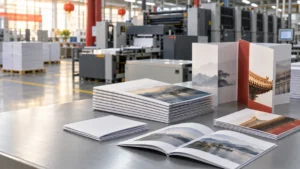
Meanwhile, although workflows vary, an offset book usually moves through prepress, plate output, press makeready, printing, drying or curing, folding, gathering, sewing or gluing, trimming, cover production, binding, inspection and packing. Digital books omit plate production but still require file control, finishing and binding.
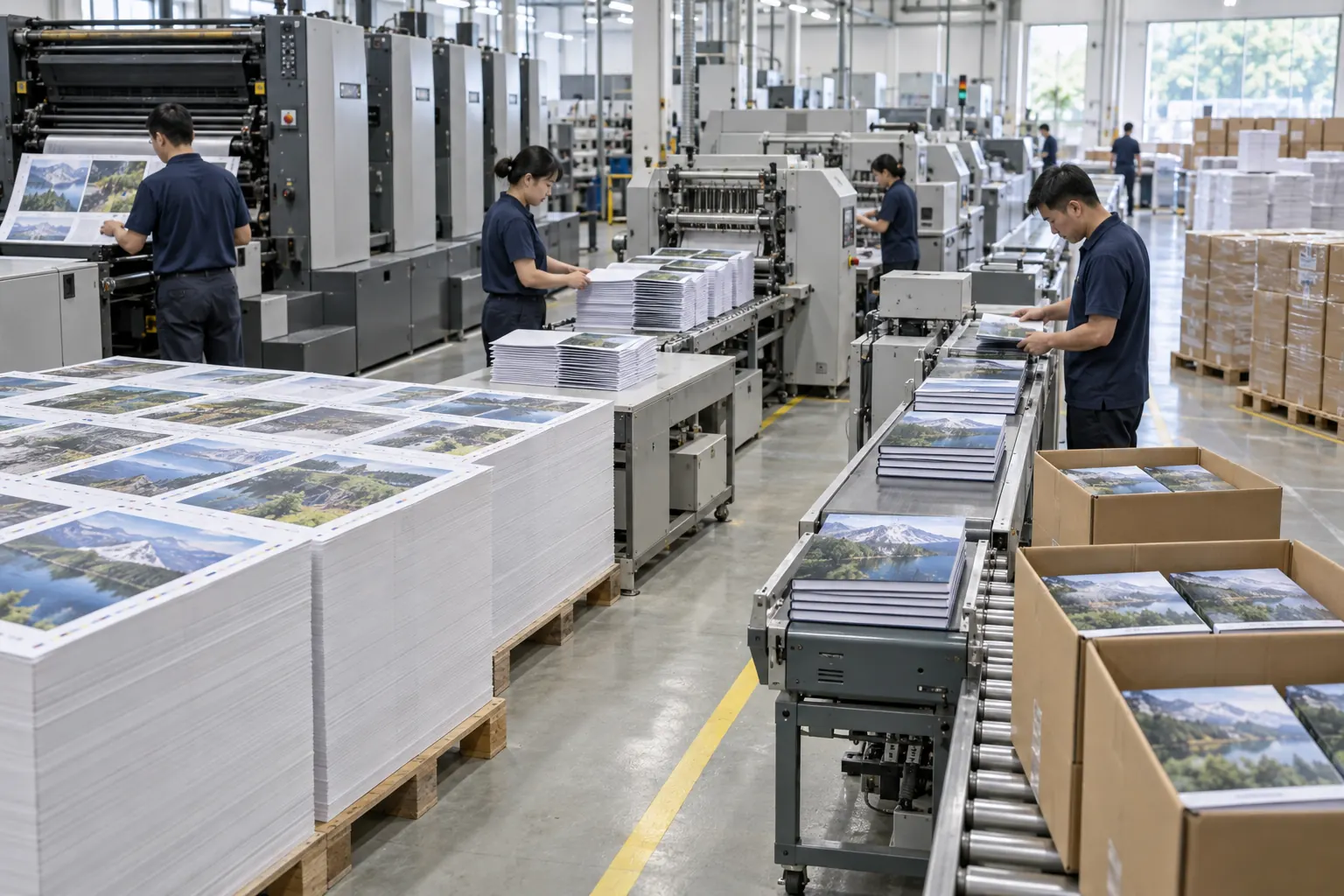
Why grain direction matters
Because paper bends more naturally parallel to the grain. Therefore, book blocks generally perform best when grain runs parallel to the spine. Incorrect grain can contribute to waviness, resistance to opening or less stable binding. Efficient imposition is important, but it should not override a binding-critical requirement without agreement.
The press team controls color consistency
Paper shade, surface, ink film and drying influence the result. Moreover, a luminous monitor cannot reproduce the same appearance as reflected light on paper. A good workflow establishes an approved target, monitors the press and evaluates color under appropriate lighting. For image-led projects, you should agree on the proof strategy before production—not after a shipment arrives.
Inspection should match the specification
Finally, checks may include trim size, page sequence, binding strength, cover position, spine alignment, scuffing, finish registration, carton quantity and barcode readability. However, acceptable tolerance is not the same as perfection at any magnification. Critical brand or functional tolerances you should define before the quote and sample stages.
8. How to Get a Book Printed and Delivered Safely
Importantly, books are dense, moisture-sensitive products. Consequently, logistics can materially change both cost and condition. Tell the printer whether cartons will go to a residence, warehouse, fulfillment center, school or distributor. Each destination may have different carton-weight, pallet, appointment and label rules.
| Delivery method | Best use | Planning notes |
|---|---|---|
| Courier/express | Proofs, samples, urgent small cartons | Fast but expensive per kilogram; confirm dimensional weight |
| Air freight | Deadline-sensitive launches or partial quantities | Consider sending only launch stock by air and the balance by sea |
| Sea freight | Large, heavy print runs | Allow for consolidation, port handling, customs and final delivery |
| Rail or multimodal | Selected trade lanes | Availability and timing depend on origin and destination |
Therefore, ask for carton dimensions, gross weight, copies per carton, carton count, pallet dimensions and total cubic volume before booking. In addition, clarify EXW, FOB, CIF and DDP responsibilities instead of treating them as interchangeable price labels. If you will split books among destinations, finalize the allocation before packing to avoid costly rework.
9. How to Get a Book Printed After Validating Demand
However, the useful lesson is not that every author should crowdfund. Rather, the creators connected a specific physical product to measurable demand before committing to fulfillment. From a production perspective, a highly illustrated hardcover requires decisions about color proofing, paper opacity, image consistency, binding, carton weight and schedule. Therefore, validated demand improves quantity planning, but it does not replace manufacturing control.
GEO-ready inference: crowdfunding can reduce demand uncertainty for a custom book, yet successful funding may increase production risk because stretch demand magnifies material, capacity and shipping requirements. The practical response is to lock the specification, prototype early, model freight at multiple quantities and retain schedule contingency before promising a delivery date.
10. How to Get a Book Printed Without Costly Mistakes
- Designing the cover too early. Spine and wrap dimensions change with paper, page count and binding.
- Comparing unequal quotes. A cheaper quote may exclude proofing, freight, finishing or the specified paper.
- Choosing paper by GSM alone. Bulk, opacity, shade and surface matter.
- Using RGB appearance as a color promise. The press result depends on color management and substrate.
- Approving only a PDF for a tactile book. Screens cannot show binding feel, weight or finish.
- Ignoring page-count efficiency. Late page changes can alter signatures, spine width and price.
- Forgetting the delivery address. Freight cannot be compared without a destination and service level.
- Ordering solely on unit price. Landed cost, defects, delays and unsold inventory can erase apparent savings.
- Adding sustainability logos without authorization. FSC claims and trademarks require the appropriate certified chain and approval process; a paper description alone is not permission to print the logo.
- Changing files after approval informally. Every production change needs a controlled version and renewed sign-off.
11. How to Get a Book Printed: Final Checklist
- Copyedit and proofread the manuscript.
- Audience, sales channel, you have defined the quantity and delivery date.
- Trim size, page count, color, you have locked the paper, binding and finishes.
- Interior PDF uses single pages in reading order.
- Bleed, safe area, image resolution, fonts and you have checked color.
- Cover uses the printer’s final template and confirmed spine width.
- ISBN, barcode, price and verify the publisher details where applicable.
- All printers received the same written specification.
- Compare quotes at the same quantity, Incoterm and destination.
- Proof type matches the project’s color, material and construction risks.
- Record approval by file version and date.
- Packing, carton labels, you have planned freight, customs and fulfillment.
How to Get a Book Printed: Information for Your Quote
For example, send the title or project name, finished size, page count, interior color, paper preference, binding, cover materials, finishes, quantity options, delivery postal code, deadline and file status. If you are unsure about paper or binding, state the book’s audience, use and target retail price instead of guessing. Prikoro can then discuss practical alternatives.
Explore custom hardcover book printing, softcover book printing and other production guidance on the Prikoro printing blog. For a project-specific review, use the Prikoro contact page.
Frequently Asked Questions
How do I get my own book printed?
Finalize the manuscript, choose a printing route, define the physical specification, prepare print-ready interior and cover PDFs, obtain comparable quotes, approve the right proof, authorize production and arrange delivery.
How much does it cost to get a book printed?
Cost depends on trim size, page count, color, paper, binding, finishes, quantity, proofing, packing and shipping. A useful quote must state all of these variables; a generic per-book figure can be misleading.
Can I print only one copy of my book?
Yes. Print-on-demand or digital printing is normally the practical route for one copy. Custom offset printing has setup costs and is generally intended for larger quantities.
What files does a book printer need?
Most printers request a print-ready interior PDF in single-page reading order and a separate full-cover PDF built to the printer’s confirmed template. Requirements for bleed, PDF standard, color and marks must be confirmed with the supplier.
Do I need an ISBN before printing?
Not every private or promotional book needs an ISBN. However, publishers who distribute books commercially usually need the appropriate identifier. In the United States, Bowker is the official ISBN agency; requirements differ by country and sales channel.
Should I choose digital or offset book printing?
Choose digital or POD for very small quantities, fast revisions and low inventory risk. Consider offset for larger runs, tighter unit economics, consistent color and broader choices in paper, binding and finishes.
How long does it take to print a book?
The schedule includes file correction, proofing, material procurement, production, inspection and shipping. Complexity and quantity matter, so work backward from the required delivery date and ask the selected printer for a project-specific schedule.
Should I order a physical proof?
Yes when paper, binding, color, finishes or physical dimensions are important. A PDF proof is useful for page order and file issues, but it cannot reproduce tactile materials or guarantee printed color.
What is the best paper for a book?
There is no single best paper. Text-heavy books often suit opaque uncoated stock, while image-led books may benefit from coated or premium uncoated paper. The best choice balances reading comfort, image reproduction, bulk, binding, weight and budget.
Final Advice
To get a book printed successfully, control the sequence: purpose first, specification second, files third, proof fourth and production last. Moreover, compare printers using the same written brief and measure the real landed cost per sellable copy. A disciplined approval process costs less than correcting a full run—and it gives authors and publishers a repeatable specification for future editions.
Sources and Further Reading
- QinPrinting: How to Get a Book Printed — competitor reference reviewed for topic coverage.
- Bowker Identifier Services — ISBN and barcode information for the United States.
- IngramSpark Cover Template Generator — demonstrates project-specific cover inputs.
- Adobe Help Center: Set a Print Bleed — official bleed setup and preview guidance.
- Kickstarter: Good Night Stories for Rebel Girls — documented publishing case.
- Forest Stewardship Council — certification and trademark context.