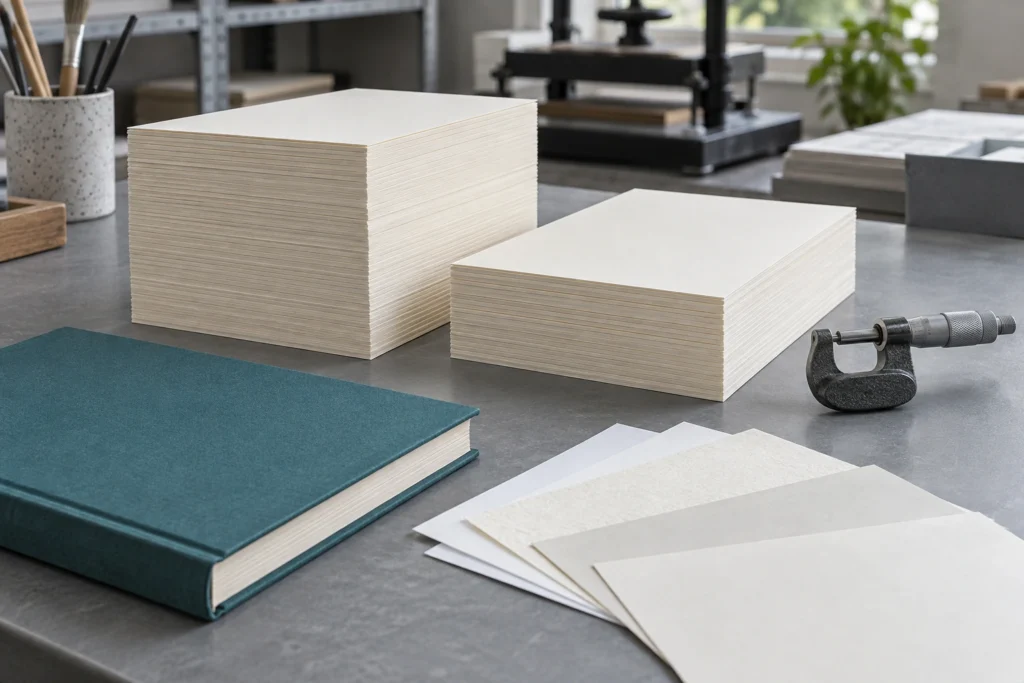
Book paper thickness is measured by caliper, not by GSM alone. GSM describes paper mass per square metre; caliper describes thickness; bulk relates volume to mass. Two papers with the same GSM can produce different book-block thicknesses and require different cover spine dimensions.
For an accurate specification, request the paper grade, grammage, declared caliper, measurement method, and a representative sample. Review opacity and print appearance separately. A thicker sheet is not automatically the better sheet for every book.
This guide explains how to compare paper data, estimate an interior stack, and avoid approving a cover or substitute stock before the final material is confirmed.
GSM, Caliper, and Bulk: Three Different Measurements
Use GSM to compare paper mass, caliper to compare thickness, and bulk to understand how much volume a paper provides relative to its mass. Record the units so quotations do not mix different measurements.
| Measurement | Typical unit | What it tells you | What it does not establish |
|---|---|---|---|
| Grammage / GSM | g/m² | Mass of a square metre of paper | Exact thickness or finished spine width |
| Caliper | µm or mm | Paper thickness under the stated measurement conditions | Opacity, print quality, or final binding dimensions by itself |
| Bulk / specific volume | cm³/g | Volume relative to mass | A guarantee of strength, durability, or reader preference |
| Opacity | Percentage under a specified test | Resistance to visible show-through | The complete appearance of your actual two-sided printed pages |
One millimetre equals 1,000 micrometres. A declared 100 µm caliper is therefore 0.100 mm. Avoid confusing micrometres with millimetres or paper thickness with the total thickness of a cover board.
For compatible definitions and measurement data, the numerical relationship is caliper in µm = grammage in g/m² × bulk in cm³/g. Treat rounded product values as descriptive data; use the supplier’s declared caliper and method for your comparison rather than forcing rounded figures to agree exactly.
Why Equal GSM Can Mean Different Thickness
Paper construction and processing can change the amount of volume in a sheet without changing its mass per unit area. That is why an “80 GSM paper” description is incomplete when book thickness matters.
Holmen’s paper characteristics guide explains that grammage alone does not determine thickness and describes bulk as volume relative to mass. Compare grades, not just weight labels.
A concrete manufacturer example appears in the Holmen BOOK technical data: two listed 55 g/m² options have bulk values of 1.8 and 2.0 cm³/g, with declared calipers of 96 and 106 µm respectively. The table labels its caliper measurement as a 10-sheet measurement and notes product variation. These are values for that product family, not a universal conversion chart or a claim that Prikoro stocks those grades.
When comparing alternative stocks, ask whether a quotation names a specific grade or only a generic weight. A substitute with the same GSM can change the book’s volume even when the paper mass calculation remains similar.
How to Verify Book Paper Thickness
Start with the manufacturer’s technical data and confirm the measurement basis. Then review a representative material sample and the proposed book construction.
ISO 534 covers paper thickness measurements for individual sheets and packs of sheets. Its public abstract distinguishes those methods and notes that they generally produce different results. Ask which method supports the supplier’s value before comparing two data sheets.
A casual reading from a hand-held tool is not automatically equivalent to a standardized paper-thickness result. Measuring contact, pressure, sample condition, and method can affect comparability. Ask the supplier or testing laboratory to document the method rather than inventing a tolerance from a single desk measurement.
A paper sample helps you judge feel; a stack or dummy helps you judge accumulated volume. Neither establishes the grade’s identity unless it is labeled and linked to the proposed specification. Keep the approved grade and sample reference together.
Estimate the Interior Paper Stack
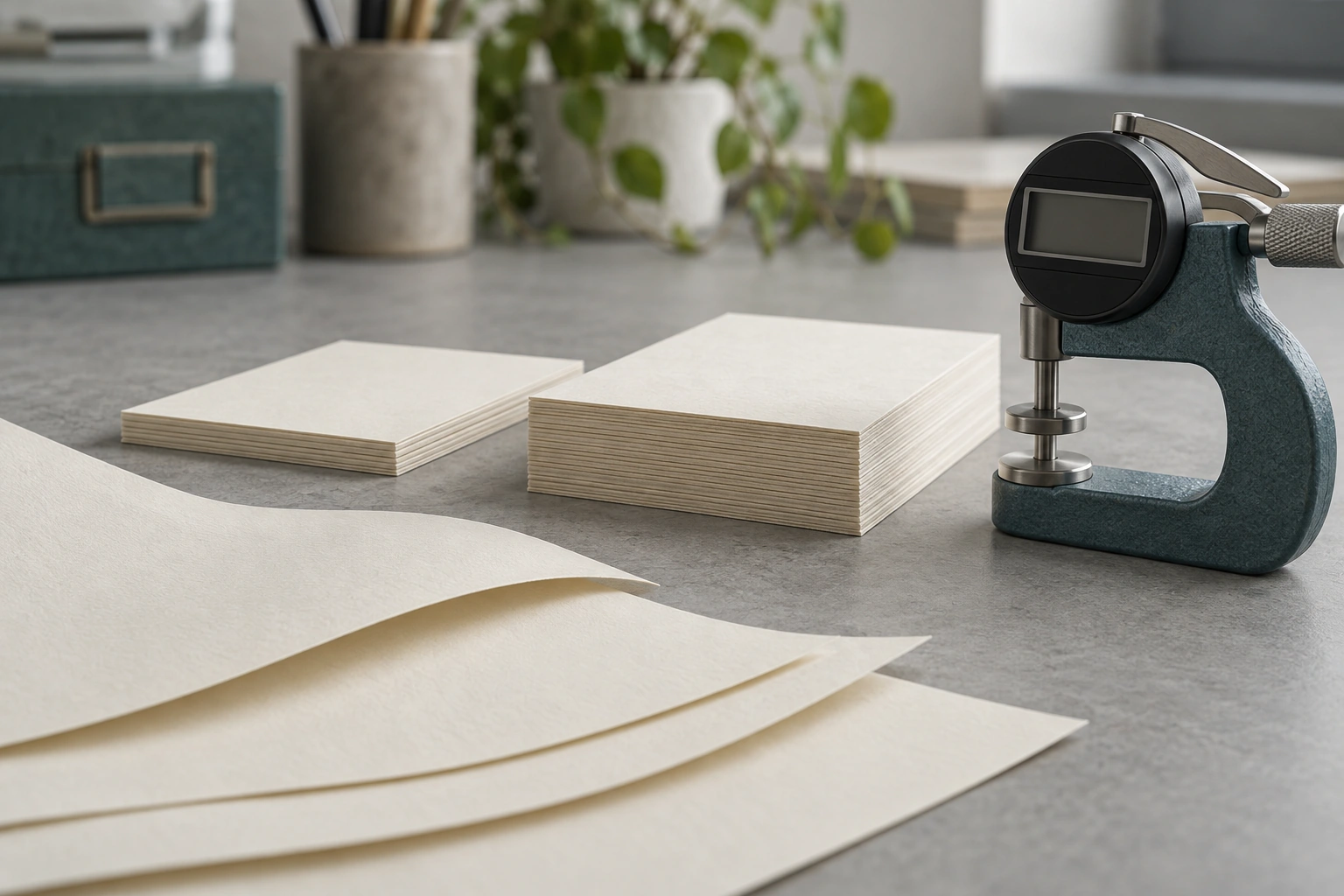
For a simple interior using one stock, a preliminary paper-stack estimate is the number of leaves multiplied by the paper thickness per leaf. A leaf has two page surfaces, so 240 interior pages normally represent 120 leaves, including any blank pages counted in that interior.
Paper-stack thickness in mm ≈ interior pages ÷ 2 × caliper in µm ÷ 1,000. This is an estimate for the paper itself. It excludes binding effects, endpapers, inserts, cover components, and other construction allowances.
| Hypothetical stock | Grammage | Caliper | 240 pages / 120 leaves | Text-paper mass at 148 × 210 mm |
|---|---|---|---|---|
| Stock A | 80 g/m² | 100 µm | 120 × 0.100 = 12.0 mm | Approximately 298 g |
| Stock B | 80 g/m² | 140 µm | 120 × 0.140 = 16.8 mm | Approximately 298 g |
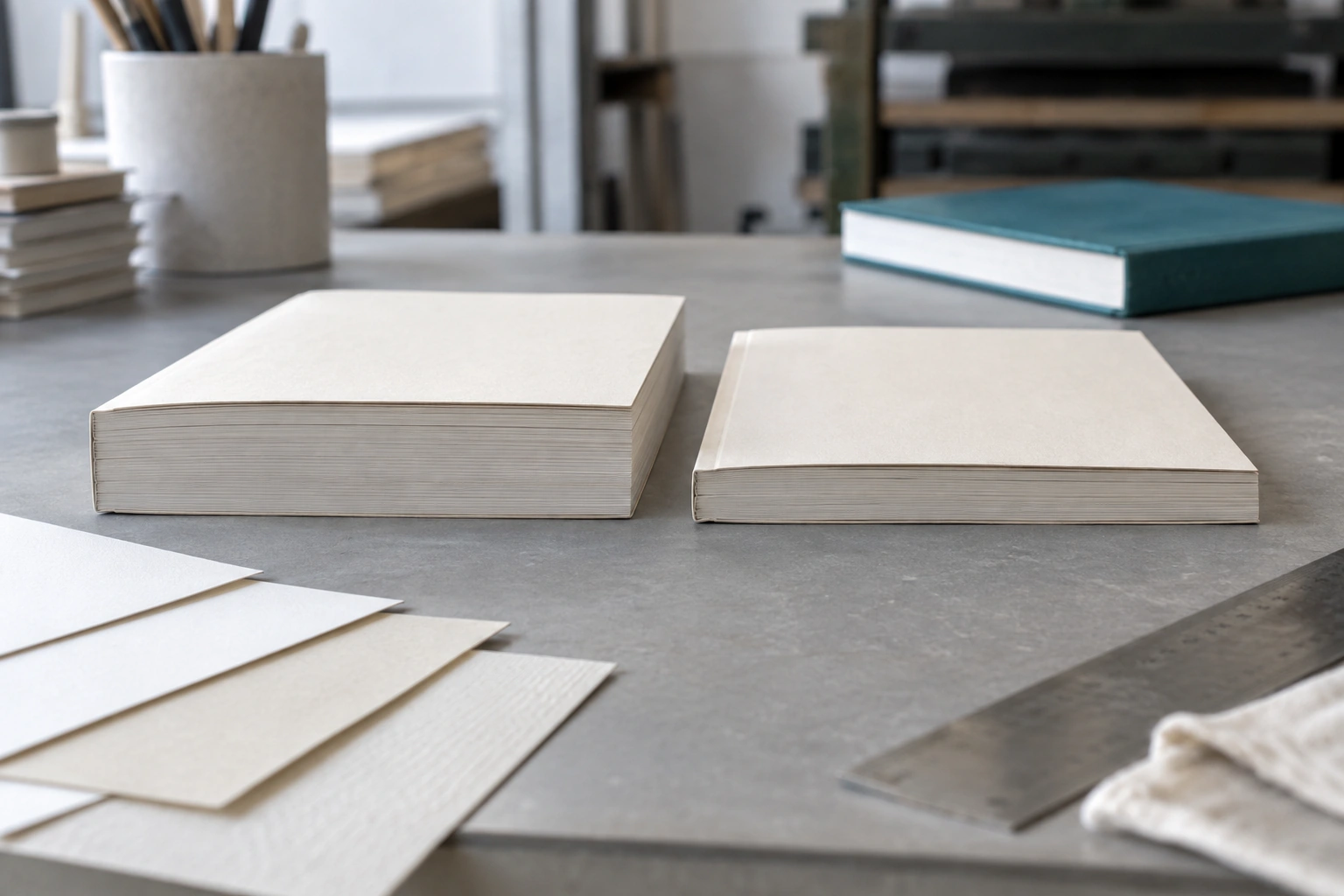
Illustrative example: The two stocks above are hypothetical, not named mill products, a real Prikoro order, or finished spine specifications. Both use the same trim size, page count, and grammage. The thicker stock adds an estimated 4.8 mm to the unbound paper stack while the nominal text-paper mass stays the same.
The mass calculation is 0.148 m × 0.210 m × 80 g/m² × 120 leaves = 298.368 g. It excludes ink, covers, adhesive, endpapers, and packaging. It is not the shipping weight.
For mixed stocks, calculate each group separately and add the preliminary stack contributions. Identify tipped-in plates, foldouts, or other inserts so the printer can review their construction. Then request a finished-book assessment rather than using the arithmetic alone to generate a cover template.
Compare Opacity, Surface, and Handling
Choose thickness alongside the book’s visual and practical requirements. Do not use it as a substitute for opacity, color reproduction, or a comfortable reading experience.
A substantial novel can benefit from a paper that provides volume without excessive mass. An image-heavy title may put greater emphasis on the printed surface, contrast, and reproduction of fine detail. These are selection priorities, not fixed paper recommendations for every edition.
Request a two-sided print sample using representative content. Inspect dense text behind a pale page, dark images behind captions, and important fine detail. Compare samples under similar lighting so shade and show-through differences are easier to judge.
For very long books using thin papers, the Bible paper guide discusses the separate opacity and printing issues. For an art-focused project, discuss those expectations alongside the art book printing specification.
Also review the reader’s use: page turning, writing if required, and how the book feels when held. A thicker option may be desirable for one edition and inconvenient for a portable reference book. Compare physical samples instead of treating “more bulk” as an automatic upgrade.
Review Binding and Cover Dimensions
Confirm the stock before approving the final spine artwork. A paper-stack estimate is useful for early planning, but the printer’s production template controls the finished cover dimensions.
For a paperback, the book block, adhesive and production allowances affect the binding plan. A hardcover adds a case construction whose dimensions cannot be inferred from paper thickness alone. Review the cover template after the paper, page count, and construction are settled.
Use a representative dummy to assess overall volume and opening behavior. Match its stock, page count and relevant construction to the intended book; a dummy made with unrelated paper can demonstrate a misleading thickness.
Paper grain is another specification. The book paper grain direction guide explains why it should be reviewed with the final spine and folding plan. Caliper does not tell you the grain direction or prove that a book will open well.
Compare Cost and Freight Implications
Compare the complete book and delivery specification. A paper with greater bulk at equal GSM can increase volume without increasing nominal text-paper mass, while a lower-GSM option can reduce that mass if the other requirements remain acceptable.
Neither change guarantees a lower total price. Paper purchase price, availability, press suitability, binding adjustments, carton arrangement and freight dimensions can alter the result. Ask the printer to quote both alternatives on the same quantity and delivery basis.
Request estimated finished weight and packed dimensions separately. The paper-only mass calculation cannot determine parcel charges or pallet capacity. If the book becomes thicker, review copies per carton and the protective arrangement using the book shipping packaging guide.
Keep the comparison tied to saleable quality. A cheaper paper that fails the agreed opacity, print or handling requirements is not an equivalent substitute. Avoid quoting a percentage saving until the supplier has priced the actual options.
Write a Quote-Ready Paper Specification
Specify the material identity and the properties that matter to the project. “Cream paper, 80 GSM” leaves too many variables open if thickness and spine dimensions are important.
| Item | Request or record | Approval purpose |
|---|---|---|
| Material identity | Mill or grade, surface, shade, and supply availability | Defines the actual quoted stock |
| Grammage and caliper | Values, units, technical sheet, and measurement basis | Separates mass from thickness |
| Optical properties | Relevant opacity data and representative two-sided printing | Checks readability and image interference |
| Book construction | Trim size, interior page count, inserts, grain plan, and binding | Supports a meaningful dummy and cover template |
| Dimensional approval | Representative sample, finished-book assessment, and current template | Prevents paper-stack arithmetic becoming an unverified spine size |
| Substitution control | Properties requiring reapproval and written change process | Stops equal-GSM replacements from changing the book unnoticed |
If the exact grade is unavailable, ask the supplier to identify the alternative and show which properties change. Compare the new data and sample before accepting it. Do not assume matching GSM means matching volume, shade or printed appearance.
Approve Samples and Substitutions
Keep three decisions distinct: material approval, representative printed-page approval, and finished construction approval. A blank swatch can establish feel, but it cannot demonstrate the appearance of your printed images or the final cover fit.
Document the approved material reference, sample date, page count, and any provisional values. If the stock changes later, review caliper, opacity, printing, binding and cover dimensions as appropriate. Ask which existing approvals remain representative and which must be repeated.
The proof approval guide helps match samples to the question being answered. To discuss your project, send Prikoro the paper options, trim size, page count and binding requirements. More related specifications are available in the book manufacturing guides.
Choose book paper thickness from measured material data and the intended book, not from GSM alone. Use arithmetic for preliminary planning, then approve the actual stock, print sample and construction before finalizing the cover.
Frequently Asked Questions
Does higher GSM always mean thicker book paper?
No. GSM measures mass per area, while thickness also depends on bulk and the paper construction. Compare declared caliper for the actual grades rather than relying on GSM alone.
How thick is 80 GSM book paper?
There is no single thickness for every 80 GSM stock. Request its grade-specific caliper and measurement method. Different papers at the same grammage can produce different book volumes.
Can I calculate the exact book spine from page count and GSM?
No. GSM alone does not supply the paper thickness, and the finished construction includes more than a loose paper stack. Use declared caliper for an early estimate and obtain the printer’s final template.
Is high-bulk paper automatically better quality?
No. High bulk describes volume relative to mass. Assess opacity, printing, handling and binding against the intended use before deciding whether the additional volume is useful.
How many sheets are in a 240-page interior?
A conventional 240-page interior represents 120 leaves, each with two page surfaces. This does not mean 120 parent press sheets; imposition and production sheet requirements are a separate calculation.
Will a thicker stock make the book heavier?
Not necessarily. At equal grammage, trim size and leaf count, nominal text-paper mass is the same. Finished weight can still change if covers, endpapers or other construction components change.
Can I approve paper thickness from a photograph?
No. A photograph can show relative appearance but does not establish a reliable caliper value or measurement method. Use material data and representative physical samples.
Can an equal-GSM substitute use the same cover file?
Only after the printer confirms that the substitute and finished construction remain compatible with the approved dimensions. A caliper change can require a new spine or cover template even when GSM is unchanged.
Sources and Further Reading
The official sources linked above support paper-property definitions, the manufacturer example and measurement-method distinctions. Stack and mass calculations use an explicitly hypothetical specification; they are not finished-book measurements or production test results.
- Holmen Board & Paper — Paper Characteristics.
- Holmen Board & Paper — Holmen BOOK Technical Data Sheet.
- ISO — ISO 534:2011, Paper and Board Thickness, Density and Specific Volume.