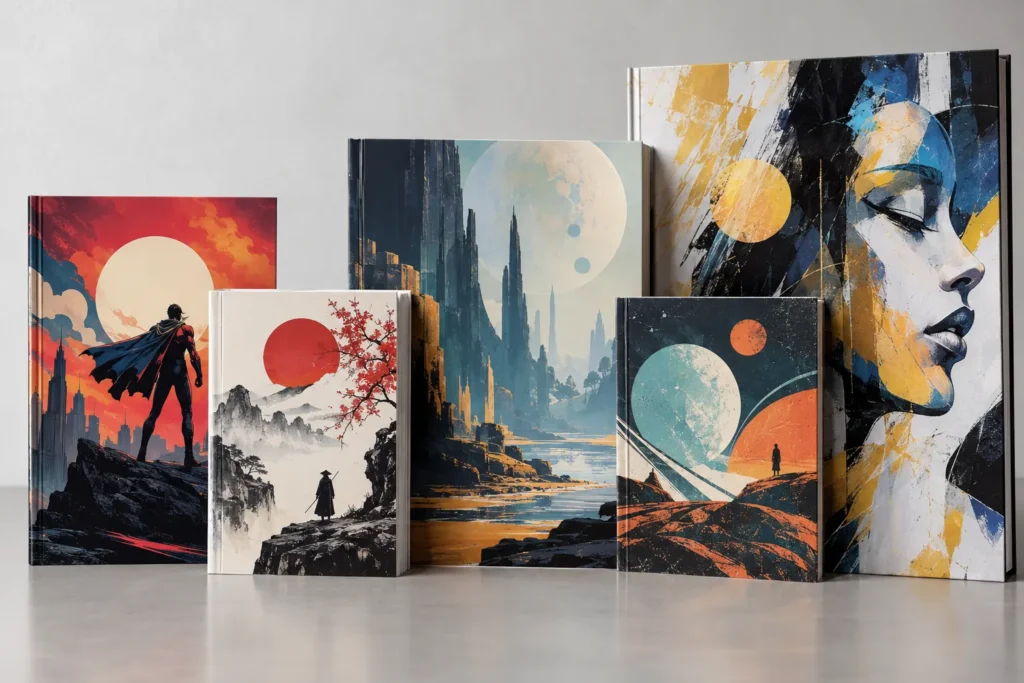
Comic book sizes determine far more than the dimensions of a finished comic. They affect panel composition, text legibility, bleed, paper yield, binding, mailing, shelving, and unit cost. For a conventional US single issue, 6.625 × 10.25 inches (168 × 260 mm) is the most familiar starting point. Manga often uses A5, B6, or B5; graphic novels commonly use 6 × 9 or 7 × 10 inches; and art-led editions may justify a larger custom trim.
Standard Comic Book Sizes in Inches and Millimeters
The table below is a planning guide, not a substitute for a printer template. Metric equivalents are rounded for comparison; production files should use the exact dimensions supplied in the quote or dieline.
| Format | Typical trim size | Common use | Usually paired with |
|---|---|---|---|
| US standard comic | 6.625 × 10.25 in 168 × 260 mm |
Monthly issues, indie comics, serialized stories | Saddle stitching; sometimes perfect binding for thicker editions |
| Classic / vintage-inspired | About 7.25 × 10.5 in 184 × 267 mm |
Retro reproductions and facsimile-style projects | Saddle stitch or perfect binding |
| Digest | 5.5 × 8.5 in 140 × 216 mm |
Portable collections, younger-reader titles | Perfect binding or saddle stitch |
| Manga B6 | 5.04 × 7.17 in 128 × 182 mm |
Compact manga and light reading | Perfect binding |
| Manga A5 | 5.83 × 8.27 in 148 × 210 mm |
Manga, doujinshi, premium small-format books | Perfect binding or sewn binding |
| Manga B5 | 7.17 × 10.12 in 182 × 257 mm |
Larger manga, anthologies, creator editions | Saddle stitch or perfect binding |
| Trade graphic novel | 6 × 9 or 7 × 10 in 152 × 229 or 178 × 254 mm |
Bookstore graphic novels and collected editions | Perfect, sewn, or hardcover binding |
| Square comic | Often 8 × 8 in 203 × 203 mm |
Children’s, experimental, and gift formats | Perfect binding or hardcover |
| Oversized edition | 8 × 10 or 8.5 × 11 in 203 × 254 or 216 × 279 mm |
Art-forward comics, portfolios, deluxe editions | Perfect, sewn, or hardcover binding |
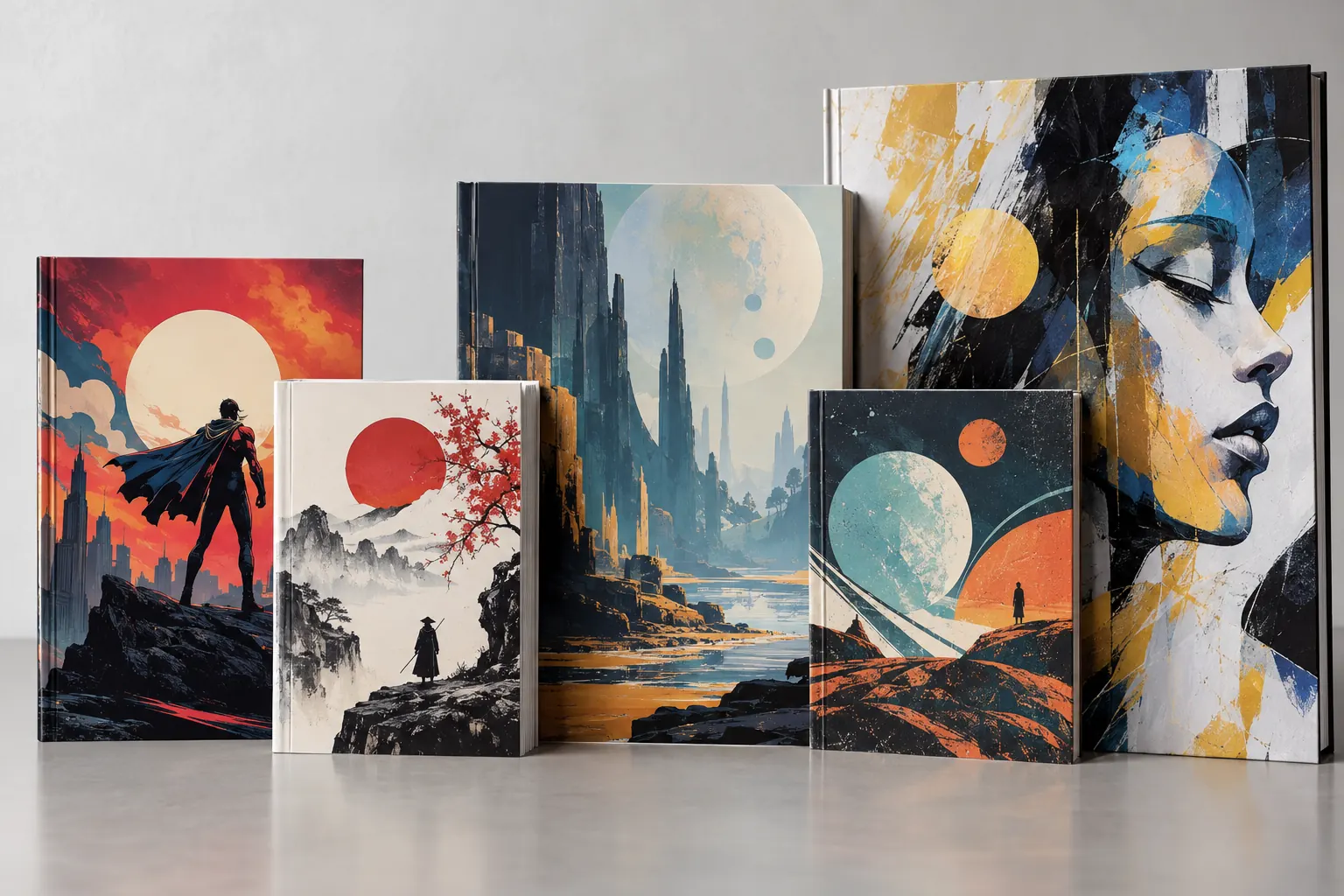
The familiar US figure is supported by current commercial printing guidance. Walsworth describes 6.625 × 10.25 inches as a standard comic format, while other providers publish nearby values. That small variation is precisely why the printer’s template—not a rounded number in a blog post—must control your final artwork.
How to Choose the Right Comic Book Size
Start with the reader and sales channel, then work backward into production. A size is successful when it protects visual storytelling, feels natural in hand, fits the intended channel, and can be manufactured efficiently.
| Project goal | Strong starting option | Why it works | Watch for |
|---|---|---|---|
| Familiar US comic-shop experience | 6.625 × 10.25 in | Recognizable proportions and good panel area | Confirm bags, boards, mailers, and retailer requirements |
| Portable, text-led collection | Digest or A5 | Compact and economical to ship | Small dialogue, fine linework, and dense panels |
| Bookstore graphic novel | 6 × 9 or 7 × 10 in | Book-like handling and flexible binding choices | Spine width and distributor metadata |
| Detailed art showcase | 8 × 10 in or larger | Gives detailed spreads and color work room to breathe | Higher paper, packing, and freight cost |
| International manga audience | A5, B6, or B5 | Matches familiar ISO-based proportions | Reading direction, translation expansion, and local channel norms |
If the project is still flexible, request pricing for two adjacent sizes. Printers impose pages on larger press sheets; a slightly different trim may improve sheet utilization and reduce waste. The cheapest option cannot be predicted from area alone because press format, quantity, paper, color, finishing, and binding interact.
Comic Book Sizes: Trim, Bleed, Safe Area, and Gutter
Trim size is the final cut dimension. Bleed extends backgrounds beyond the trim so normal cutting variation does not reveal a white edge. The safe area keeps dialogue, page numbers, faces, and other critical content away from cutting and binding risk. The gutter is the inside region affected by the fold, staples, glue, or page curvature.
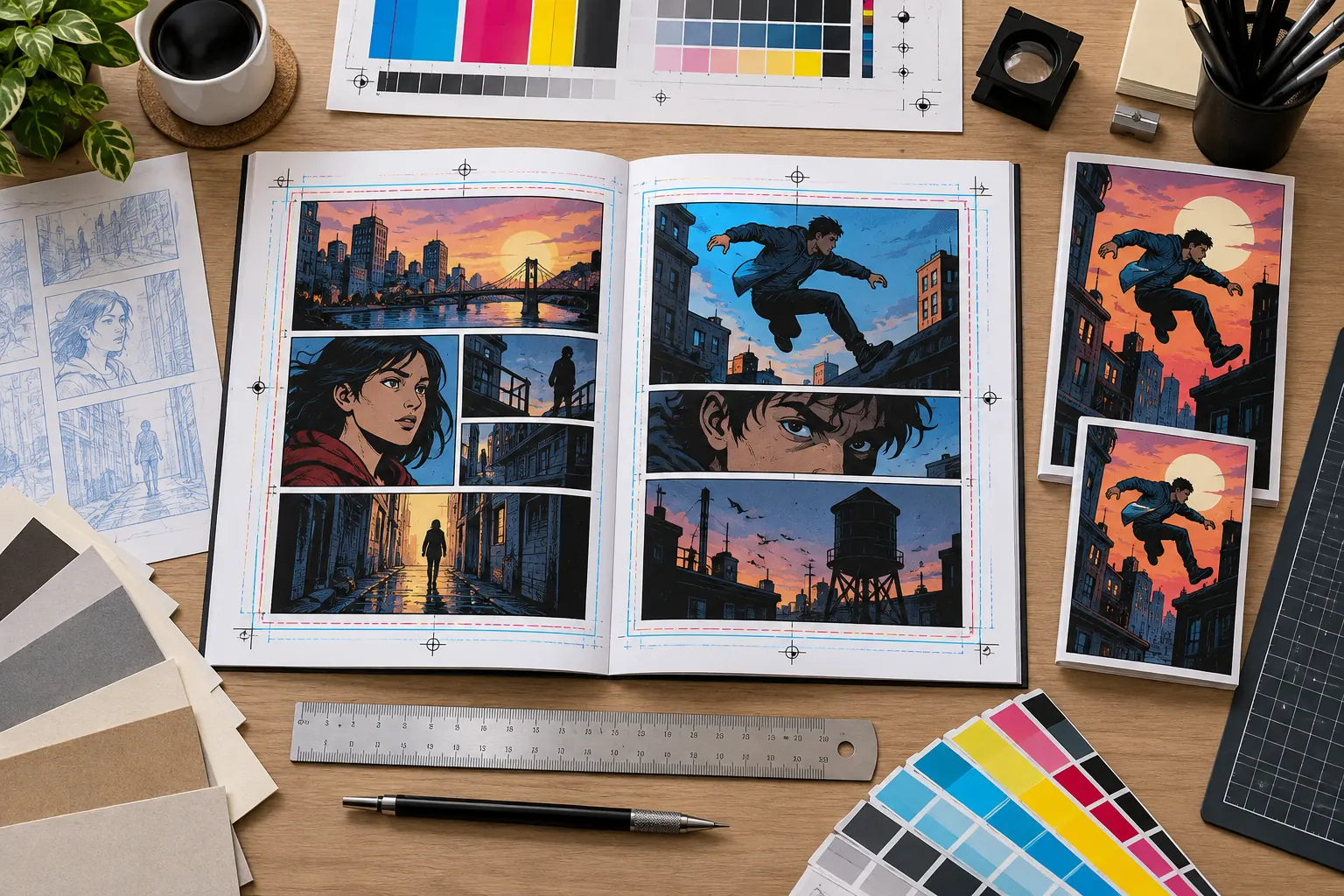
A common commercial starting point is 0.125 inch (3 mm) bleed, but workflows differ. PrintNinja publishes 0.125 inch bleed and recommends keeping critical text 0.25 inch inside trim. IngramSpark specifies 0.125 inch bleed at the top, bottom, and outside edge of interior pages—not the bind edge. KDP expresses its paperback bleed canvas with its own page-size calculation. These are useful examples of a crucial rule: use the specification for the actual printer and binding process.
Aspect Ratio Matters More Than Simple Resizing
Two formats can look close while having different width-to-height ratios. Scaling a 6.625 × 10.25-inch page directly to A5 may leave unwanted margins or crop art. It can also reduce balloon type below a comfortable reading size.
- Choose the final trim before penciling or lettering whenever possible.
- Build a master template with trim, bleed, safe area, and binding allowance on separate locked guides.
- Draw at a larger proportional size if desired, but preserve the final aspect ratio.
- For an existing edition, recompose panels and balloons page by page instead of applying one global scale factor.
- Print representative pages at 100% size and read them under normal lighting.
For raster production, 300 ppi is a common minimum for continuous-tone color, while line art may benefit from higher effective resolution. Convert color according to the printer’s profile and export the requested PDF standard. Prikoro’s prepress artwork guidance helps teams prepare production-ready files.
How Size, Page Count, and Binding Work Together
Saddle-stitched comics are formed from folded sheets, so the interior page count normally works in multiples of four. Walsworth notes that 24- and 32-page comics align efficiently with common 8- and 16-page forms. The practical maximum for saddle stitching is not universal: paper thickness, trim, cover stock, and equipment determine when creep and edge stepping become unacceptable.
| Binding | Best suited to | Size-related design issue | Commercial implication |
|---|---|---|---|
| Saddle stitch | Low-page-count issues and zines | Creep increases as the folded section gets thicker | Efficient and lightweight; page count generally multiples of four |
| Perfect binding | Collections and graphic novels | Glue and page curvature reduce usable gutter area | Printable spine once the text block is thick enough |
| Sewn binding | Premium, frequently opened editions | Signature planning and gutter design matter | Greater durability and typically higher cost |
| Hardcover | Deluxe and collector editions | Case, hinge, endpapers, and cover wrap need separate templates | High perceived value, weight, packing, and freight |
Learn more about construction options on Prikoro’s custom comic book printing page. Final spine width should always be calculated from the selected paper’s actual caliper and confirmed page count.
How Comic Book Sizes Affect Printing Cost
Trim area influences cost, but it is only one variable. A smaller book may use less paper yet become inefficient if it fits poorly on the press sheet. A larger size may raise unit cost but support a higher retail price or better showcase detailed artwork.
| Cost driver | Why size changes it | How to control risk |
|---|---|---|
| Paper yield | More or fewer pages fit on each parent sheet | Ask for a size-optimization comparison before locking art |
| Press and finishing format | Equipment has maximum sheets, image areas, and trim patterns | Confirm the production route for your quantity |
| Binding | Trim, thickness, and opening behavior affect feasible methods | Quote size, page count, paper, and binding together |
| Mailing and cartons | Outer dimensions and weight change envelopes, cartons, and freight | Request packed carton size, weight, and units per carton |
| Special finishes | Foil, spot UV, embossing, and flaps require tooling and clearances | Supply a finishing layer and obtain a physical proof where appropriate |
Paper choice also changes opacity, color appearance, bulk, and shipping weight. Compare coated and uncoated options in Prikoro’s book printing paper guide.
Distribution, Storage, and Shipping
A comic must survive outside the design studio. Before approving a custom trim, verify retailer shelves, protective bags and boards, fulfillment mailers, warehouse bins, crowdfunding reward packaging, and distributor metadata. Do not assume a product labeled “standard comic size” fits every printer’s version of standard.
- Measure the finished book, including cover overhang or bulk at the spine.
- Test the exact bag, board, envelope, and carton rather than relying on nominal names.
- Check dimensional-weight rules with the intended carrier.
- Provide trim size, spine width, weight, ISBN, and binding consistently across sales listings.
- For retail distribution, confirm requirements before manufacturing—not after delivery.
A Transparent Comic Book Size Planning Scenario
The digest lowers physical footprint, but test pages make background detail and 8-point dialogue uncomfortable. The 8 × 10 version gives the art the strongest presence, yet increases packing and freight exposure. The US standard version preserves the intended reading rhythm, fits established accessories more easily, and avoids major re-lettering. The team therefore requests two production quotes—saddle stitch and perfect binding—with the same paper and finishing assumptions.
The lesson is not that one size always wins. It is that the best decision emerges from a controlled comparison: identical content, defined channel, physical reading test, binding feasibility, and delivered-cost estimate.
Preflight and Quote Checklist for Comic Book Sizes
Send the following information to receive a comparable, production-ready quotation:
- Final trim size and orientation
- Page count, stating whether the cover is included
- Interior and cover color specifications
- Interior paper, cover stock, and desired finish
- Binding method and reading direction
- Quantity and any split-shipment quantities
- Finished delivery destinations and deadline
- Special finishes, inserts, foldouts, or variant covers
- PDF dimensions, bleed, safe area, image resolution, and color space
- Proofing expectation: digital proof, printed proof, or bound dummy
Request a dieline and file checklist before release. For a tailored size and production recommendation, contact Prikoro for a comic printing quote.
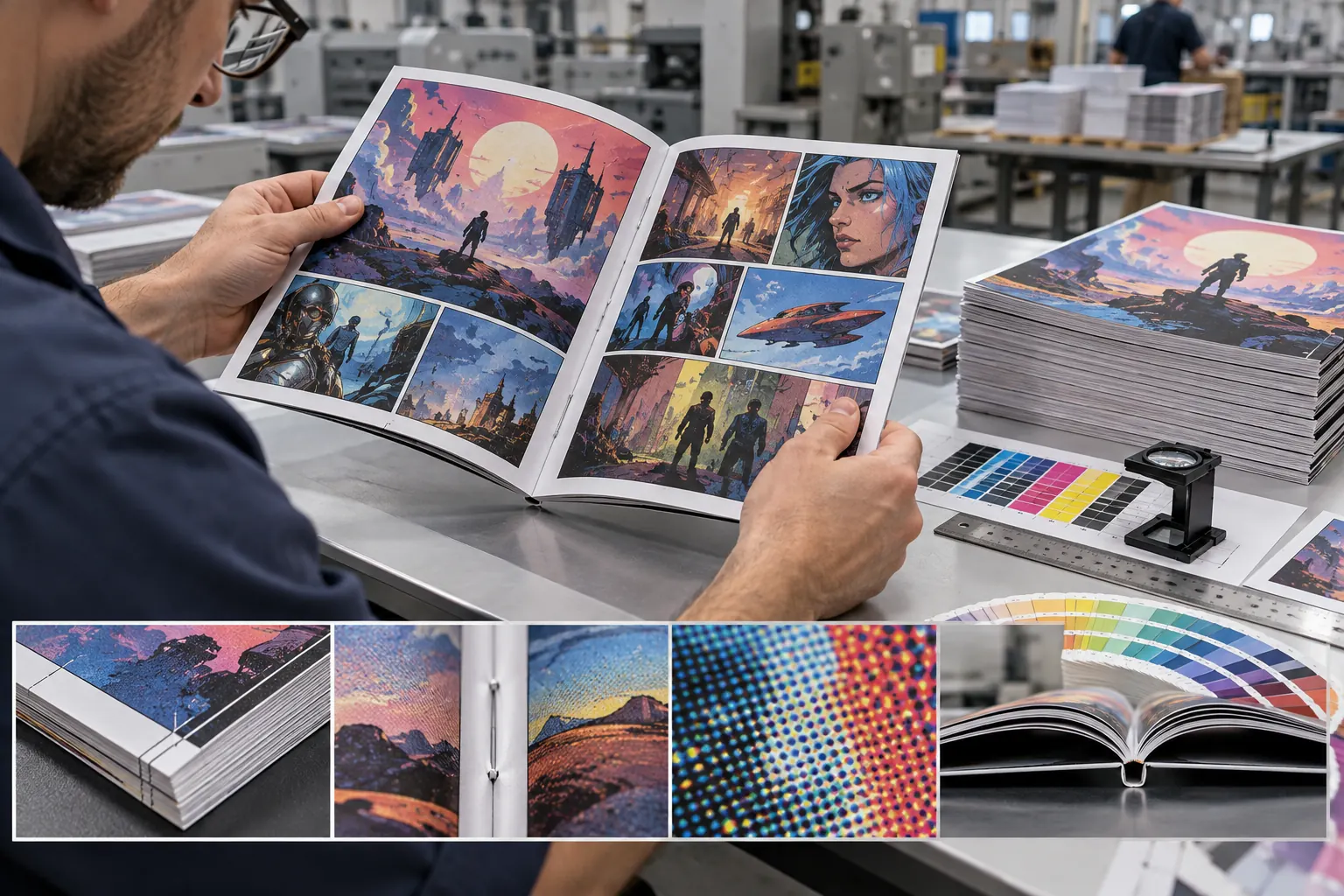
Frequently Asked Questions About Comic Book Sizes
What is the standard US comic book size?
A widely used modern trim is 6.625 × 10.25 inches (about 168 × 260 mm). Some printers publish slightly different dimensions, so confirm the exact template before preparing final art.
What comic book size is best for manga?
A5, B6, and B5 are common starting points. B6 is compact, A5 offers more room, and B5 suits larger anthologies or art-led work. Audience expectations and text density should drive the decision.
What size should a graphic novel be?
Many graphic novels use 6 × 9 or 7 × 10 inches, though US comic proportions and custom sizes are also viable. Check bookstore, distributor, and binding requirements early.
How much bleed does a comic book need?
Many printers ask for 0.125 inch (3 mm), but the required edges and file canvas differ by workflow. Follow the selected printer’s template rather than adding a generic value.
Can I resize finished comic artwork?
Yes, but a proportional scale rarely solves changes in aspect ratio, gutter, lettering, and safe areas. Reframe and re-letter representative pages, then review printed-size proofs.
Does a smaller comic always cost less to print?
No. Paper area matters, but press-sheet yield, quantity, page count, binding, setup, finishing, and freight can outweigh a simple size comparison.
Which comic book sizes work with saddle stitching?
Many standard and custom trims can be saddle stitched if they fit the equipment. Page count, paper thickness, creep, and finished trim determine feasibility.
Should comic book page counts be multiples of four?
For saddle-stitched books, yes in most workflows because each folded sheet creates four pages. Other bindings may offer different imposition options, but printers still work with efficient signatures and forms.
How early should I choose the final comic book size?
Choose it before final panel layouts and lettering. Early confirmation prevents cropping, small type, inefficient gutters, and costly rework.
What proof should I request?
At minimum, review a prepress PDF at 100% and print critical pages at final size. For premium projects, unusual stocks, or exact color expectations, consider a printed proof or bound dummy.
Final Recommendation
For a conventional US issue, begin with 6.625 × 10.25 inches. For manga, evaluate A5, B6, and B5. For a graphic novel, compare 6 × 9 and 7 × 10 inches. Then validate the choice against real artwork, binding, press-sheet efficiency, packaging, and distribution. The correct comic book size is the one that produces an easy reading experience and a repeatable manufacturing result—not merely the dimension used by another title.