Premium hardcover Bible printing is one of the most technically demanding forms of book manufacturing. For example, a Bible may contain more than one thousand pages, fine typography, cross-references, maps, thumb indexes, multiple ribbons, edge decoration, and a cover expected to survive years of repeated use. Moreover, every specification influences another: lighter paper reduces bulk but may increase show-through; a smaller trim improves portability but can compromise type size; additional finishes add value but also require production testing.
Premium Hardcover Bible Printing Specification at a Glance
| Component | Practical starting point | Why it matters | Confirm before ordering |
|---|---|---|---|
| Trim size | Portable, standard, or study edition | Controls type size, line length, bulk, and freight | Closed finished dimensions in mm and inches |
| Interior paper | Lightweight, high-opacity Bible paper | Reduces book-block thickness while limiting show-through | Actual GSM, caliper, opacity, shade, grain, certification |
| Interior printing | Black or black plus one spot color | Fine text needs density without excessive strike-through | Ink color, map signatures, proof method |
| Binding | Smyth sewn / section sewn case binding | Improves strength and opening for frequent use | Signature plan, adhesive, spine shape, hinge construction |
| Cover | Cloth, coated paper, PU leatherette, or genuine leather where appropriate | Defines durability, feel, and price position | Material sample, color tolerance, foil and stamping tests |
| Accessories | Headbands, ribbons, edge finish, slipcase | Adds usability and presentation | Exact colors, quantities, attachment and rub testing |
For premium hardcover Bible printing, this is a starting framework rather than a universal recipe. A pew Bible, compact personal Bible, study Bible, family heirloom edition, hotel placement Bible, and fundraising presentation edition have different priorities.
How to Choose Paper for Premium Hardcover Bible Printing
Bible paper is engineered to carry a large amount of content without producing an unmanageably thick book. Buyers often focus only on GSM, but four characteristics must be evaluated together: basis weight, caliper, opacity, and strength. However, two sheets with the same GSM can behave differently because fiber composition, formation, coating, fillers, and manufacturing process affect thickness and light transmission.
| Paper priority | What to inspect | Risk if ignored |
|---|---|---|
| Opacity | Show-through under actual two-sided printed pages | Opposite-page text competes with the reading side |
| Caliper | Finished dummy thickness using final page count | Spine becomes too bulky or too weak |
| Formation | Uniformity when held to transmitted light | Mottled text and uneven show-through |
| Strength | Fold, tear, turning, sewing and binding performance | Pages wrinkle, tear or fail during gathering and use |
| Shade | White, natural, or warm ivory under viewing light | Reading comfort and brand appearance differ from proof |
| Grain direction | Grain parallel to the spine | Poor opening, waviness, and structural stress |
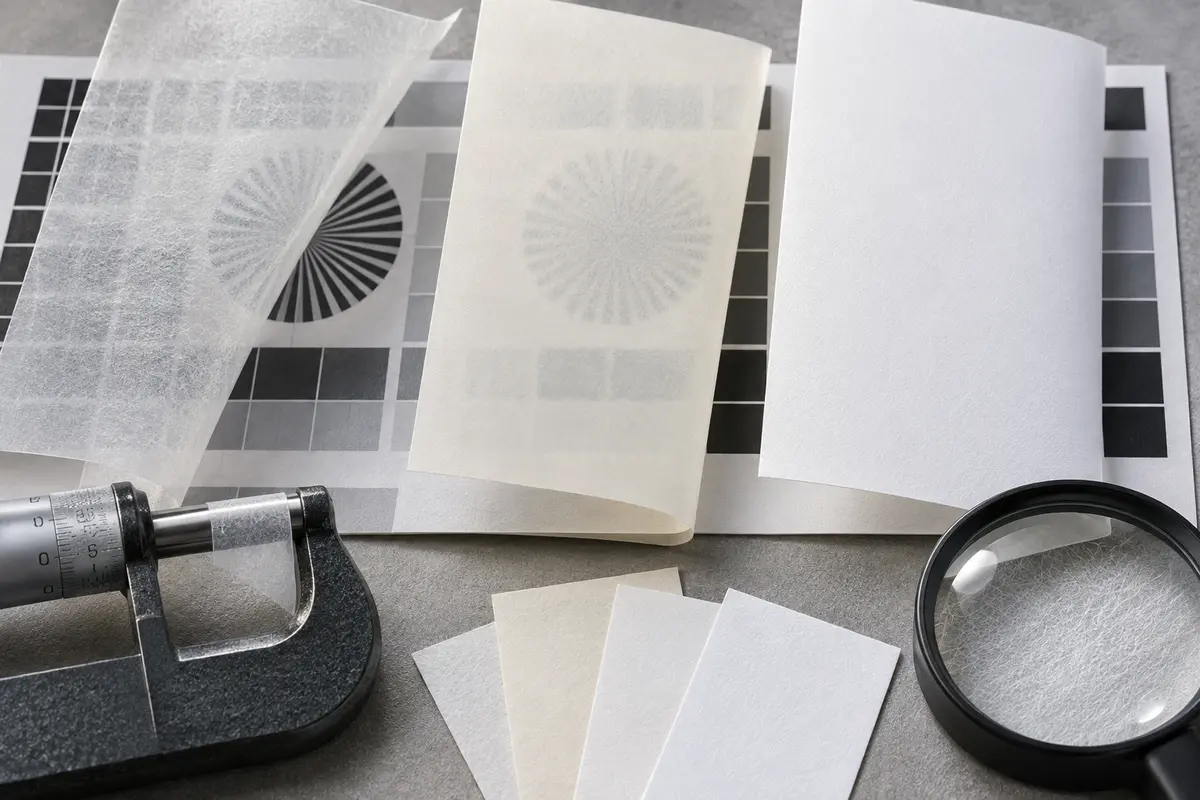
ISO 2471 is an established method for determining paper opacity. Therefore, a purchasing specification does not need to reproduce laboratory standards, but it should ask the printer for measurable paper data and a representative printed sample. For example, the best approval tool is a bound dummy plus printed proof pages containing the project’s smallest text, bold headings, rules, footnotes, red-letter content if used, and dense map colors.
Premium Hardcover Bible Printing Typography and Layout
Fine Bible typography is not simply “small text.” It must remain readable across long sessions. Trim size, page count, number of columns, leading, font design, line length, margins, notes, concordance, and cross-references must be planned as one system. Consequently, a compact edition should not be created by scaling down a larger PDF.
- Print representative pages at 100% and test them with intended readers.
- Keep critical text clear of trim and the binding gutter.
- Use consistent folios, chapter openings, running heads, notes, and reference systems.
- Check overprint, trapping, and registration when black text is combined with a spot color.
- Embed fonts and verify licensing for commercial print use.
Best Binding for Premium Hardcover Bible Printing
Sewn binding is normally the strongest starting point for a long Bible intended for repeated use. First, folded signatures are sewn, combined into a book block, lined, attached to endpapers, and cased into boards. However, adhesive selection and spine construction still matter: sewing alone does not guarantee a durable or comfortably opening book.
| Binding option | Suitable project | Advantages | Limitations |
|---|---|---|---|
| Smyth sewn case binding | Study, pew, presentation, and long-life editions | Strong; good page security; improved opening | Higher cost and longer process than simple adhesive binding |
| Sewn flexible cover | Personal and portable editions | Comfortable in hand; flexible opening | Requires careful cover material and reinforcement choices |
| Adhesive case binding | Budget projects where paper and page count permit | Lower manufacturing complexity | May open less freely and provide less long-term security |
| Mechanical loose-leaf formats | Special teaching or reference systems | Pages can be updated or reorganized | Not the traditional premium Bible experience |
For related construction options, review Prikoro’s hardcover book printing service. Therefore, final suitability must be confirmed using the actual paper, page count, trim size, and proof.
Cover Materials for Premium Hardcover Bible Printing
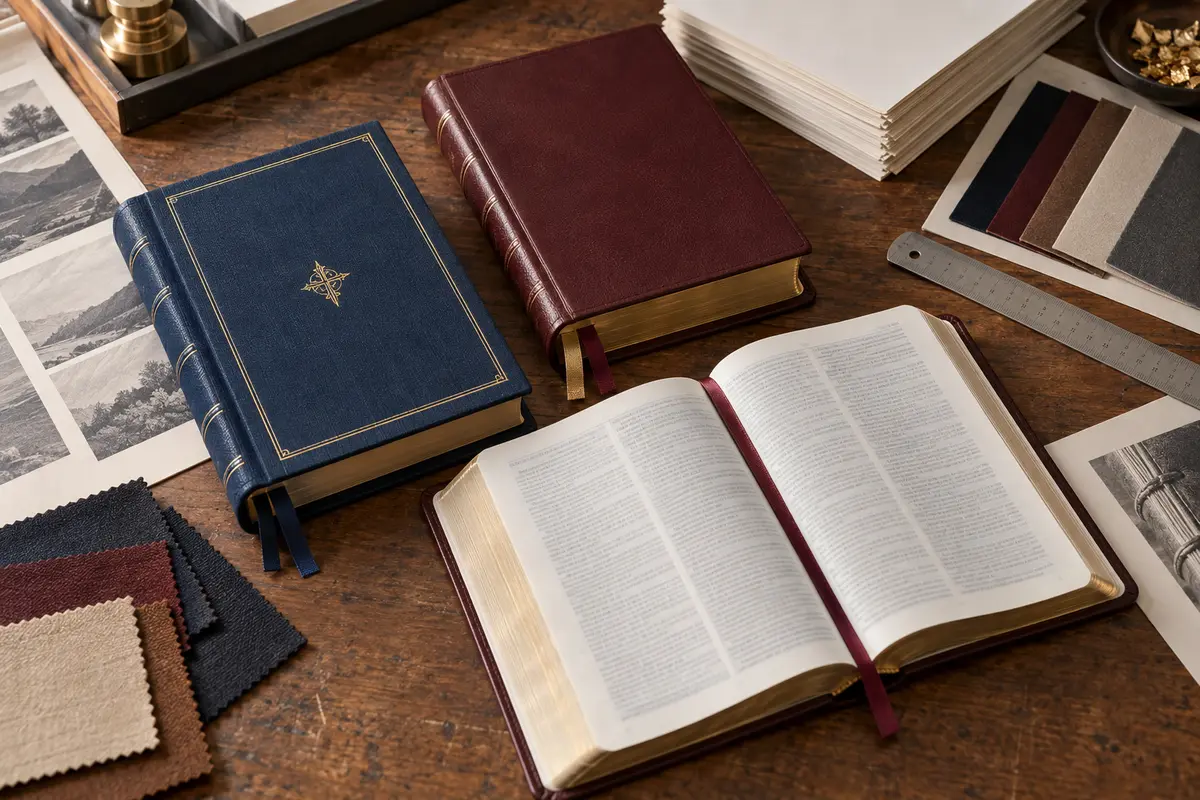
Cloth provides a classic tactile surface and works well with foil or debossing. PU leatherette offers consistent color, grain, and scalable production. Printed paper case wraps support illustration and photography. By contrast, genuine leather may suit limited editions but introduces natural variation, sourcing documentation, higher cost, and more demanding workmanship.
Therefore, request physical swatches because screen color cannot communicate hand feel, grain depth, flexibility, coating, foil adhesion, or rub resistance. For a heavily handled Bible, test foil and printed decoration at the spine, hinge, corners, and fore-edge—the areas most likely to experience friction.
Premium Hardcover Bible Printing Features
| Feature | Reader or buyer value | Production control |
|---|---|---|
| Foil stamping | High-contrast title and ornamental detail | Approve die artwork, foil sample, heat/pressure, and registration |
| Emboss or deboss | Tactile hierarchy without relying only on ink | Test depth against cover material and board |
| Two or three ribbons | Useful for parallel references and study | Confirm length, width, color, cut, and secure attachment |
| Gilt or colored edges | Premium appearance and coordinated design | Check evenness, rub resistance, page release, and corner coverage |
| Thumb indexing | Faster navigation | Requires exact tab plan, cutting accuracy, and reinforced handling review |
| Slipcase | Protection and presentation | Allow correct clearance; test insertion without abrasion |
In premium hardcover Bible printing, more decoration is not automatically more valuable. For instance, a restrained cloth cover with excellent sewing, paper, typography, and foil registration often feels more valuable than a crowded cover with several poorly controlled processes.
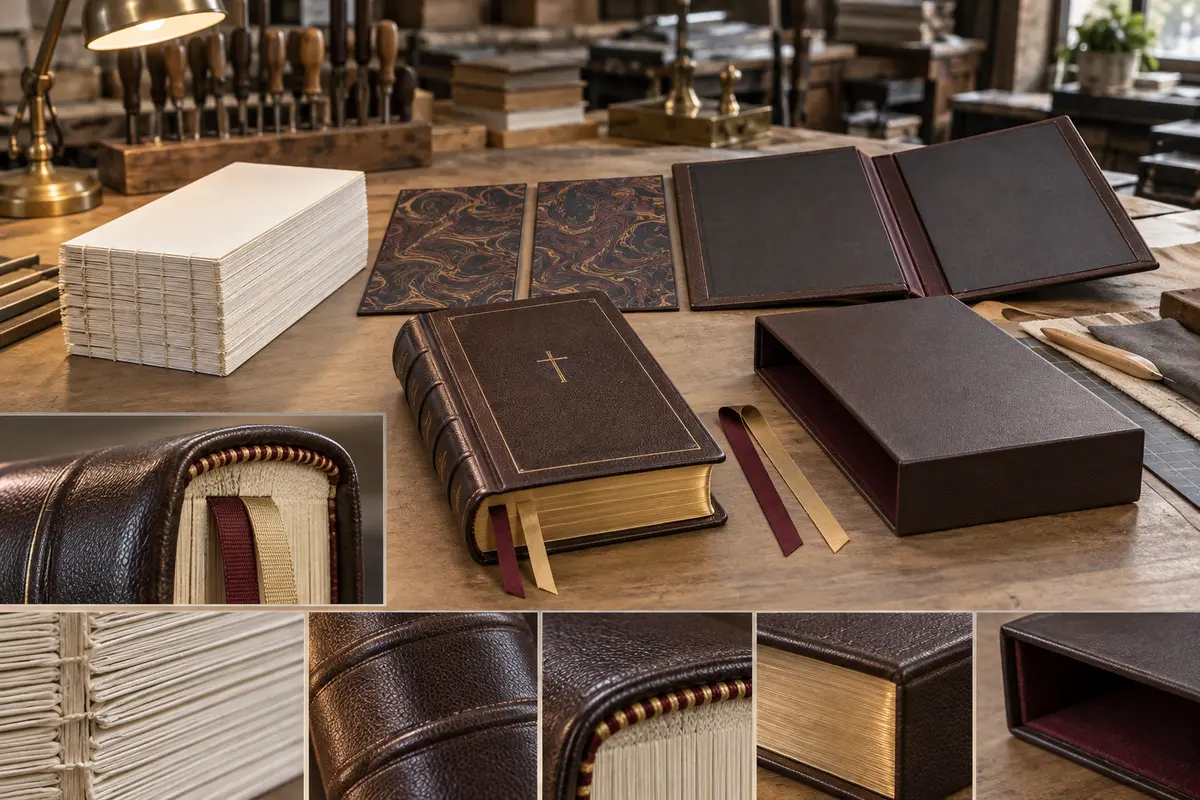
Premium Hardcover Bible Printing Workflow
- Rights and content: confirm translation permissions, territory, quantity, edition notice and licensed supplementary content.
- Specification: lock trim size, page count, color plan, paper, binding, cover and accessories.
- Prepress: check fonts, fine rules, images, spot colors, overprint, imposition risks and cover template.
- Proofing: review PDF proofs, printed paper tests, material samples, foil/deboss tests, and a blank or printed bound dummy.
- Pilot approval: for complex editions, approve a representative physical sample before mass production.
- Manufacturing: print, fold, gather, sew, bind, finish, inspect, pack and record batch controls.
- Shipping: plan moisture protection, carton strength, palletization, customs documents and delivery appointment.
Buyer Decision Sequence
First, define the intended reader and use environment. Next, confirm that every text and image asset is legally cleared. Then, freeze the final trim size and page count. Moreover, compare paper by opacity and bulk. However, do not approve paper from an unprinted swatch alone. Therefore, request representative two-sided print tests. For example, include the smallest notes and the densest map colors. In addition, build a dummy at the full page count. Consequently, the team can judge spine size and handling before production. Meanwhile, test the proposed sewing and opening behavior. Likewise, approve cover material and foil on physical samples. Specifically, inspect hinges, corners, ribbons and edge decoration. Afterward, document the approved tolerances and packing method. Finally, compare the complete landed cost and delivery schedule. Overall, this sequence reduces avoidable revisions and protects the finished edition.
Furthermore, confirm all accessory colors under the agreed lighting. Nevertheless, prioritize structural reliability before decorative upgrades. Similarly, verify carton protection with the heaviest finished configuration. As a result, transport risk becomes easier to control. Finally, retain approved samples and specifications for batch comparison. Thus, future reprints can reproduce the intended edition more consistently.
Therefore, confirm the approval record before authorizing mass production.
Premium Hardcover Bible Printing Quality-Control Checklist
- Correct edition, collation, folios and page sequence.
- Stable black density with acceptable show-through on final paper.
- Accurate spot-color or red-letter registration where applicable.
- Consistent folding, sewing, spine rounding and page-block squareness.
- Secure endpapers, hinges, headbands and ribbon markers.
- Foil, embossing, debossing, edge color and thumb indexes aligned to approved tolerances.
- No blocked pages, adhesive contamination, torn corners, wrinkles or excessive spine noise.
- Slipcase fit and carton protection verified with production samples.
The Library of Congress provides public guidance on the care and handling of books and paper. However, preservation guidance is not a manufacturing specification, it reinforces a practical principle: long-term performance depends on materials, environment, handling, and protective storage—not on decorative appearance alone.
What Determines Premium Hardcover Bible Printing Cost?
For premium hardcover Bible printing, the largest cost variables are quantity, trim size, total pages, paper grade, interior colors, sewing, cover material, number and area of foil or embossing operations, edge finishing, ribbons, indexing, slipcase, proofing, packing and freight. Meanwhile, lightweight paper can reduce thickness and freight but may cost more per tonne and demand specialized production control.
Therefore, ask for quotations using an identical specification at meaningful quantity tiers. Compare landed cost, not only EXW unit price. A Bible shipped to New York, Toronto, London, Sydney, Nairobi, Johannesburg, or an EU distribution center may require different pallet, customs, tax, and last-mile assumptions.
Transparent Production Scenario
This is an illustrative planning case, not a claimed customer order. A ministry plans 3,000 study Bibles with about 1,600 pages, black plus one spot color, two ribbon markers, a PU leatherette case, gold foil, and a slipcase. Initially, the team requests the thinnest available paper. Instead, a proper comparison tests two paper options for opacity, bulk, folding and readability, then builds dummies at the final page count. If the slightly heavier sheet produces a book that is still manageable but substantially easier to read, it may deliver better lifetime value than the smallest spine.
Therefore, the lesson is transferable: decide from physical evidence and the audience’s use, not from a single paper number or online photograph.
How to Request a Premium Hardcover Bible Printing Quote
Send the finished size, page count, interior colors, preferred paper or target bulk, binding, cover material, finishes, ribbon count, edge treatment, indexing, quantity, packing, destination country/city/postal code, schedule, and rights status. If specifications are open, state the priorities—portability, opacity, durability, price, or presentation—so the printer can recommend trade-offs.
Read more production guidance on the Prikoro blog, or contact Prikoro for a project-specific quotation and material discussion.
Premium Hardcover Bible Printing FAQs
What paper is used for Bible printing?
High-opacity lightweight paper commonly called Bible paper is used for long editions. Choose it by GSM, caliper, opacity, strength, formation, shade and grain—not by weight alone.
What is the best binding for a premium Bible?
Smyth sewn or section-sewn case binding is a strong starting choice for repeated use, provided the spine, adhesive, paper grain, hinges and endpapers are engineered correctly.
How many pages can a hardcover Bible contain?
There is no single limit. Page count must be evaluated with trim size, paper caliper, signature plan, binding equipment, spine geometry and intended handling.
Can a Bible have red-letter printing?
Yes. It requires a defined spot color or controlled process build, registration tolerances, and proofs on the actual lightweight paper.
Can I add multiple ribbon markers?
Yes. Two or three ribbons are common in study and reference editions. Specify count, width, color, length, cut and attachment.
Are gilded edges durable?
They can be durable when materials and application are controlled, but samples should be tested for evenness, page release and rub resistance.
Do I need permission to print a Bible translation?
Usually, unless the specific text is demonstrably in the public domain for the intended territory and use. Obtain written permission from the rights holder and verify maps, notes, fonts and illustrations separately.
Should I approve a physical proof?
For premium or complex editions, yes. A physical sample reveals opacity, bulk, opening, material feel, foil, edge finishing and slipcase fit that a screen PDF cannot show.
How long does custom Bible printing take?
Timing depends on proofing, paper availability, complexity, quantity, finishing and freight. Request a milestone schedule after the complete specification is confirmed.
What information produces the most accurate quote?
Final size, pages, colors, paper, binding, cover, finishes, quantity, packing and full delivery destination. Include the intended launch date and any required certifications.
Authoritative Sources and Further Reading
- ISO 2471 — Paper and board: Determination of opacity.
- Biblica Permissions — an example of translation-rights and quotation permissions guidance.
- Library of Congress Collections Care — preservation and handling resources for books and paper.