What Is Bible Paper?
Bible paper is a family of lightweight, high-opacity papers engineered for books with unusually high page counts. It may also be called lightweight opaque paper or, in some markets, India paper. The name describes a performance category rather than one universal recipe. Two papers with the same grammage can have different caliper, opacity, stiffness, formation, shade, surface, and press behavior.
That distinction matters. A 1,200-page book printed on ordinary lightweight offset paper may show distracting text from the reverse side, wrinkle during printing, or become too bulky. A purpose-selected Bible paper controls those risks while keeping the finished volume portable. Therefore, a professional specification should name the mill grade or approved equivalent—not only “40 gsm Bible paper.”
Bible Paper Specifications That Matter More Than GSM
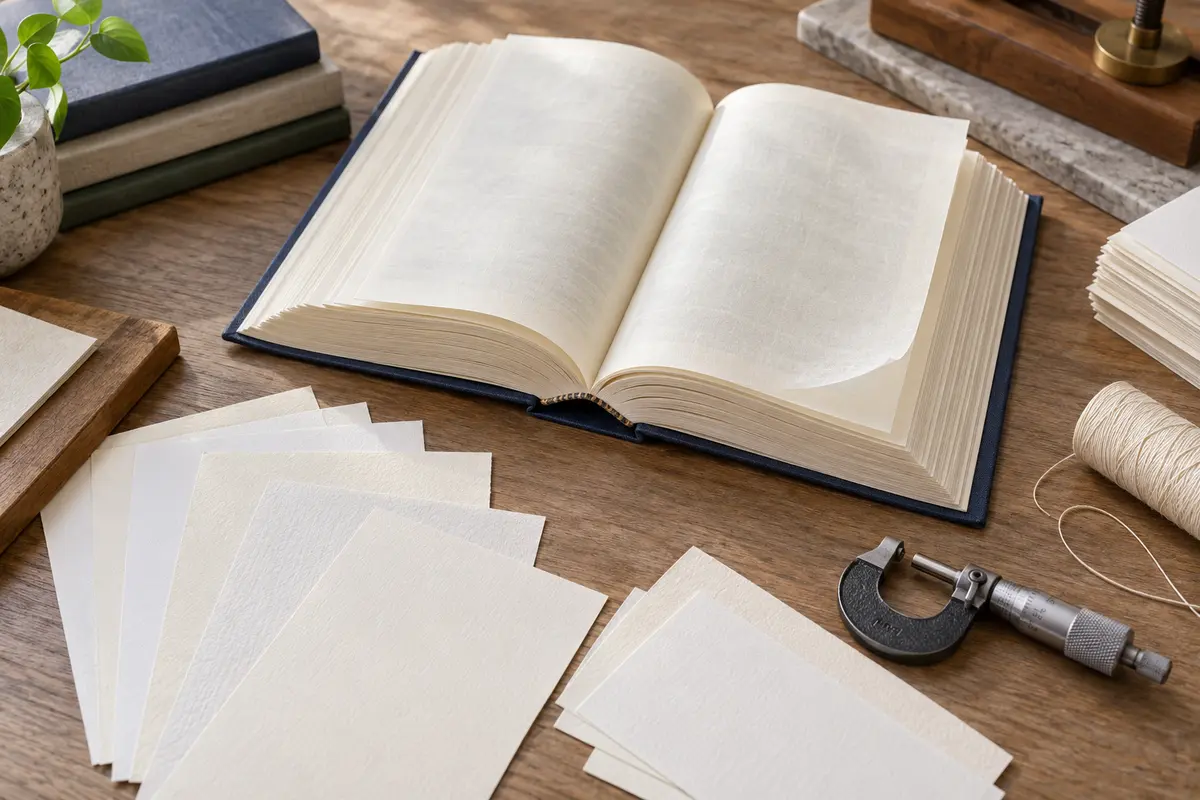
GSM is useful, but it measures mass per unit area—not thickness or quality. In fact, ISO 536 defines the standard method for determining paper grammage. For a reliable purchasing specification, evaluate the following properties together.
| Property | What it describes | Why it matters in a Bible | How to verify |
|---|---|---|---|
| Grammage (gsm) | Mass per square metre | Affects book weight, handling and freight | Mill data plus incoming-paper check |
| Caliper (µm) | Physical sheet thickness | Drives book-block and spine thickness | Micrometer under specified pressure |
| Opacity (%) | Ability to block light | Controls reverse-side show-through | Instrument reading plus printed visual test |
| Bulk (cm³/g) | Thickness relative to weight | Explains why equal-gsm papers build different spines | Calculate from grammage and caliper |
| Formation | Evenness of fibre distribution | Affects mottling, translucency and small-type clarity | Backlit sample inspection |
| Tensile/tear strength | Resistance to pulling and tearing | Supports thin-page turning and sewing | Supplier test data and physical dummy |
| Surface/ink holdout | How ink sits on or penetrates the sheet | Affects dot gain, sharpness and strike-through | Production-press proof |
Ask for both nominal values and tolerances. Paper is a natural fibre product, so production lots vary. For critical editions, the printer should reserve one lot for the full run and record the approved sample.
Bible Paper Weight Guide: 28–80 GSM
The ranges below are decision starting points, not universal press guarantees. Availability and minimum run size depend on the paper mill, printing method, sheet size, grain direction, and the converter’s ability to fold and sew the stock.
| Typical range | Likely application | Main advantage | Main risk |
|---|---|---|---|
| 28–35 gsm | Ultra-compact, very high-volume editions | Minimum bulk and carrying weight | Specialist sourcing, handling and opacity constraints |
| 36–45 gsm | Compact Bibles and dense text editions | Strong page-count-to-spine efficiency | Requires controlled ink film and careful folding |
| 46–60 gsm | Standard, reference and portable editions | Practical balance of opacity and thickness | Exact grade still determines show-through |
| 61–70 gsm | Study, journaling and moderate large-print editions | Easier handling and stronger page feel | Heavier, thicker book block |
| 71–80 gsm | Large-print, illustrated or premium editions | Higher opacity and substantial feel | May make 1,000+ pages unwieldy |
Bible Paper Opacity, Show-Through and Strike-Through
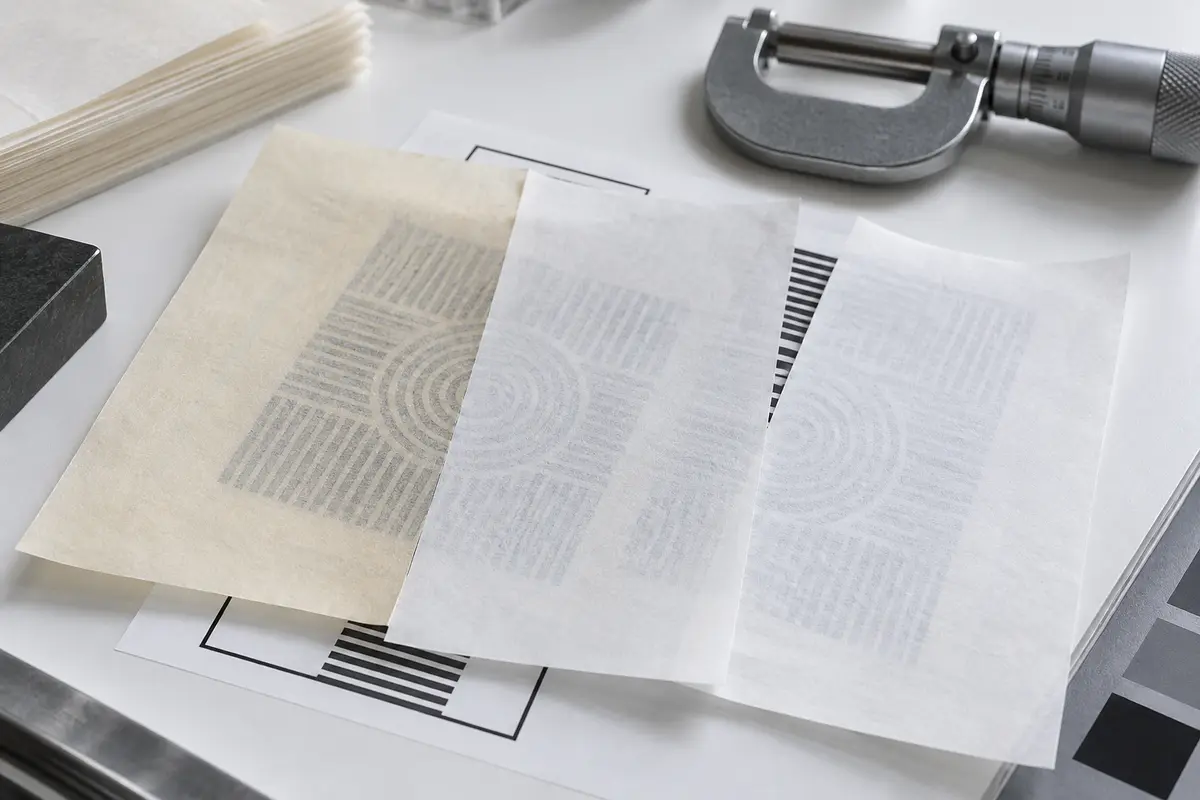
These terms are related but not identical. Show-through is the visible impression of printing on the reverse side, influenced by paper opacity, ink density, lighting, line spacing, and whether text on both sides aligns. Strike-through is ink vehicle or pigment penetrating into or through the sheet. A paper can have respectable laboratory opacity and still produce an uncomfortable reading experience if the design uses very dark, dense text.
ISO 2471 specifies an instrumental method for measuring paper opacity by diffuse reflectance. Nevertheless, a percentage alone cannot simulate every reader or layout. The most useful approval tool is a press-printed test form using the final typeface, point size, solid density, two-sided imposition, rules, notes, and any maps.
Five practical ways to reduce visual interference
- Choose a grade engineered for high opacity rather than selecting by GSM alone.
- Use a slightly warm neutral shade to soften perceived contrast during long reading sessions.
- Control ink density and dot gain; excess ink rarely makes small text more legible.
- Avoid placing heavy rules, solid boxes, or photographs directly behind fine text.
- Test synchronized and staggered line placement. Depending on the layout, reverse-side line alignment can either mask or accentuate show-through.
How to Estimate Bible Spine Thickness
The book block contains half as many physical leaves as numbered pages. A simplified estimate is:
Then add allowances for folded signatures, sewing swell, endpapers, adhesive, rounding and backing, and production compression. Your printer must provide the final cover-template spine.
For example, a 1,200-page interior has 600 leaves. If the measured caliper is 0.055 mm, the simple leaf stack is about 33 mm. At 0.070 mm, it becomes about 42 mm—a 9 mm difference before binding allowances. This example is illustrative, not a Prikoro manufacturing tolerance or quotation.
| Illustrative input | Option A | Option B | Decision implication |
|---|---|---|---|
| Page count | 1,200 | 1,200 | 600 physical leaves |
| Measured caliper | 0.055 mm | 0.070 mm | GSM is insufficient without this value |
| Simple text-block estimate | 33 mm | 42 mm | Cover artwork and hand-feel change materially |
| Next action | Build a blank dummy and request the printer’s production spine template | Do not design the spine early | |
White or Ivory Bible Paper?
Ivory or cream is often comfortable for sustained black-text reading and gives traditional editions a warm character. White preserves cleaner color balance for maps, photographs, color-coded notes, and bright contemporary designs. However, shade names are subjective: one mill’s “natural” may be another mill’s “ivory.” Approve a physical swatch under daylight and the lighting in which readers will use the book.
If an edition combines an ivory text block with coated color inserts, check the visual transition and confirm that the signatures can be gathered and sewn in the intended sequence. Mixed stocks also behave differently during trimming and edge gilding.
Bible Paper Printing: Ink, Type and Prepress
Thin paper magnifies small prepress errors. For crisp scripture text, use a typeface designed for small sizes, maintain adequate x-height and line spacing, and avoid excessively fine reversed text. Black-only interiors usually need controlled single-black text rather than an uncontrolled rich-black build. For two-color editions, define spot or process colors consistently and verify trapping on the actual stock.
Offset printing is common for longer custom runs because it offers stable small-type reproduction and economical unit costs at scale. Yet press suitability depends on the grade and equipment. Lightweight stock requires dependable sheet separation, tension, register control, drying, and careful delivery. Digital printing may suit shorter prototypes, but not every digital press accepts ultra-light paper. The correct answer comes from a named press-and-paper test, not a generic claim about one technology.
How Bible Paper Affects Binding
High-page-count Bibles are frequently section sewn because thread connects folded signatures and supports repeated opening. Good sewing alone is not enough: signature size, fold quality, grain direction, endpaper construction, spine lining, cover hinge geometry, and adhesive flexibility all affect durability and opening behavior. Learn more about Prikoro’s custom hardcover book printing options before locking the cover structure.
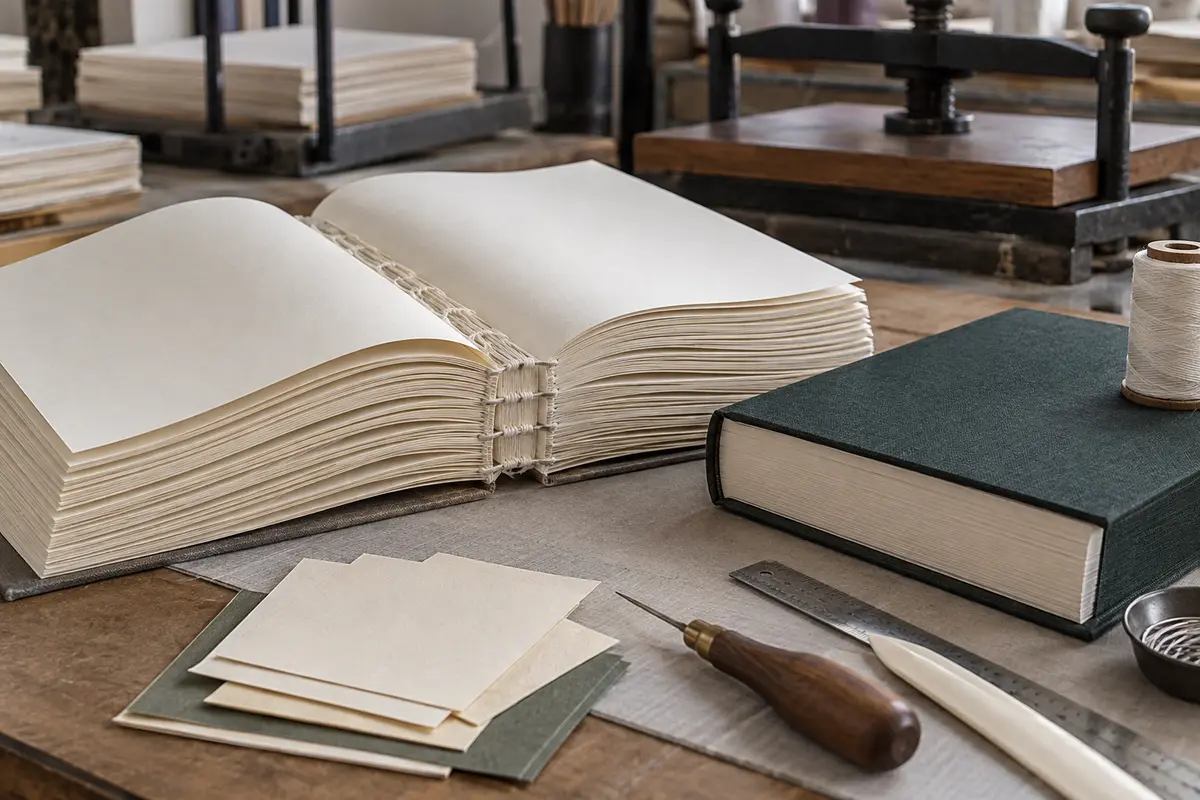
Paper grain should normally run parallel to the spine so pages turn naturally and the book opens with less resistance. Edge gilding or painting adds another process constraint: the trimmed block must remain stable, and the finish should be tested for blocking, cracking, and page separation. Discuss ribbons, headbands, thumb indexes, and slipcases at the same time because each affects manufacturing order.
Bible Paper Selection Matrix by Edition Type
| Edition | Starting paper direction | Prioritize | Prototype test |
|---|---|---|---|
| Compact carry Bible | Specialist lightweight, often below 50 gsm | Low caliper, opacity, tear strength | Full-size bound dummy and page-turn test |
| Standard text Bible | High-opacity uncoated around 45–60 gsm | Readability-to-bulk balance | Two-sided text press sheet |
| Study/reference Bible | Approximately 50–70 gsm | Dense notes, rules, navigation durability | Worst-case dense spread |
| Journaling Bible | Often 60–80 gsm, subject to writing tool | Writing response and opacity | Pencil, pen and highlighter test |
| Large-print/pulpit Bible | Often 60–80 gsm | Opacity, page handling, lectern use | Weight and open-book stability |
| Illustrated premium edition | Higher-opacity white sheet or mixed stocks | Color, tactile quality, finishing compatibility | Color proof plus finished dummy |
Illustrative Production Case: Choosing Between Two Bible Papers
Consider a hypothetical 7 × 10 inch, 1,152-page study Bible with two-color text, cross-references, eight map pages, sewn hardcover binding, and a target retail experience that feels substantial but remains portable. This is a transparent decision example—not a claimed customer project.
The team compares a lower-caliper 50 gsm high-opacity sheet with a firmer 60 gsm option. Instead of choosing from swatches, they print the densest reference spread on both sides, include fine rules and the darkest two-color elements, fold one signature, and build two blank dummies. The 50 gsm version wins on portability; the 60 gsm version wins on page turning and perceived opacity. If readers primarily carry the book, the 50 gsm grade may be the better system choice. If it is used on a desk for annotation, the 60 gsm grade may justify the added bulk. The decision is documented with the approved paper code, lot sample, ink targets, and signed proof.
This process demonstrates why a “best GSM” answer is incomplete. The best Bible paper is the grade that satisfies the edition’s measurable priorities with acceptable production risk.
Bible Paper Proofing and Quality-Control Plan
- Paper shortlist: obtain current mill data sheets and physical swatches.
- Worst-case test form: include dense text, fine rules, reverses, notes, color and solid coverage.
- Two-sided press proof: inspect show-through, strike-through, sharpness and rub resistance.
- Folded signature: check cracking, wrinkles, register and creep.
- Bound dummy: verify spine, weight, hinge, page turn and opening.
- Preproduction sample: approve paper identity, shade, cover fit and finishing.
- Run controls: retain an approved reference and inspect register, density, folding and collation.
For broader preparation guidance, visit the Prikoro printing resource center. For your own project, request samples early: lightweight specialty grades may have mill minimums or procurement lead times.
What to Send for an Accurate Bible Printing Quote
- Trim size, final page count and estimated word/layout density
- Black, two-color, CMYK, or mixed interior specification
- Edition type and target reader: compact, study, journaling, large-print or premium
- Preferred white/ivory shade and any required paper certification
- Binding, cover material, ribbons, headbands, gilding, indexes and packaging
- Quantity, delivery destination, schedule and split-shipment needs
- Print-ready PDF or representative dense spreads for testing
- Translation and artwork permissions confirmed by the rights holder
A responsible printer should return a named paper recommendation, applicable tolerance, proofing path, finished-size estimate, packing plan and clear commercial assumptions. Use the Prikoro contact page to share your specification and request a project-specific review.
Frequently Asked Questions About Bible Paper
What GSM is Bible paper?
Bible paper can range roughly from the high 20s to 80 gsm depending on format and performance. Many custom editions begin evaluation around 40–60 gsm, but the correct grade depends on opacity, caliper, press compatibility and page count.
Is Bible paper the same as India paper?
The terms sometimes overlap, but they are not precise guarantees of identical composition or performance. Specify a mill grade and measurable properties rather than relying on a generic name.
What is the best Bible paper weight?
There is no universal best weight. Compact editions prioritize low caliper; study editions need opacity and handling; illustrated editions need color performance. A two-sided press test and bound dummy provide the most reliable answer.
Why is Bible paper so thin?
A complete Bible can exceed 1,000 pages. Low-caliper paper keeps the spine, total weight and hand-held usability within practical limits while high opacity protects readability.
Does higher GSM always mean better opacity?
No. Higher grammage often helps, but fibre selection, fillers, formation and coating or surface treatment also matter. Compare the opacity specification and printed result.
How can I prevent text showing through?
Use a high-opacity grade, control ink density, choose reader-friendly typography and avoid heavy reverse-side elements. Test the real imposed artwork on both sides of the production paper.
Can Bible paper be printed in full color?
Yes, if the chosen grade and press can hold the required detail and density. Because thin uncoated stock can alter saturation and show-through, proof the most demanding color pages. Separate color inserts may be preferable.
Can readers write on Bible paper?
Many uncoated grades accept pencil and selected pens, but bleed, feathering and dry time vary. A journaling edition should test the exact writing tools its audience is likely to use.
Is Bible paper archival?
“Archival” should not be assumed from the product name. Ask for documented permanence, pH and lignin-related claims relevant to your market and intended service life.
When should the cover spine be designed?
Only after the production paper, page count and binding construction are confirmed. Use the printer’s final dieline or cover template, not a generic online estimate.
Final Recommendation
Choose Bible paper as part of a complete manufacturing system. First define the reader, page count, format, color coverage and portability target. Next compare named grades by grammage, caliper, opacity, strength and shade. Finally, approve a two-sided press test and a bound dummy. This evidence-led workflow produces a more readable, durable and commercially predictable Bible than selecting paper by GSM alone.