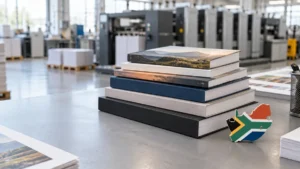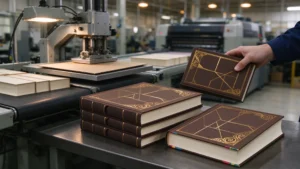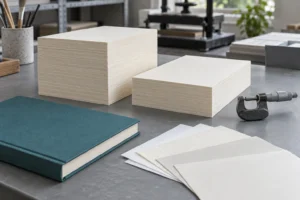
Paperback book printing specifications look simple, but a quote built from “A5, 200 pages, softcover” is not complete enough for dependable pricing or production. Two books with the same trim size and page count can differ substantially in weight, opacity, spine thickness, color accuracy, opening behavior, durability, packing volume, and landed cost.
This guide explains every paperback book printing specification a publisher, author, brand, or procurement team should confirm. It also provides a quote-ready checklist and worked specification examples so you can compare printers on the same basis instead of comparing incomplete estimates.

Table of Contents
- Paperback specifications at a glance
- 1. Finished trim size
- 2. Page count and extent
- 3. Interior paper
- 4. Interior printing and color
- 5. Cover construction and finish
- 6. Binding and opening behavior
- 7. Spine width
- 8. Print-ready artwork
- 9. Proofing and color approval
- 10. Quality-control tolerances
- 11. Packing, shipping and landed cost
- Three quote-ready examples
- Paperback quote checklist
- Frequently asked questions
Paperback Book Printing Specifications at a Glance
| Specification | What to state | Why it changes the result |
|---|---|---|
| Finished size | Width × height after trimming, in mm or inches | Affects imposition, paper yield, readability, postage and shelf fit |
| Page count | Total numbered and unnumbered interior pages; cover excluded | Determines paper consumption, spine width, binding feasibility and weight |
| Interior paper | Grade, coating, color, weight and ideally bulk/caliper | Controls opacity, feel, image reproduction, spine and freight |
| Interior print | Black, spot color or CMYK; one-sided or both sides | Drives press setup, color control and unit cost |
| Cover | Stock, print, lamination/coating and special finish | Affects protection, appearance, scoring and cracking resistance |
| Binding | EVA or PUR perfect binding, sewn paperback, or another method | Changes durability, opening, minimum spine and production cost |
| Quantity | One or more exact print-run quantities | Determines digital versus offset economics and unit price |
| Files and proof | PDF standard, bleed, color profile and required proof type | Prevents avoidable prepress corrections and approval disputes |
| Packing and delivery | Carton limits, wrapping, palletization, destination and Incoterm | Turns an ex-factory print price into a usable landed-cost comparison |
1. Paperback Book Printing Specifications for Trim Size
Trim size is the final width and height of one closed book after the three open edges are cut. State it as width × height and use one measurement system consistently. “A5” may be clear in many markets, but “148 × 210 mm” removes ambiguity. A custom format can create a distinctive object, yet it may reduce paper yield, complicate cartons, and raise freight cost.
Common paperback formats include 5 × 8 in, 5.5 × 8.5 in, 6 × 9 in, 148 × 210 mm, and 170 × 240 mm. These are conventions, not universal rules. ISO 216 defines A- and B-series trimmed paper sizes for many commercial uses, but the standard itself notes that it does not necessarily apply to published books. That is why publishers should specify the exact finished dimension rather than relying only on a size name. See ISO 216.
2. Page Count in Paperback Book Printing Specifications
In commercial book printing, one leaf has two pages: a front and a back. The cover is usually quoted separately and should not be added to the interior page count. Blank pages, half-title pages, copyright pages, inserts and end matter still count if they are part of the bound interior.
Offset sections are commonly imposed in signatures, so the production-friendly extent depends on trim size, press sheet, paper and binding plan. Do not add blank pages merely to reach a multiple of four until the printer has checked the imposition. A printer may combine signatures efficiently or recommend a small adjustment.
Page count affects more than price
- Spine width: more leaves create a thicker book block.
- Paper choice: a bulky stock can make a short book feel substantial; a thin opaque stock can control a long book’s weight.
- Binding: very thin books may not provide enough spine area for standard perfect binding or readable spine text.
- Freight: a small weight increase per copy becomes significant across a large run.
3. Interior Paper in Paperback Book Printing Specifications
Paper weight in gsm tells you mass per square meter; it does not fully describe thickness, opacity, stiffness, shade, surface or print behavior. Two 80 gsm papers can produce different spine widths and show-through. For repeat editions, record the actual mill and grade when possible, or approve an equivalent standard before substitution.
| Book content | Practical starting range | Paper characteristics to prioritize |
|---|---|---|
| Novel, memoir, poetry | 70–90 gsm uncoated white or cream | Opacity, comfortable shade, low glare, sufficient bulk |
| Workbook or manual | 80–120 gsm uncoated | Writability, stiffness, show-through control |
| Illustrated nonfiction | 100–150 gsm matte or silk coated | Image detail, opacity, smoothness, controlled glare |
| Full-color art or photography paperback | 128–170 gsm coated | Color gamut, ink holdout, fold and binding performance |
| Eco-positioned edition | Recycled or FSC-certified options | Verified sourcing claim, shade consistency, availability |
Heavier is not automatically better. A 170 gsm interior can make a 240-page book bulky, resistant to opening and expensive to ship. For environmental claims, confirm both the paper claim and the printer’s eligibility to pass that claim through the supply chain. FSC explains that chain-of-custody certification checks certified materials at each processing stage. Read FSC’s chain-of-custody guidance.
For product-specific advice, compare Prikoro’s paper types and softcover book printing options.
4. Define Interior Printing and Color Expectations
State whether the interior is 1/1 black, 2/2 with black plus a spot color, or 4/4 CMYK. A manuscript that contains only black text does not need full-color printing. Conversely, screenshots, illustrations and photographs should be assessed in their intended print space rather than assumed to match a luminous monitor.
Rich black versus text black
Use 100% K for small body text unless your printer supplies another rule. Multi-ink rich black may suit large solid areas, but it can create registration halos on fine text. Ask for the printer’s maximum total area coverage and preferred rich-black recipe before building heavy backgrounds.
Image resolution
A practical target for continuous-tone images is 300 ppi at final placed size. Line art often needs higher effective resolution. Upsampling a small web image does not restore missing detail; assess the effective resolution after cropping and scaling.

5. Build a Complete Paperback Cover Specification
A paperback cover is normally supplied as one spread: back cover + spine + front cover, with bleed around the outside. A strong specification includes the cover stock, printing, lamination or coating, scoring, and any special finishing.
| Cover choice | Best used when | Watch-outs |
|---|---|---|
| 250–300 gsm coated cover | General retail paperback and catalog-style books | Confirm grain direction, scoring and compatibility with adhesive |
| Matte lamination | Premium, subdued appearance; general scuff protection | Dark solids can show rubbing or fingerprints depending on film |
| Gloss lamination | High color saturation and easy-clean surface | Reflections may reduce readability under strong light |
| Soft-touch film | Gift, design and premium editions | Higher cost; request a physical sample and scuff test |
| Spot UV, foil, embossing | Selective shelf impact and tactile hierarchy | Requires separate artwork, registration tolerance and approved sample |
Ask how film and adhesive are tested together. The cover should be scored at the spine and hinge positions to support a clean fold and reduce cracking. Dark wraparound graphics also need careful spine alignment; avoid designs that depend on sub-millimeter registration across folds.
6. Select the Binding by Use, Not Appearance Alone
Perfect binding is the standard choice for many paperbacks. Folded or loose sections are gathered, the spine edge is prepared, adhesive is applied, and the cover is wrapped around the book block. EVA adhesive is economical and widely used. PUR adhesive generally provides stronger adhesion and better flexibility for demanding stocks and ink coverage, but the correct choice depends on paper, coating, grain, page count and use.
Sewn paperback binding adds thread-sewn signatures before the cover is attached. It is useful for books that must withstand frequent handling or that use heavier sections, though it costs more and still does not behave like a true lay-flat binding. For workbooks or manuals that must stay open hands-free, consider Wire-O binding rather than forcing a perfect-bound solution.
7. Calculate Spine Width Only After Paper Is Confirmed
A planning formula is:
Spine width ≈ (page count ÷ 2) × paper caliper per leaf
This is an estimate, not a production template. Compression, grain direction, adhesive, folding and manufacturing tolerances affect the finished spine. The safest workflow is to lock the final page count and chosen paper, then obtain the printer’s cover template. Keep spine text comfortably away from both fold lines; very thin spines may need no text at all.
8. File Requirements for Paperback Book Printing Specifications
Send separate interior and cover PDFs unless your printer requests another workflow. Interior pages should be single pages in reading order—not printer spreads. The production team handles imposition for the press and binding method.
- Document page size matches the final trim size.
- Bleeding artwork extends to the printer’s required bleed, commonly 3 mm or 0.125 in.
- Critical text and page numbers sit inside the agreed safe margin.
- Fonts are embedded or correctly outlined where appropriate.
- Images have sufficient effective resolution.
- Colors and profiles follow the printer’s supplied workflow.
- Overprint, transparency and spot colors have been preflighted.
- The final page count matches the cover template and purchase specification.
Adobe explains that bleed lies outside the page edge and is removed when the job is trimmed; its InDesign guidance also recommends exporting with the document bleed settings required by the print provider. See Adobe’s printer marks and bleeds guidance. PDF/X is the ISO 15930 family for exchanging files for commercial print, but the correct PDF/X variant and output intent must match the printer’s RIP and color workflow. Adobe’s PDF Print Engine FAQ identifies PDF/X as the international standard for constructing commercial-print PDF files.
9. Choose a Proof That Answers the Right Question
| Proof | What it can verify | What it cannot fully verify |
|---|---|---|
| Screen PDF | Page order, text, placement, links and basic preflight corrections | Paper feel, binding, exact press color |
| Contract color proof | Color target under specified viewing conditions | Final stock texture and binding construction |
| Digital hard-copy dummy | Size, pagination, general handling and approximate appearance | Exact offset color or production-stock behavior unless specifically matched |
| Blank paper dummy | Thickness, weight, opening and physical proportions | Printed color and image quality |
| Production sample | Closest representation of final materials and processes | May add cost and lead time; later changes require reapproval |
For a color-critical art paperback, a screen proof alone is not enough. For a black-text novel, a carefully checked PDF plus a paper dummy may answer the important questions more efficiently. Write the proof type and approval responsibility into the order.
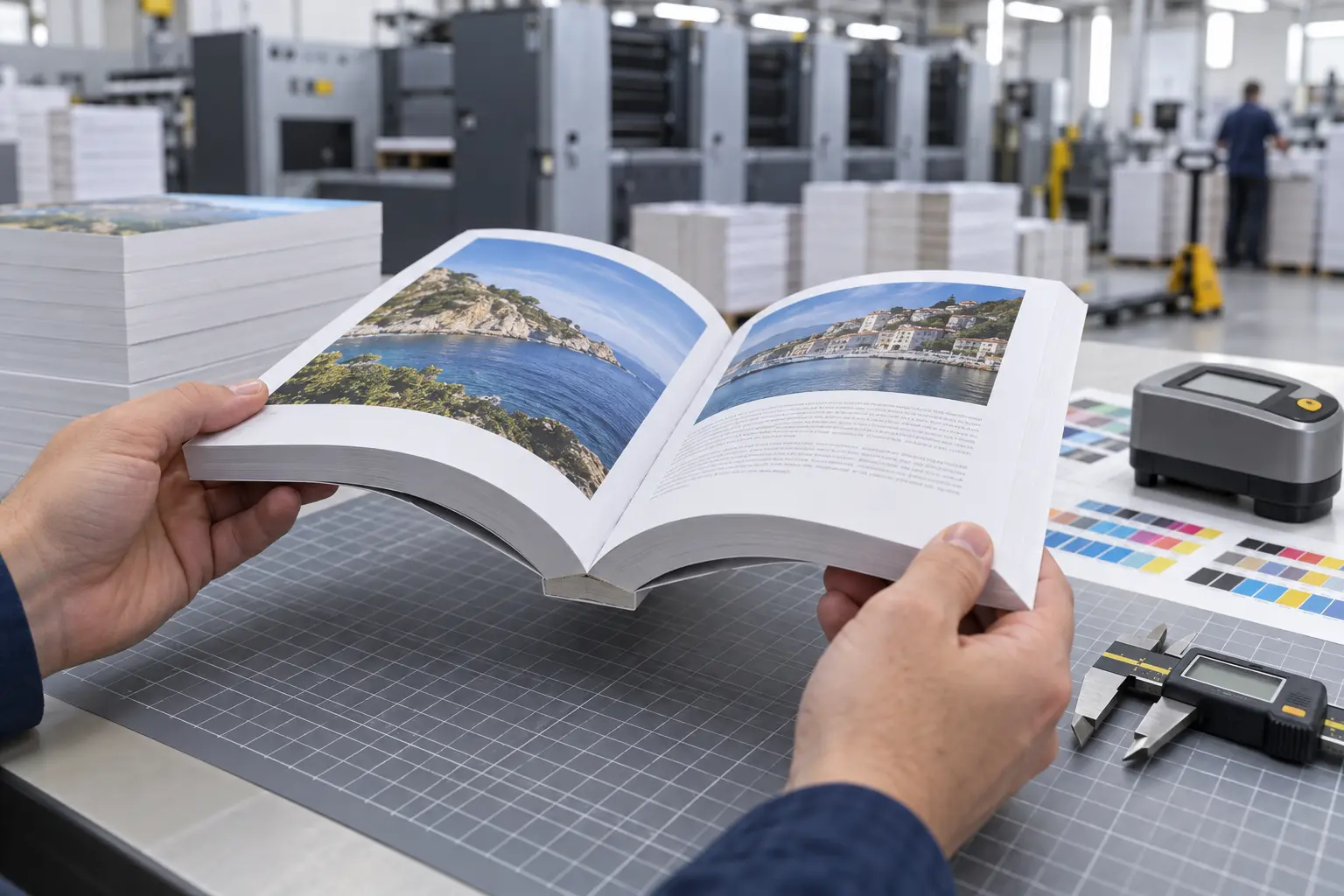
10. Quality Control for Paperback Book Printing Specifications
“High quality” is not an inspection standard. Define what will be checked and how a nonconforming result will be handled. Useful controls include:
- Correct pagination, version and quantity
- Trim size, squareness and consistent margins
- Spine alignment and cover-to-book-block registration
- Adhesive coverage, page-pull performance and opening behavior
- Color consistency against the approved target
- Lamination adhesion, scuffing, cracking and finish registration
- Carton count, carton strength, moisture protection and shipping marks
11. Include Packing and Delivery in the Commercial Specification
A low unit print price can become an expensive landed cost if book weight, cartons, pallets, customs or last-mile delivery are ignored. Request the estimated net and gross weight, books per carton, carton dimensions, pallet plan where relevant, production lead time, shipping method, Incoterm and destination postcode.
Set a maximum carton weight if warehouse staff or parcel carriers have limits. For humid or long ocean routes, discuss moisture-resistant inner wrapping and pallet protection. Use Prikoro’s custom book printing order guide to map quotation, file review, proof approval, production and delivery.
Three Quote-Ready Paperback Specification Examples
The following are illustrative procurement scenarios, not claims about completed client projects.
| Project | Illustrative specification | Decision logic |
|---|---|---|
| Trade novel | 5.5 × 8.5 in; 288 pages; 80 gsm cream uncoated; 1/1 black; 250 gsm cover, 4/0 CMYK + matte lamination; PUR perfect bound; 2,000 copies | Cream uncoated stock supports long-form reading; controlled bulk keeps the book substantial without excessive freight weight |
| Training workbook | 210 × 297 mm; 128 pages; 100 gsm white uncoated; 2/2 black + spot color; 300 gsm cover + matte lamination; PUR perfect bound; 1,500 copies | Writable paper and stronger cover suit repeated classroom use; margins allow annotation |
| Illustrated brand book | 210 × 250 mm; 160 pages; 128 gsm matte coated; 4/4 CMYK; 300 gsm cover + soft-touch film + spot UV; sewn paperback; 3,000 copies | Coated paper supports imagery; sewing and premium finish reinforce durability and presentation value |
Copy-and-Send Paperback Printing Quote Checklist
- Book title / project reference:
- Finished size (W × H):
- Interior page count:
- Interior paper grade, color and gsm:
- Interior printing (for example, 1/1 black or 4/4 CMYK):
- Cover stock and printing:
- Lamination/coating and special finishes:
- Binding and preferred adhesive:
- Quantity options to quote:
- Proof required:
- Packing or maximum carton-weight requirement:
- Delivery city, postcode and country:
- Required delivery date:
- Requested Incoterm:
- Environmental or certification requirement:
When every supplier quotes this same specification, cost, timing and quality comparisons become meaningful. If a specification is still open, ask each printer to show the assumption separately instead of hiding it inside one total.
Frequently Asked Questions
What is the best paper weight for a paperback book?
There is no universal best weight. Text-led novels often use 70–90 gsm uncoated paper; workbooks commonly use 80–120 gsm writable stock; illustrated books may use 100–170 gsm coated paper. Opacity, bulk, shade, surface, page count and freight matter as much as gsm.
How thick should a paperback cover be?
A common starting range is 250–300 gsm coated cover stock with lamination, but stiffness and folding performance vary by grade. Confirm the actual stock, grain direction, scoring and finish with the printer.
Does a paperback page count include the cover?
Normally, no. State the interior page count separately and specify the cover as a four-page cover component. Blank interior pages still count.
Should paperback files be sent as spreads?
Usually the interior should be exported as single pages in reading order. The printer imposes those pages for the press and binding workflow. The cover is typically supplied as one spread using the printer’s confirmed spine template.
What bleed should I use for a paperback book?
Many printers request 3 mm or 0.125 in, but use the requirement in your printer’s template. Extend backgrounds and images through the bleed while keeping essential text inside the safe area.
Is PUR binding always better than EVA?
No. PUR can provide strong adhesion and flexibility, especially for coated or demanding stocks, while EVA remains suitable and economical for many conventional paperbacks. The best adhesive depends on stock, ink coverage, spine preparation, use and production conditions.
When should I use offset instead of digital printing?
Digital printing is often efficient for short runs and rapid proofs. Offset printing becomes attractive as quantity rises or when the project needs stable color, special stocks or complex finishing. Compare total project cost at the exact quantities you may order.
What information most often causes paperback quote changes?
Unconfirmed page count, a vague paper description, missing delivery location, special finishes added late, and a cover designed before spine confirmation are common causes. Lock these variables before comparing final quotations.
Final Recommendation
The best paperback specification is not the one with the heaviest paper or the most finishes. It is the one that connects content, reader behavior, manufacturing limits, distribution and budget. Start with the final size, page count and use case; test paper and binding together; approve the right proof; and compare landed quotations built from identical assumptions.
For a project-specific specification review, visit Prikoro’s softcover book printing service or contact the production team with your size, page count, paper, quantity and delivery destination.