What Offset Printing Means for Self-Published Authors
Offset printing transfers ink from a plate to a rubber blanket and then to paper. Each ink color requires a prepared plate and press setup. Those fixed setup costs make very short runs expensive; however, once the press is running, the cost per copy can fall sharply as quantity rises. This economics—not a universal copy-count rule—is why established independent authors use offset for planned launches, wholesale orders, crowdfunding rewards, special editions, and backlist titles with predictable demand.
Offset is a manufacturing commitment. All copies share the same files and specification, so the method rewards disciplined prepress and punishes late revisions. Before ordering, an author should have a final manuscript, validated sales plan, confirmed rights, production budget, and a place to receive inventory.
Offset vs. Digital Printing vs. Print-on-Demand
Print-on-demand is a fulfillment model; it commonly uses digital production. A local digital batch and a POD order may use related technology but have different service, logistics, and commercial terms. Therefore, authors should compare the complete workflow rather than treating the three labels as interchangeable.
| Decision factor | Offset printing | Short-run digital | Print-on-demand |
|---|---|---|---|
| Best fit | Forecastable medium/large runs | Samples and short batches | Titles with uncertain or long-tail demand |
| Upfront cash | Higher | Moderate | Lowest inventory commitment |
| Unit cost at scale | Often strongest | Usually flattens sooner | Usually highest per copy |
| Customization | Broad paper, ink, binding and finishing range | Press-dependent | Platform-limited |
| Color control | Strong with calibrated workflow and proofs | Good, device-dependent | Less direct production control |
| Inventory risk | Author carries it | Smaller exposure | Minimal |
| Fulfillment | Must be arranged | Must be arranged | Often integrated |
How to Calculate the Offset Printing Break-Even Point
There is no honest universal answer such as “offset is cheaper at 500 copies.” Trim size, page count, colors, paper, binding, printer, destination and freight can move the crossover substantially. Request comparable quotations and calculate the economics from the same specification.
Contribution per copy = net receipts − effective cost per sold copy − fulfillment − selling fees
For example, printing 2,000 copies is not economical if only 700 are likely to sell before a cover, price, or edition change. Conversely, a higher landed investment can be rational when 1,500 preorders and wholesale commitments already exist. Model conservative, expected and strong sales cases.
| Scenario input | Conservative | Expected | Strong |
|---|---|---|---|
| Copies manufactured | 2,000 | 2,000 | 2,000 |
| Expected copies sold | 900 | 1,500 | 1,900 |
| Unsold/waste exposure | High | Moderate | Low |
| Decision | Reduce run or use digital | Compare cash flow and storage | Offset likely deserves serious evaluation |
This scenario is illustrative, not a Prikoro quotation or claimed client result.
Where Offset Book Printing Adds Real Value
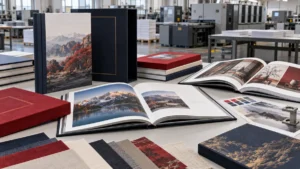
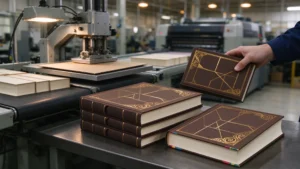
Offset does more than lower unit cost. It opens a larger manufacturing palette: custom-size signatures, multiple uncoated and coated stocks, spot colors, metallic ink, flood colors, foil, embossing, edge treatments, sewn sections, cloth cases, ribbons, slipcases and coordinated packaging. That makes it particularly useful for photography books, illustrated children’s books, premium fiction, Bibles, cookbooks and collector editions.
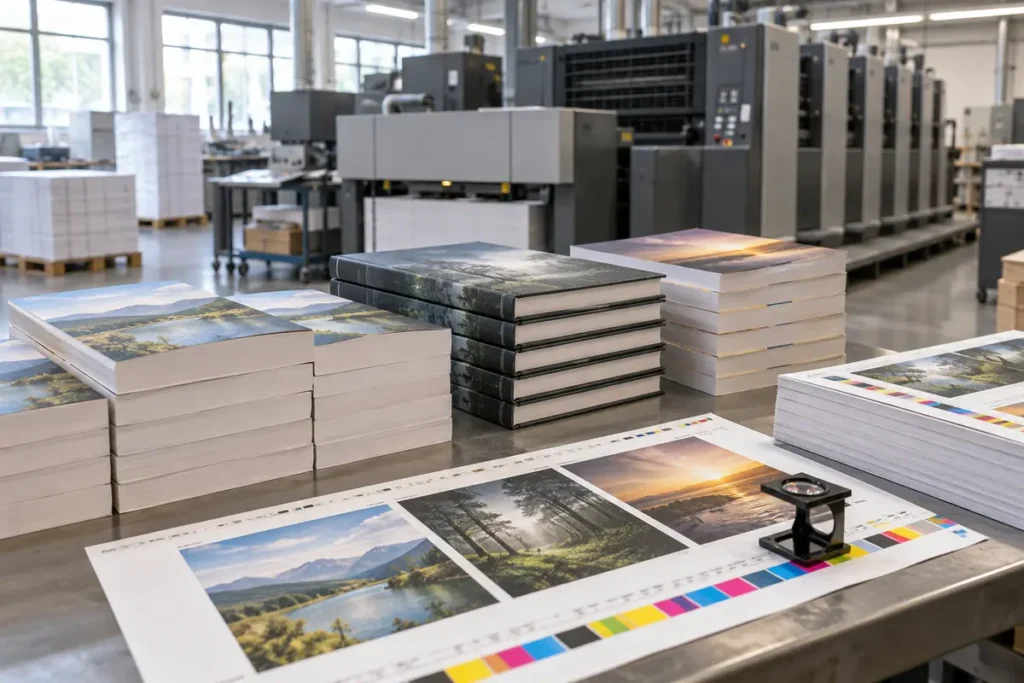
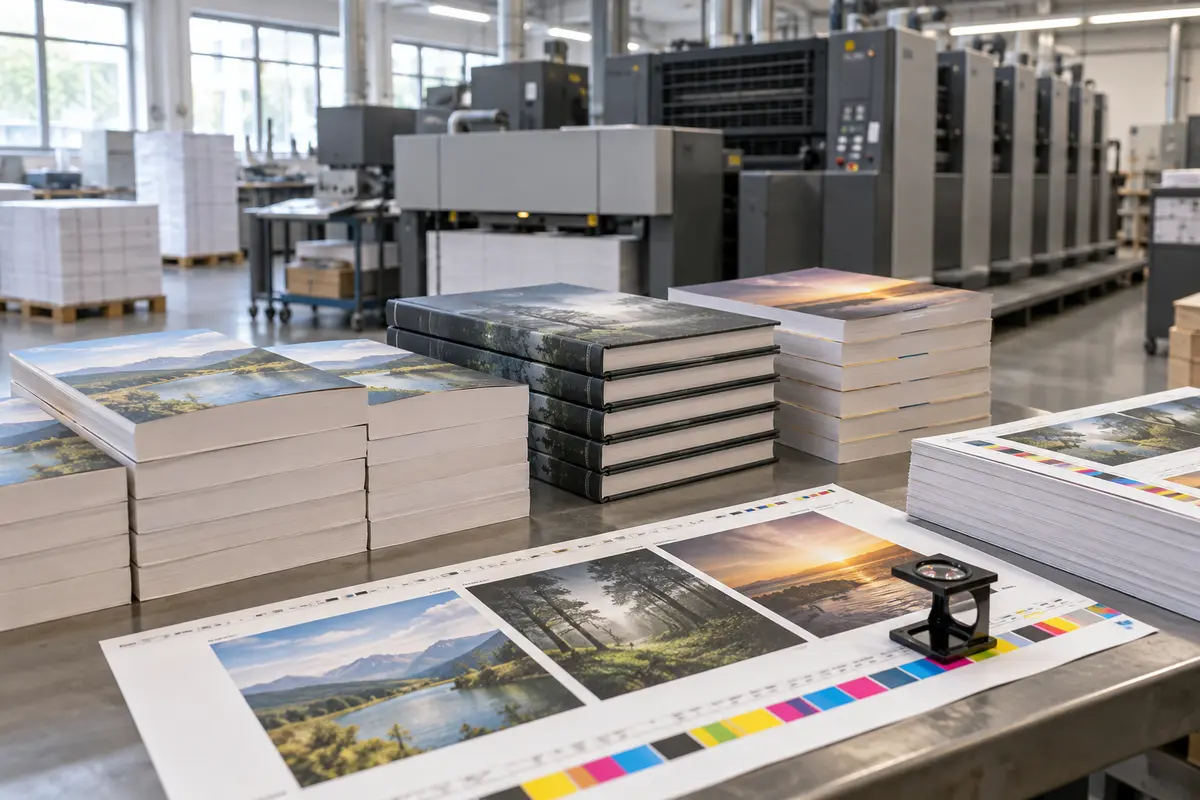
For color-critical books, a defined print condition, ICC workflow and measurable proof are more reliable than judging an uncalibrated screen. ISO 12647-2 covers process control parameters for offset lithographic production, while the PDF/X family in ISO 15930 supports dependable exchange of print-ready files. The printer must still specify the exact PDF standard, profile and proof condition it accepts.
What Determines an Offset Book Printing Quote?
| Cost driver | Why it changes cost | Author decision |
|---|---|---|
| Quantity | Spreads fixed setup across more copies | Quote realistic tiers, not vanity volume |
| Trim size | Affects sheet yield and freight efficiency | Ask for press-efficient alternatives |
| Page count | Changes paper, plates, signatures and binding | Finalize pagination before quoting |
| Interior colors | Changes plates, passes and inspection | Separate black-only, spot and CMYK needs |
| Paper | Impacts purchase price, bulk and weight | Approve named stock or equivalent |
| Binding | Perfect bound, sewn, hardcover and special structures differ | Choose for use life, not appearance alone |
| Finishing | Each foil, UV, emboss or edge process adds setup | Prioritize finishes that support positioning |
| Packing/freight | Cartons, pallets, route and destination affect landed cost | Request EXW/FOB/DDP assumptions clearly |
Explore Prikoro’s perfect-bound book printing and custom hardcover book printing options when defining the specification.
Print-Ready Files for Offset Book Printing
Submit separate interior and cover PDFs unless instructed otherwise. Confirm final trim, bleed, safe margins, embedded fonts, image resolution, color space, overprint, transparency handling, rich-black rules, spine width and barcode placement. Do not build a hardcover spine from an early page count: paper caliper, endpapers and binding construction determine the final template.
- Use the printer’s requested PDF/X preset and output profile.
- Export pages, not reader spreads, unless a special foldout requires otherwise.
- Extend backgrounds through the specified bleed.
- Keep live text and critical elements inside safe margins.
- Use 100% K for small black text unless the printer specifies differently.
- Check image licenses, fonts, ISBN data and regional rights before upload.
Offset Printing Proofs: What Each One Can Prove
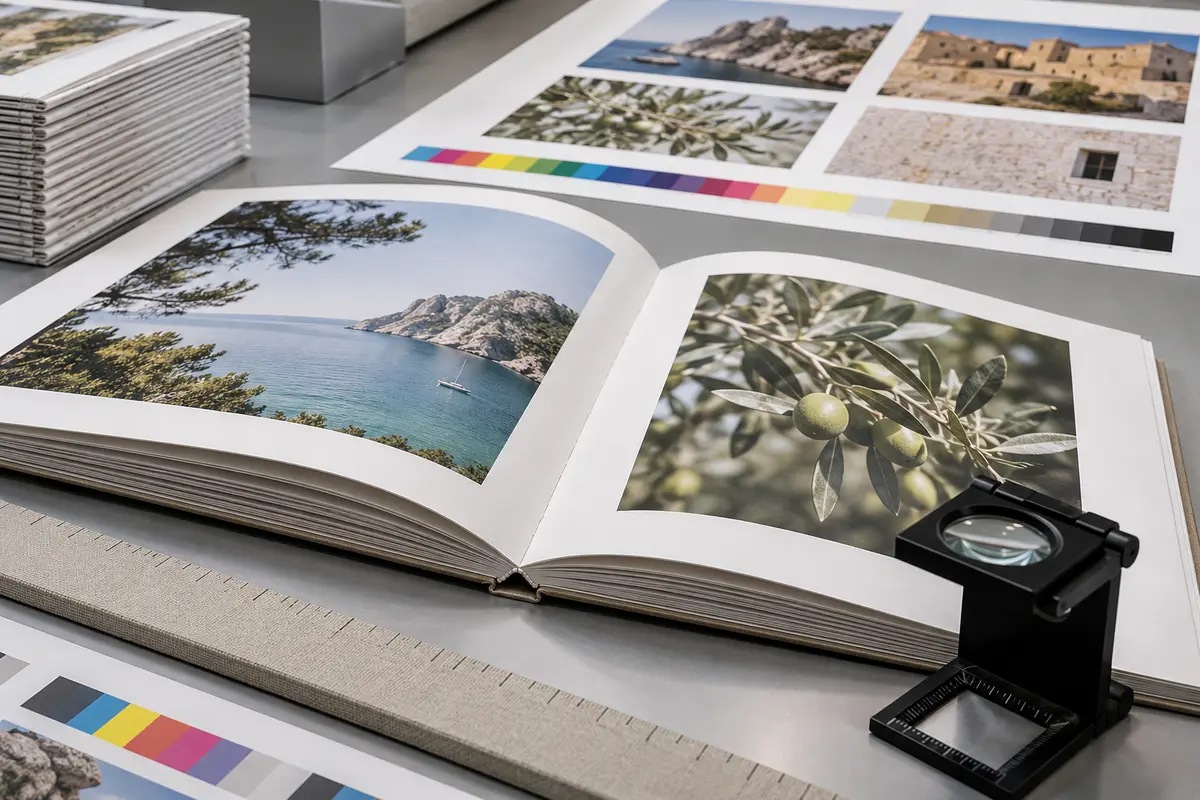
| Proof | Useful for | Cannot fully prove |
|---|---|---|
| PDF soft proof | Content, trim, bleed, pagination, obvious preflight issues | Paper feel or exact output color |
| Digital hard proof | Layout, approximate appearance, binding dummy | Exact offset screening and ink-on-stock result |
| Contract color proof | Predicting color under a defined print condition | Binding, tactile finish or every special ink |
| Wet/press proof | Production ink on intended paper | Low-cost rapid revision |
| Finished preproduction sample | Size, structure, cover, page turn and finishes | Perfect replication of all mass-run tolerances |
A Realistic Offset Book Production Timeline
- Specification and quote: confirm size, pages, materials, quantity, finishes and destination.
- Preflight: printer checks files and returns technical questions.
- Proof approval: author reviews content, color and physical sample as applicable.
- Materials and plates: paper is allocated; plates and tooling are prepared.
- Printing: signatures and covers are produced under defined controls.
- Binding and finishing: folding, gathering, sewing/gluing, casing, trimming and decoration.
- Quality control and packing: inspect count, registration, binding and carton protection.
- Freight and receiving: export documentation, transit, customs and final delivery.
Calendar time varies by specification and season. A responsible schedule includes approval time and freight contingency rather than quoting production days alone.
Inventory, Freight and Cash Flow
A low factory unit price can become expensive after storage, pick-and-pack, damaged stock and slow sell-through. Estimate cartons, gross weight, cubic volume, pallet needs and delivery access before ordering. Ocean freight can suit planned replenishment; air freight may be sensible for advance copies or a small launch allocation. Split shipping can balance speed and cost.
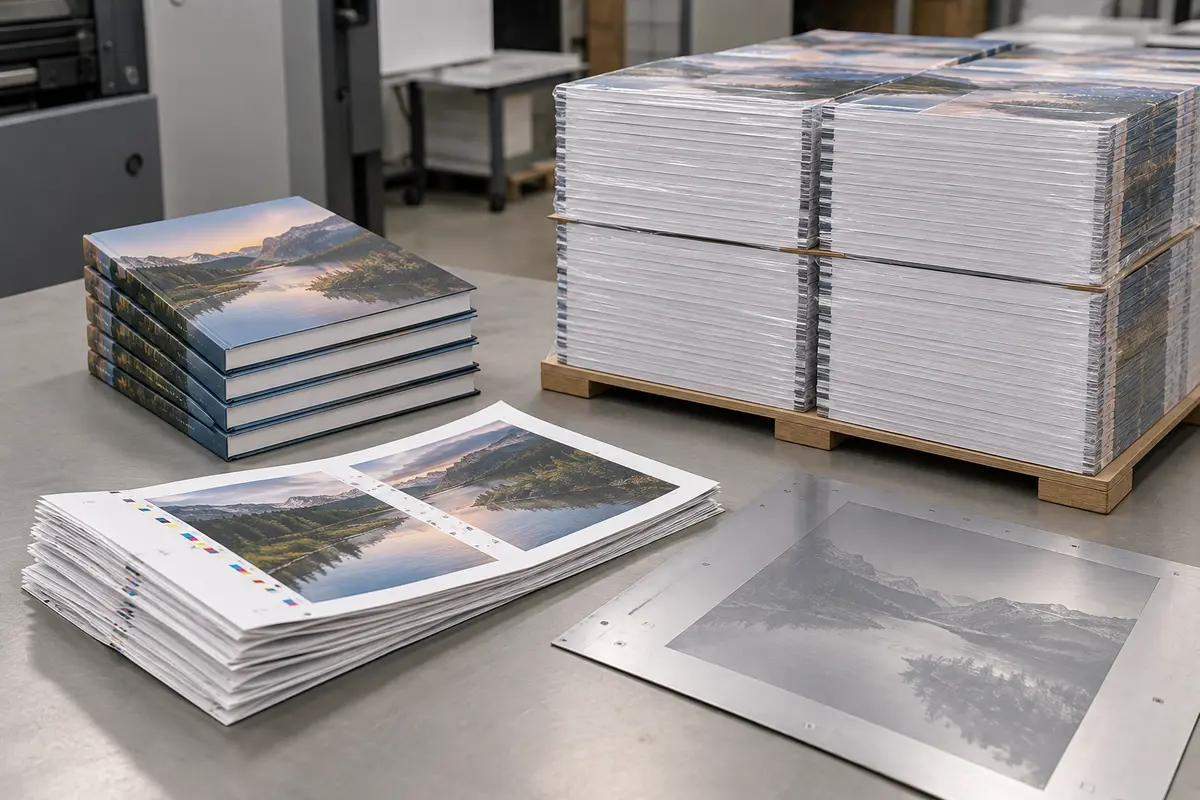
Illustrative Case: A 1,500-Copy Independent Art Book
Consider a hypothetical author with 800 preorders, two gallery partners and a 1,500-copy full-color hardcover. POD cannot deliver the chosen large format, sewn binding, cloth case and foil. The author compares 1,000, 1,500 and 2,000 offset copies using identical paper and freight assumptions. The 2,000-copy unit price is lowest, but the expected case shows that the extra 500 copies would remain in paid storage for a year. The 1,500-copy tier therefore protects cash while fulfilling committed sales and leaving stock for direct sales.
The team approves a contract color proof, a blank binding dummy and a finished sample. It sends a small portion by air for launch events and the balance by sea. This is a transparent planning example—not a claim about an actual Prikoro customer.
Seven Common Offset Printing Mistakes
- Ordering the largest quantity because its unit price looks best.
- Comparing quotes with different paper, packing, Incoterms or proof scopes.
- Finalizing cover artwork before the spine template is confirmed.
- Assuming a screen or office print predicts production color.
- Making editorial changes after plates or materials are released.
- Ignoring storage, fulfillment, customs and delivery access.
- Skipping a retained approved sample and written quality criteria.
Offset Printing Checklist for Self-Published Authors
- Final trim size, binding, page count and color specification
- Named interior, cover and endpaper stocks
- Quantities based on conservative sell-through
- Print-ready interior and cover PDFs
- Proof type and authorized approver
- Finish tolerances and reference samples
- Carton, pallet and labeling requirements
- Incoterm, destination, duties and delivery scope
- Warehouse and fulfillment plan
- Rights, ISBN, barcode and legal-page checks
For more production planning resources, browse the Prikoro book printing blog. For a specification review and comparable quantity tiers, use the Prikoro contact page.
Frequently Asked Questions
Is offset printing good for self-published books?
Yes, when demand is sufficiently predictable and the author needs scale, customization or controlled quality. It is less suitable when files or market positioning are still changing.
How many books make offset printing worthwhile?
There is no fixed threshold. Several hundred copies may justify a quote for some specifications, while others cross over much later. Compare landed cost and expected sell-through at multiple tiers.
Is offset quality always better than digital?
No. Modern digital printing can be excellent. Offset’s advantage is repeatable high-volume production and a wider material and finishing ecosystem; quality still depends on files, calibration, paper and process control.
Can offset print black-and-white novels?
Yes. One-color offset is widely suited to text books with proven demand. Paper bulk, opacity, grain direction and binding remain important.
Can I print only 100 offset books?
Technically possible in some workflows, but plate and setup costs commonly make digital production more economical. Special structures or material needs may change the answer.
What is a plate cost?
Each printing form and ink separation may require a plate. The number depends on page imposition, colors, sheet format and press configuration, so request a complete quotation rather than estimating plates independently.
Should I choose PDF/X-1a or PDF/X-4?
Use the format requested by the printer. PDF/X-4 supports modern transparency and color-managed workflows, while some production systems still request PDF/X-1a. Never assume.
What proof should an author approve?
At minimum, approve a content proof. Add a contract color proof for color-critical work and a physical or finished sample when materials, binding or special finishes drive value.
How long does offset book printing take?
Timing depends on paper availability, proof cycles, binding and finishes. Ask for separate prepress, production and freight milestones with approval deadlines.
How can I reduce offset printing risk?
Validate demand, freeze files, compare identical specifications, approve appropriate proofs, define tolerances, plan logistics and retain a signed production reference.
Final Recommendation
Offset printing is not simply a cheaper way to manufacture more books. For a self-published author, it is a strategic choice that trades higher planning and inventory commitment for stronger scale economics, customization and control. Validate the market first, calculate effective cost per sold copy, then approve the paper, proof and binding as one production system.