How to Bind a Book: What Commercial Binding Actually Means
Learning how to bind a book for commercial production is different from learning a craft project at home. A printer is not simply attaching loose pages to a cover. The factory must transform printed sheets into a book block that opens correctly, keeps every page in order, survives repeated handling, and matches the approved dimensions.
The binding decision begins before printing. In practice, page imposition, signature size, grain direction, paper bulk, spine width, cover template, adhesive, sewing pattern, and finishing sequence affect one another. Therefore, changing the paper or page count after cover approval can change the spine and invalidate the cover artwork.
How to Bind a Book Commercially, Step by Step
1. Confirm the binding specification
First, the printer confirms trim size, page count, paper, binding style, cover construction, quantity, reading direction, special finishes, packing, and delivery. These details determine the production route and equipment.
2. Impose pages and print press sheets
Prepress operators arrange individual PDF pages on larger sheets so that they appear in the correct order after folding and trimming. Printers call this arrangement imposition. As a result, press size, trim size, paper weight, grain direction, and folding limits determine the number of pages in a signature.
3. Fold, gather, and verify signatures
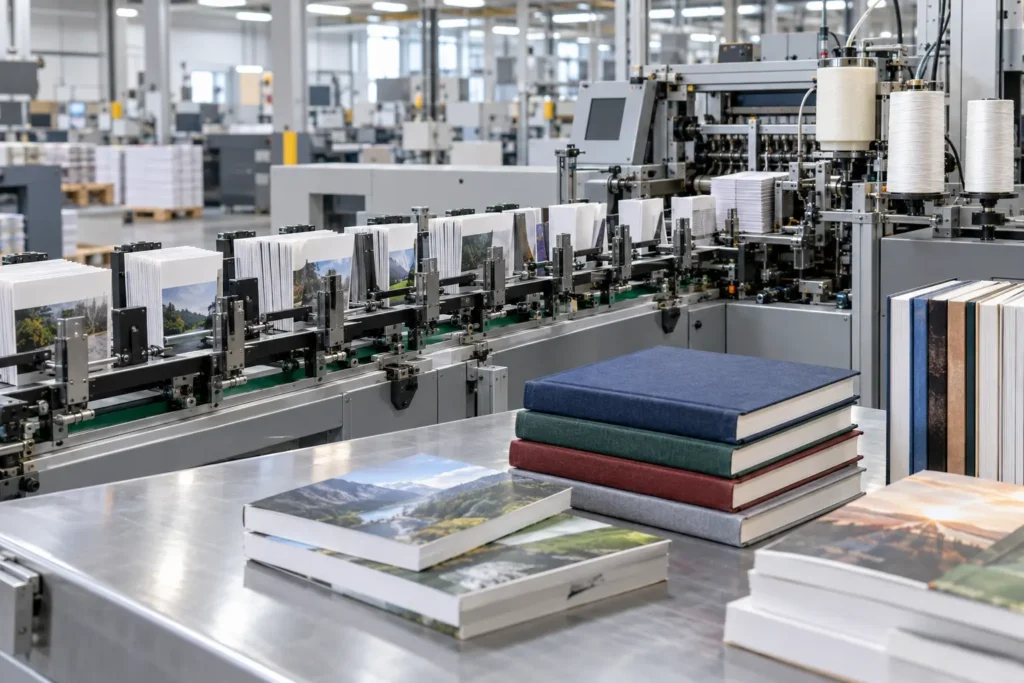
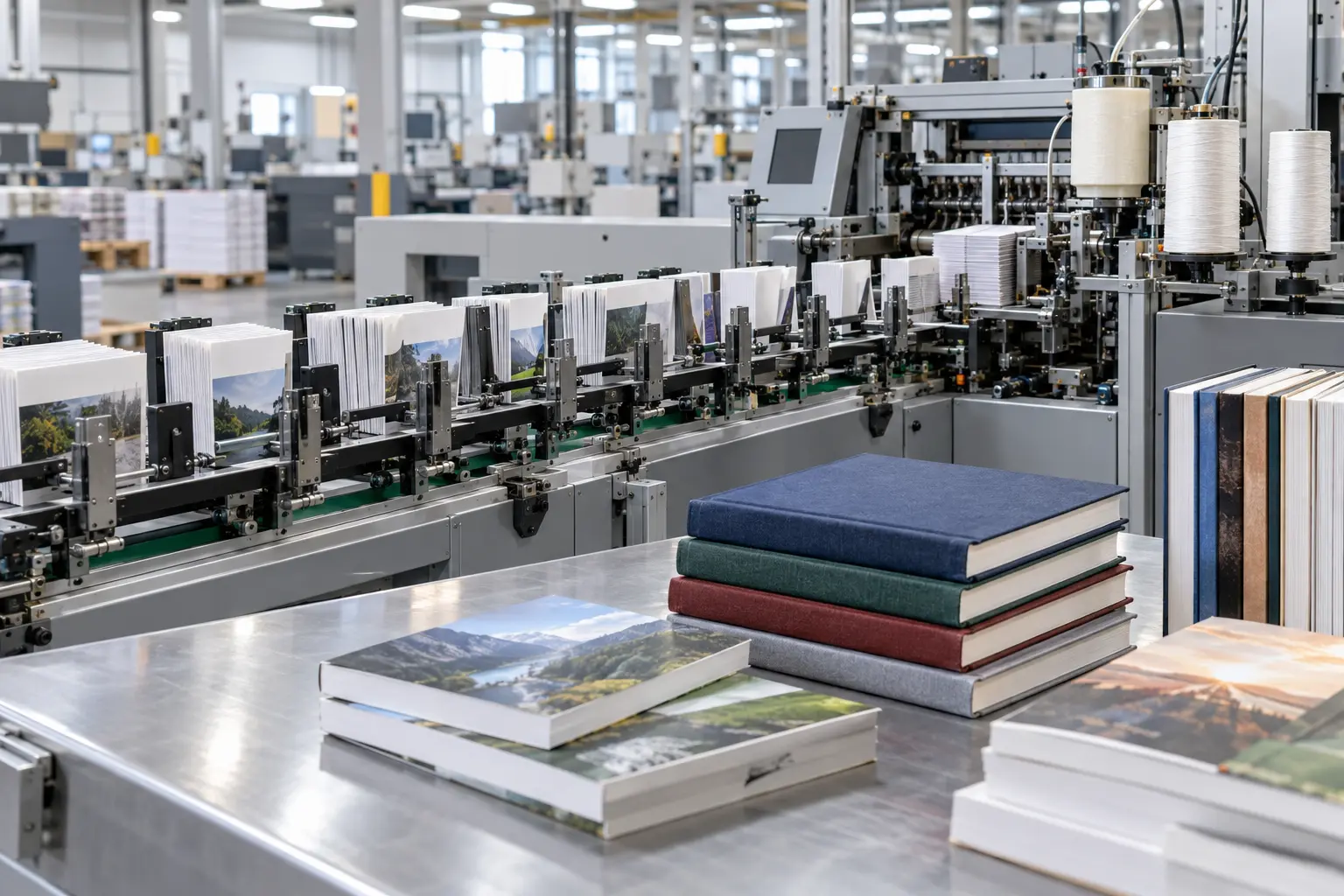
Folding equipment turns printed sheets into signatures, and gathering equipment places them in sequence. Next, optical or barcode controls can help detect missing, duplicated, or incorrectly ordered sections. Digitally printed books may instead use collated sheets or smaller signature groups.
4. Join the book block
Bindery equipment joins the book block with PUR or EVA adhesive, thread sewing, saddle wire, side wire, Wire-O, plastic coil, or another specified method. Moreover, some premium books combine sewing with adhesive reinforcement.
5. Attach the cover or case
Paperbacks receive a scored cover wrapped around the prepared spine. By contrast, hardcovers usually receive endpapers, lining material, boards, a spine piece, and a printed-paper, cloth, or leatherette case. Finally, the casing-in line joins the completed block to its case and presses the assembly.
6. Trim, form, finish, and cure
Three-knife trimming creates clean head, foot, and fore-edge dimensions. For rounded-spine hardcovers, dedicated equipment shapes and backs the spine before casing. Meanwhile, adhesives need appropriate setting or curing time before aggressive opening tests, packing, or transport.
7. Inspect and pack
Finally, quality control covers pagination, trim, spine alignment, adhesive penetration, sewing, hinge function, cover position, squareness, opening, surface damage, and carton protection. The final sample should be compared with the approved proof and manufacturing specification.
Book Binding Methods Compared
| Binding method | Best suited to | Opening behavior | Durability | Important limitation |
|---|---|---|---|---|
| Perfect binding | Novels, manuals, catalogs, paperbacks | Moderate; improves with suitable margins and paper | Good with correct preparation and adhesive | Very low page counts or very thick stocks may be unsuitable |
| PUR perfect binding | Coated papers, demanding paperbacks, mixed stocks | Moderate | Very good adhesive performance | Requires controlled application and curing |
| Smyth/section sewing | Premium hardcovers, art books, textbooks, Bibles | Good; signatures flex at folds | Excellent | Higher cost and signature-planning requirements |
| Case binding | Hardcover books and premium editions | Depends on book-block construction | High | “Hardcover” describes the cover system, not whether the block is sewn |
| Saddle stitching | Booklets, comics, programs, thin catalogs | Excellent at center spread | Good for appropriate page counts | Page count usually works in multiples of four; creep increases with thickness |
| Wire-O | Workbooks, journals, manuals, cookbooks | Lays flat and can fold back | Good for functional use | Exposed wire and punched margin affect design |
| Plastic spiral | Training manuals, notebooks, frequently handled guides | Lays flat and folds back | Flexible and practical | Less conventional bookstore appearance |
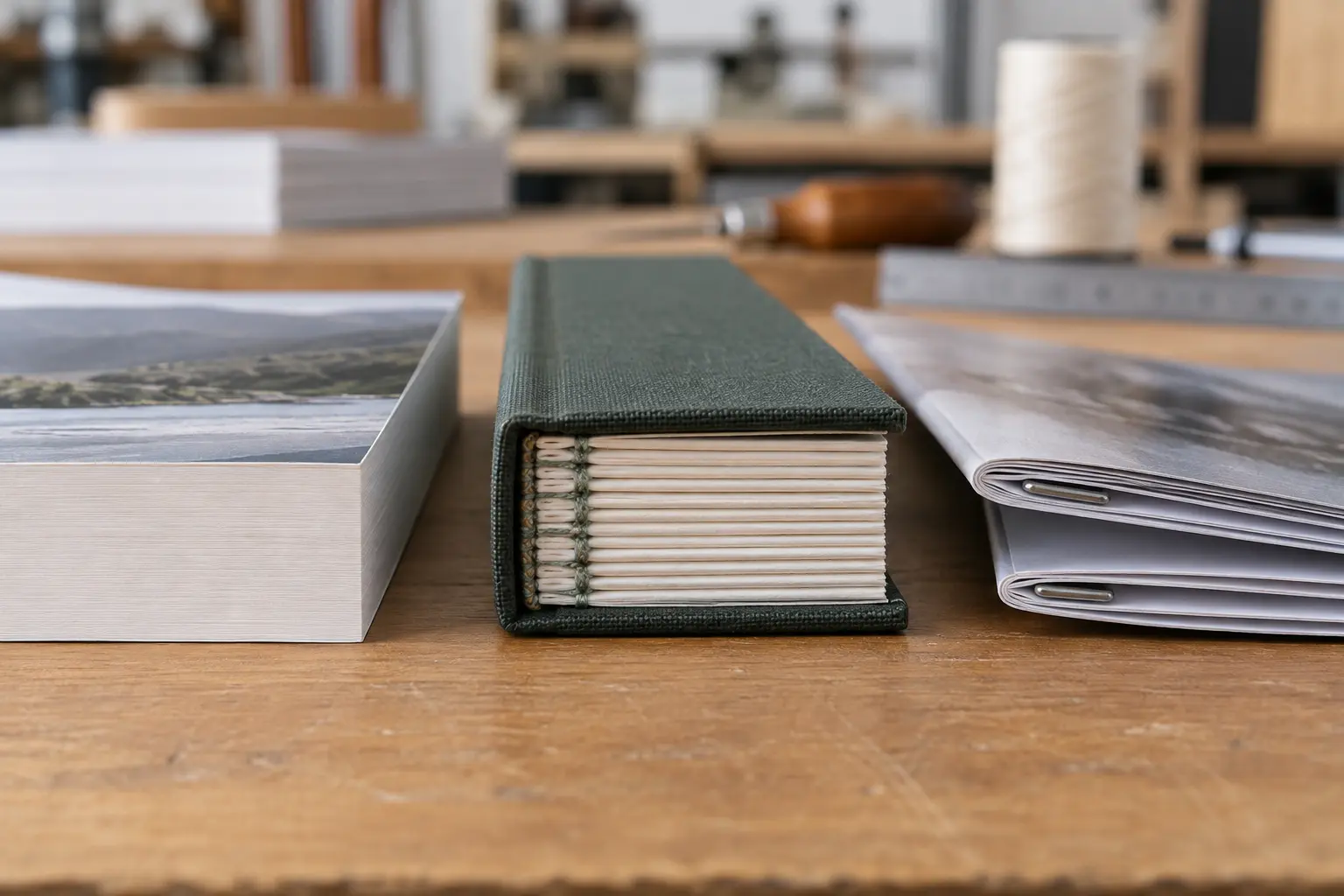
| Singer sewing | Zines, design-led booklets, short editions | Good | Good when specified correctly | Thread is a visible design feature and production is specialized |
How Perfect Binding Works
Perfect binding creates a square-spined softcover book. First, the binder clamps the gathered book block and mills or roughens the spine edge. Then, rollers or nozzles apply adhesive before the machine wraps a scored cover around the block. After the bond develops, a three-knife trimmer cuts the book on three sides.
EVA hot-melt adhesive is common and economical. PUR adhesive generally offers stronger bonding across a wider range of coated and difficult papers, and it can support improved flexibility with a thinner glue film. However, “PUR” alone does not guarantee quality. Spine preparation, glue temperature, application thickness, paper fibers, cure time, and machine control all matter.
How Section-Sewn Binding Works
In section sewing—often called Smyth sewing—a sewing machine stitches through the folds and connects the signatures into a complete book block. Afterward, the bindery may glue and line the sewn spine before adding a soft cover or hard case.
Sewing is valuable when the book must tolerate frequent reading, has a large page count, or needs better opening behavior. It is common in premium illustrated books, reference works, textbooks, religious books, and collectible editions. Yet the paper and signature plan must support folding: very heavy or crack-prone stock can limit the number of leaves per signature.
How Hardcover Case Binding Works
Case binding describes the attachment of a book block to a rigid cover made from boards and a covering material. The block may be sewn, adhesive bound, or produced with another construction. Endpapers connect the block to the case, while hinges allow the boards to open.
A factory may make a square-back or rounded-back case; add headbands, ribbon markers, foil, embossing, a dust jacket, or a slipcase; and use printed paper, cloth, or leatherette. For product-specific choices, compare Prikoro’s hardcover book printing options and the guide to hardcover dust jackets.
How Saddle Stitching Works
During saddle stitching, the line nests and folds the sheets, then drives wire staples through the fold. Consequently, the fast and economical method opens well and suits comics, brochures, programs, magazines, and booklets with modest page counts.
The main engineering issue is bulk. As nested sheets accumulate, inner pages extend farther than outer pages. Although trimming removes this “creep,” designers must allow for the shift in inner-page artwork. Therefore, a printer should calculate practical page-count limits from paper thickness and finished size rather than promising one universal maximum.
Wire-O, Spiral, and Other Functional Bindings
Wire-O and plastic spiral systems punch holes near the spine and insert a mechanical element. Because both structures can lie flat and fold back, they work well for recipes, instruction manuals, planners, workbooks, music books, and classroom materials.
Wire-O has a clean, regular appearance, while plastic coil is flexible and resists permanent deformation in many handling situations. Designers must reserve a safe punched margin and avoid small type, folios, or images near the holes. Covers can be self-cover, card, polypropylene, or concealed inside a wraparound hardcover construction.
How to Choose the Best Way to Bind Your Book
| If your priority is… | Strong starting option | Why | Confirm with the printer |
|---|---|---|---|
| Lowest cost for a substantial paperback | Perfect binding | Efficient square-spine production | Minimum spine, paper compatibility, EVA vs PUR |
| Long service life and premium feel | Sewn hardcover | Strong signatures plus rigid case | Signature plan, endpapers, board and hinge |
| Thin booklet that opens easily | Saddle stitching | Few operations and low material use | Maximum thickness, creep, multiples of four |
| Hands-free use on a desk | Wire-O or spiral | Lays flat and folds back | Punch margin, wire/coil diameter, cover design |
| Premium paperback with better opening | Sewn softcover or sewn-and-glued | Flexible signatures with paper cover | Cost, minimum run, spine and cover scoring |
| Design-led short publication | Singer sewing | Visible thread becomes part of the design | Thread color, stitch length, page count |
When deciding how to bind a book, choose from the finished object backward. Consider where readers will use it, how often they will open it, whether it must lie flat, how the distributor will ship it, and what shelf appearance the buyer expects. Then evaluate production constraints. Prikoro’s comparison of perfect binding vs. saddle stitching offers a focused decision guide.
Specifications to Send a Commercial Book Binder
- Finished trim size and reading direction
- Total page count, including blanks
- Interior paper name, weight, coating, opacity, and grain requirement
- Interior color: black, spot color, or CMYK
- Binding method and required opening behavior
- Cover paper, board thickness, wrap material, endpapers, and lamination
- Foil, embossing, debossing, spot UV, edge color, ribbon, jacket, or slipcase
- Quantity and any split shipment quantities
- Packaging, carton marks, barcode, and destination requirements
- Approved files, proof type, quality criteria, and required delivery date
If you are unsure about paper, use the book printing paper types guide. For a project-specific recommendation, send the specification through the Prikoro contact page; internal links open in a new tab so your checklist remains available.
How to Bind a Book Reliably: Quality Control Checklist
| Inspection point | What good production looks like | Typical defect |
|---|---|---|
| Pagination and gathering | All signatures present, sequenced, and correctly oriented | Missing, duplicated, or inverted section |
| Spine bond | Consistent adhesion appropriate to the paper and method | Loose leaves, brittle glue, weak pull strength |
| Sewing | Consistent thread tension without torn folds | Broken thread, skipped stitch, damaged signature |
| Trim and squareness | Clean edges and dimensions within agreed tolerance | Out-of-square block, rough edge, variable size |
| Cover position | Spine, hinge, front, and back artwork correctly aligned | Off-center spine or shifted cover |
| Opening | Pages turn smoothly; structure behaves as approved | Cracking, excessive gutter loss, detached endpaper |
| Surface and finishing | Clean laminate, foil, embossing, and case surfaces | Scuffing, bubbles, foil voids, registration shift |
| Packing | Correct count, moisture protection, suitable carton strength | Corner damage, rubbing, mixed versions |
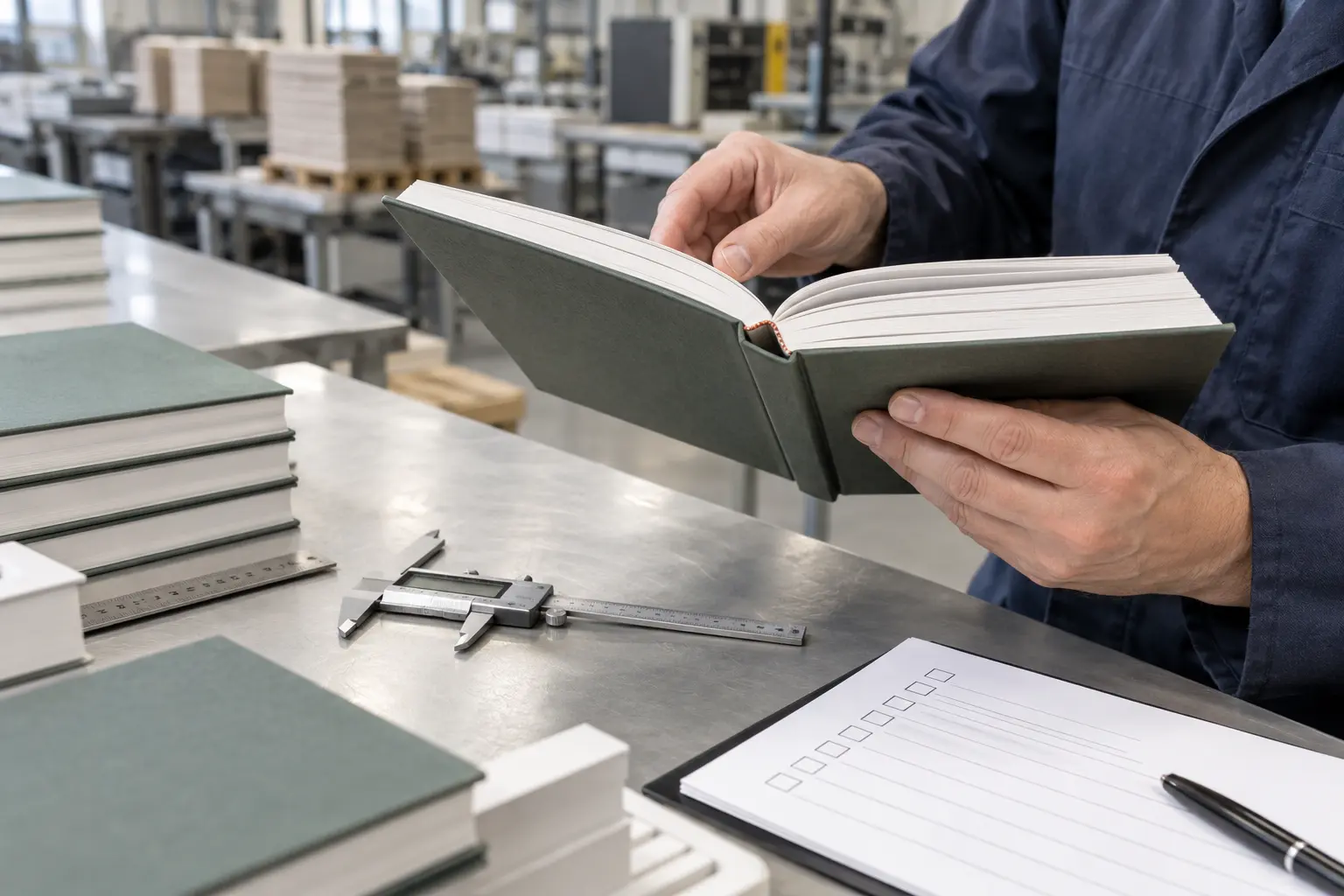
For durable or archival work, buyers should write measurable requirements instead of relying on labels such as “library quality.” Specifically, ISO 11800 addresses binding materials and methods used in book manufacture, while ISO 14416 addresses bindings for archive and library use. The intended service life and purchasing specification determine the relevant standard.
What Changes the Cost of Binding a Book?
Understanding how to bind a book also clarifies its cost. The main cost drivers are quantity, page count, signature plan, paper, trim size, adhesive or sewing method, cover construction, setup, manual operations, special finishes, proofing, quality criteria, and packing.
A sewn hardcover normally costs more than an adhesive-bound paperback because it adds folding and sewing, spine lining, board cutting, case making, endpapers, casing-in, pressing, and additional inspection. At larger quantities, more copies share the setup costs; however, extra materials and handling still matter.
Real-World Project Example: One Title, Two Binding Editions
A practical publishing project involved a 6 × 9 inch, approximately 217-page, black-text book planned in both paperback and hardcover editions for delivery to Mombasa. The content file could remain consistent, but the binding specifications could not.
The paperback route required a final spine calculated from the selected text stock and a scored paper cover. The hardcover route required boards, endpapers, a separate case template, hinge allowances, and a decision on whether the block would be adhesive bound or section sewn. Packing and freight also changed because hardcover copies are heavier and occupy more volume.
The lesson is transferable: “same book, different cover” is not a complete manufacturing instruction. When a title has two editions, approve separate cover templates, physical constructions, weights, packing plans, and unit costs. This prevents artwork shifts and unexpected shipping differences.
Frequently Asked Questions
What is the strongest commercial book binding?
A well-made section-sewn hardcover is among the strongest mainstream constructions, but strength still depends on paper, folds, sewing, lining, endpapers, case materials, and workmanship. A specification is more useful than the word “strongest.”
Is PUR binding better than perfect binding?
PUR is an adhesive used in perfect binding; it is not a separate book shape. PUR often performs well with coated stocks and demanding applications, while EVA can be efficient and adequate for suitable papers and uses.
Why must saddle-stitched page counts be multiples of four?
One folded sheet creates four pages: front and back on each half. Blank pages or foldouts can change planning, but the basic nested signature advances in four-page units.
Can a hardcover book be perfect bound?
Yes. “Hardcover” describes the rigid case, while the inner book block may be adhesive bound or sewn. Confirm the block construction instead of assuming every hardcover is sewn.
Which binding lays completely flat?
Wire-O and plastic spiral bindings are reliable choices for flat opening and fold-back use. Special lay-flat adhesive structures also exist, while sewn books generally open better than standard perfect-bound books but may not lie completely flat without assistance.
How thick must a book be for perfect binding?
There is no safe universal minimum because paper thickness, equipment, adhesive, trim size, and cover stock vary. Ask the printer to calculate the finished spine from the actual specification.
How do I prepare cover artwork?
Wait for the printer’s final template based on confirmed paper and page count. Build the front, spine, and back to that template, preserve bleed and safe areas, and keep critical elements away from scores, hinges, and wraps.
Final Recommendation
The best answer to how to bind a book is not a single method. Define the reader’s use, required lifespan, opening behavior, page count, paper, visual position, quantity, and budget. Then choose a construction that manufacturing can repeat consistently. A reliable printer should explain the tradeoffs, calculate the spine from real materials, provide an appropriate proof, and document acceptance criteria before production.
Sources and Further Reading
- International Organization for Standardization — ISO 11800, requirements for binding materials and methods used in book manufacture.
- International Organization for Standardization — ISO 14416, binding requirements for archive and library use.
- Estonian Centre for Standardisation — ISO 11800:1998 record.
- Royal Netherlands Standardization Institute — ISO 14416:2003 record.