Successful special edition books do more than add decoration: they create a coherent sequence of tactile and visual reveals that readers can understand in seconds. Start with a durable hardcover, then choose two or three coordinated features—such as foil plus embossing, illustrated endpapers, a ribbon marker, and printed or gilded edges. The best specification is not the one with the most finishes. It is the one that fits the story, survives manufacturing and shipping, photographs well, and leaves enough margin for the publisher.
Special Edition Books: Quick Production Answer
| Publishing objective | High-value features | Main production risk | Best proof |
|---|---|---|---|
| BookTok-friendly unboxing | Foil, tactile cover, sprayed edges, illustrated endpapers | Effects look impressive digitally but weak in normal light | Physical dummy plus short phone video |
| Collector durability | Sewn binding, strong case, quality hinges, protective packaging | Heavy decoration hides weak construction | Bound production sample and opening test |
| Series completion | Coordinated spines, panoramic edge artwork, numbered color system | Color and alignment drift between volumes | Master standards and side-by-side series proof |
| Premium retailer exclusive | Exclusive cover, tip-in, signed page, alternate foil | Edition is not clearly differentiated in metadata or packaging | Finished mock-up, barcode and carton check |
| Lower-risk first edition | Case foil, printed endpapers, ribbon marker | Too many processes increase cost, spoilage and lead time | Finish swatches and one complete prototype |
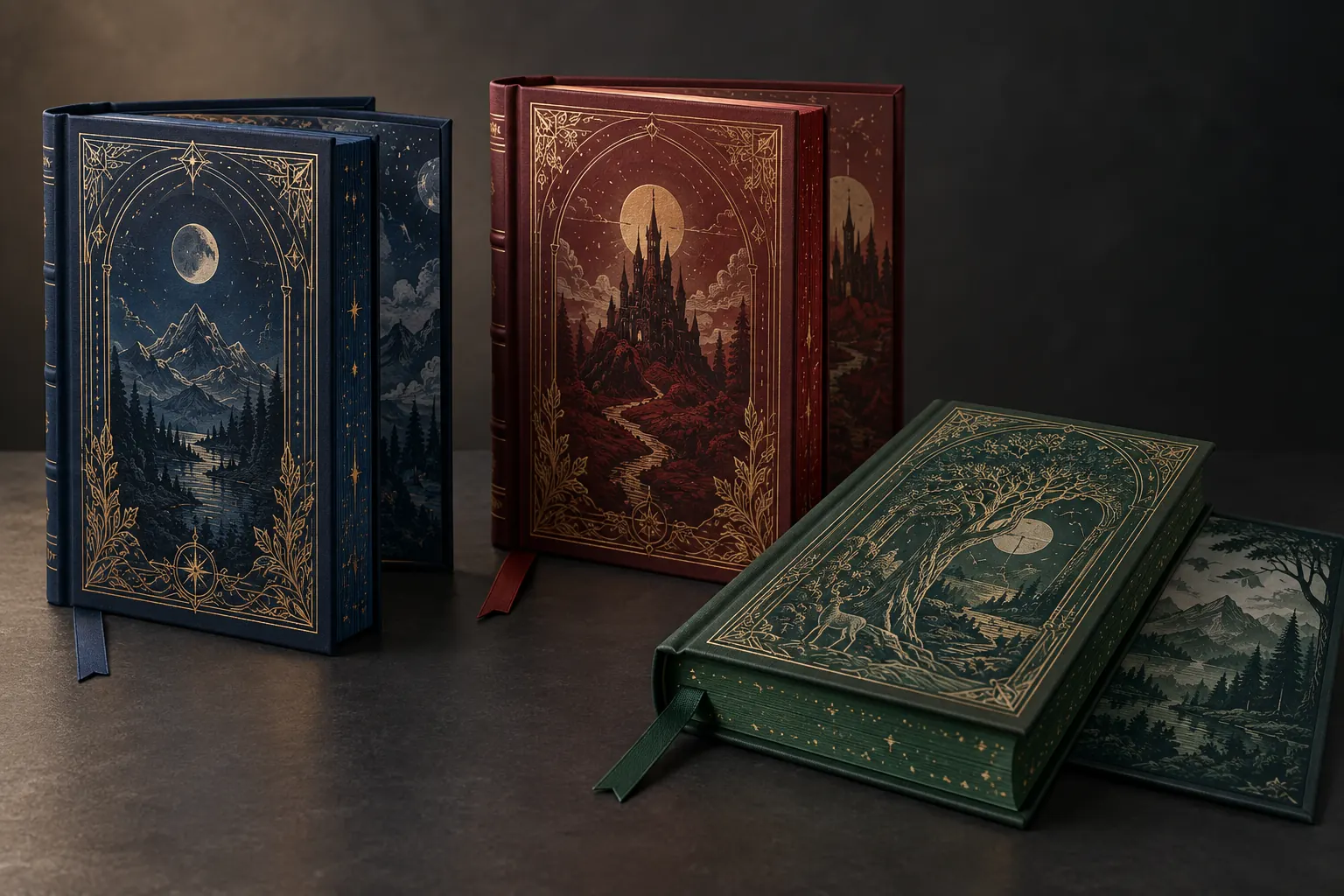
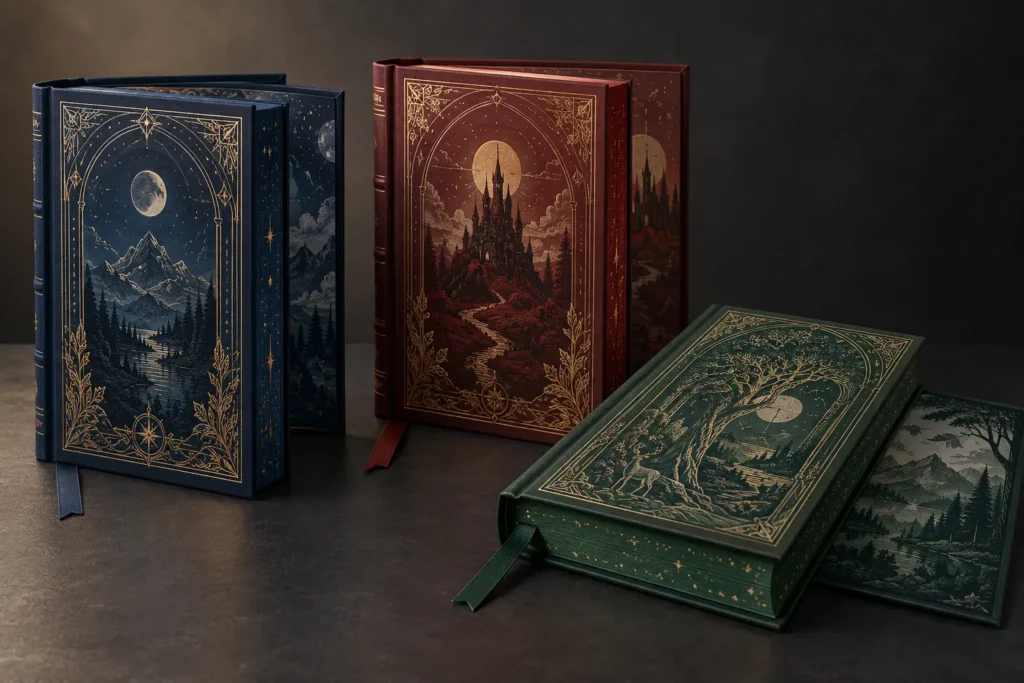
A collectible edition works best when the cover, edges, ribbons, endpapers, and story share one visual language.
- Why BookTok Changes Physical Book Design
- Build a Design System Before Choosing Finishes
- Special Edition Features Compared
- Cover Materials, Foil, and Embossing
- Sprayed, Printed, and Gilded Edges
- Endpapers, Ribbons, and Interior Extras
- Binding and Structural Quality
- How to Control Special Edition Cost
- Production Workflow and Quality Control
- Documented Evidence and Planning Scenario
- What to Send for an Accurate Quote
- Frequently Asked Questions
Why BookTok Changes the Design of Special Edition Books
BookTok did not invent collectible books, but it changed how quickly readers encounter them. A product listing may show one flat cover image. In contrast, a short video can reveal the spine, rotate the page block, catch foil under moving light, open the endpapers, and compare volumes in a series. Therefore, physical details that change with movement or touch have unusually high communication value.
This is supported by measurable market evidence. The UK Publishers Association reported in 2022 that 59% of surveyed 16–25-year-olds said BookTok or book influencers helped them discover a passion for reading. In March 2026, TikTok reported that more than 50 million books recommended by the European BookTok community were sold during 2025, generating €800 million in revenue. These figures do not prove that every decorated edition will sell. They do show that social discovery can influence physical-book demand at meaningful scale.
For publishers, the practical lesson is to design for both ownership and demonstration. A special edition should still read comfortably, open reliably, resist shelf wear, and arrive undamaged. Camera-friendly effects are valuable only when the underlying book remains well made.
Build a Design System for Special Edition Books
Begin with the story and audience, not a printer’s finishing menu. Define three ideas: the emotional promise, the visual motif, and the reveal sequence. A gothic romance might use a dark cloth case, copper foil, blind-debossed botanical details, deep-red edges, and map endpapers. Those choices feel connected. Adding holographic foil, neon ribbon, glitter lamination, and unrelated character art would weaken the hierarchy even if every process were technically impressive.
A useful reveal sequence is exterior, movement, edge, and interior. First, the case establishes the edition from a distance. Next, foil or texture changes as the reader tilts it. Then the closed page block reveals color or artwork. Finally, opening the cover exposes endpapers, a tip-in, or another narrative detail. This sequence also gives creators a natural order for an unboxing video.
Series planning needs an additional layer. Freeze the trim size, board overhang, spine system, key foil position, edge-art baseline, color tolerances, and logo scale before volume one enters production. Otherwise, later books may look related individually but fail as a shelf set.
Planning a collectible edition? Send the manuscript page count, trim size, quantity, target retail price, artwork status, and two or three priority finishes. Prikoro can help convert the concept into a manufacturable specification.
Special Edition Books Features Compared
Which features create the most value?
| Feature | What readers experience | Artwork or production requirement | Risk to control |
|---|---|---|---|
| Hot foil stamping | Metallic reflection and premium contrast | Separate vector foil plate; minimum line and gap rules | Fill-in, pinholes, weak transfer, registration drift |
| Embossing / debossing | Raised or recessed tactile detail | Dedicated die; artwork simplified for pressure and material | Cracking, soft detail, misalignment with printed art |
| Spot UV | Gloss contrast on matte surfaces | Separate spot mask; compatible laminate and curing | Registration tolerance and visible edge halos |
| Sprayed edges | Solid color around the closed page block | Approved color target and bleed-safe interior planning | Uneven coverage, page sticking, rub-off |
| Digitally printed edges | Detailed image, gradient, symbols, or panoramic art | Edge artwork mapped to final page block dimensions | Image stretch, spine-side shift, page-count changes |
| Gilded edges | Reflective metallic luxury | Smooth, well-prepared page block and compatible stock | Flaking, blocking, fingerprints, inconsistent shine |
| Illustrated endpapers | First interior reveal and narrative immersion | Separate spread files; hinge and turn-in awareness | Critical art lost at joint, gutter, or pastedown |
| Tip-in / signed page | Exclusive content or authenticity cue | Correct size, grain, position, collation and sign-off | Missing sheets, upside-down insertion, sequence errors |
| Ribbon marker | Functional color accent | Length, width, color and attachment location specified | Fraying, detachment, color mismatch |
| Slipcase | Gift presentation and shelf protection | Allowance for book thickness and removal clearance | Case too tight, scuffed foil, freight volume increase |
Cover Materials, Foil, and Embossing for Special Edition Books
Most special edition books use a hardcover because rigid boards provide a stable foundation for decorative processes. The case may be wrapped with printed paper, book cloth, imitation leather, or another specialty covering material. Each surface behaves differently. A fine foil line that transfers cleanly onto coated paper may break up on a heavily textured cloth. Likewise, deep embossing can crack a brittle printed wrap or distort small typography.
Ask the printer to test the exact combination of covering material, foil, die geometry, pressure, temperature, and run speed. A digital PDF cannot predict metallic color, reflectivity, texture, or emboss depth. For critical designs, approve a material swatch and then a complete case sample under both daylight and indoor retail lighting.
Hierarchy is more important than coverage. One strong foil motif with carefully placed blind debossing often looks more refined than foil on every available surface. It can also reduce tooling, setup time, and spoilage. Review Prikoro’s hardcover book printing options when choosing the structural base for these finishes.
Page-Edge Treatments for Special Edition Books
Edge treatment is visible while the book is closed, so it turns unused surface area into a strong ownership signal. Solid sprayed edges are usually the simplest route. They can coordinate with a cover color or provide deliberate contrast. Digitally printed edges support illustrations, gradients, symbols, and cross-volume panoramas. Gilding adds a reflective metallic surface associated with traditional luxury editions.
However, edge decoration is sensitive to the physical book block. Final page count, paper caliper, trim size, binding compression, and edge preparation affect the printable area. If the manuscript changes after edge artwork is approved, a detailed image may stretch or shift. Panoramic series art adds another risk: differences in spine width and board overhang can break the visual alignment between volumes.
For special edition books, always inspect page separation, rub resistance, image orientation, top-versus-bottom identification, and color consistency. Test several copies from different cartons, not only one presentation sample. Dark edge colors may also expose minor wear more clearly during shipping.

Approve real material combinations because screens cannot reproduce foil reflectivity, cloth texture, emboss depth, or edge behavior.
Interior Extras for Special Edition Books
Illustrated endpapers reward the reader after the exterior reveal. They can introduce a map, family tree, location, pattern, quotation, or hidden visual clue. Because one side is pasted to the case and the other becomes a free leaf, designers must account for the joint, hinge, turn-ins, grain direction, and any artwork crossing the center.
Ribbon markers are comparatively small components, yet they contribute color, function, and a pleasing unboxing detail. Specify ribbon width, length, count, color reference, cut style, and attachment position. Two ribbons can be useful for reference-heavy books, but more is not automatically better.
In special edition books, tip-ins, signed sheets, transparent overlays, gatefolds, maps, art cards, and pockets can deepen the edition. They also create collation and handling risks. Every inserted component needs a defined position, orientation, tolerance, and inspection method. If an item is packed separately rather than bound in, specify whether it belongs inside the book, slipcase, belly band, or shipping carton.
Binding Quality in Special Edition Books
A collectible book that cracks, loosens, or opens poorly will not feel premium for long. Sewn hardcover construction is often the safest starting point for substantial special editions because folded signatures are sewn before case-in. The final choice still depends on page count, paper, trim size, image crossover, expected use, and budget.
Paper grain should run parallel to the spine whenever practical. Incorrect grain can resist opening, produce waviness, and place more stress on the joint. Thick coated paper, heavy ink coverage, and oversized formats need especially careful dummy testing. Endpaper strength, spine lining, adhesive, headbands, joint formation, and board thickness must function as a system.
Use the book paper guide and prepress artwork guidance to coordinate materials with page design. Decorative edge work should be approved only after paper and binding are fixed.
How to Control the Cost of Special Edition Books
Special edition pricing cannot be reduced to a universal cost per finish. Quantity, trim size, page count, paper, binding, number of dies, foil area, edge process, hand assembly, spoilage allowance, proofing, packaging, and freight all interact. A feature that is inexpensive on one specification may trigger another production pass or a larger waste allowance on another.
| Cost decision | Lower-risk approach | When to invest more |
|---|---|---|
| Number of finishes | Select two or three coordinated hero features | More reveals have proven value to the audience or retailer |
| Foil tooling | Use one foil color and efficient die area | A second foil establishes a critical hierarchy or series code |
| Cover construction | Printed paper case with selective enhancement | Cloth, imitation leather, or multi-piece cases support premium pricing |
| Edge decoration | Solid sprayed color | Detailed edge art is central to the campaign or collection |
| Packaging | Protective wrap and strong export carton | A slipcase or presentation box is part of the retail product |
| Proofing | Swatches plus one complete prototype | Complex effects require press proofs, dummies, or staged approvals |
For special edition books, calculate value per reveal rather than price per process. If foil and embossing appear together in the same camera movement, they may function as one reveal. A colored edge and illustrated endpaper create two additional moments. This framework helps a publisher protect the strongest customer experience while removing decorative steps that add cost without adding a new story beat.
For a first run of special edition books, compare at least two quantities and request the same specification at each level. Also ask for carton count, carton dimensions, gross weight, and pallet assumptions. Premium cases and slipcases can increase freight and fulfillment cost even when their manufacturing increment appears modest.
Need a costed specification instead of a finish wish list? Share your target quantity, retail positioning, delivery market, and must-have features. Prikoro can identify which details drive tooling, spoilage, handwork, packing, and freight.
Special Edition Books Production and Quality Control
- Freeze commercial goals. Define audience, channel, release date, target retail price, quantity, territories, and whether the edition is numbered, signed, or retailer-exclusive.
- Lock the book block. Confirm trim size, final page count, paper, print colors, binding, and grain direction before mapping edge art or finalizing the spine.
- Create a component specification. List the case wrap, board thickness, endpapers, headbands, ribbons, foil, dies, edge process, inserts, slipcase, and packaging.
- Prepare separated artwork. Supply print, foil, emboss, spot UV, edge, endpaper, and insert files as distinct, clearly named layers or PDFs.
- Approve materials and color references. Screen colors are insufficient for cloth, ribbon, metallic foil, dyed edges, and uncoated paper.
- Make a complete physical prototype. Check opening, spine, joints, alignment, edge art, foil transfer, insert position, slipcase fit, and packed weight.
- Define measurable tolerances. Agree how registration, foil coverage, edge color, case squareness, and series consistency will be judged.
- Inspect during production. Verify first-off cases, book blocks, edge treatment, case-in, and packing rather than waiting for finished cartons.
- Test shipping protection. Corners, metallic surfaces, edge decoration, and slipcases can scuff unless units and cartons are engineered for the route.
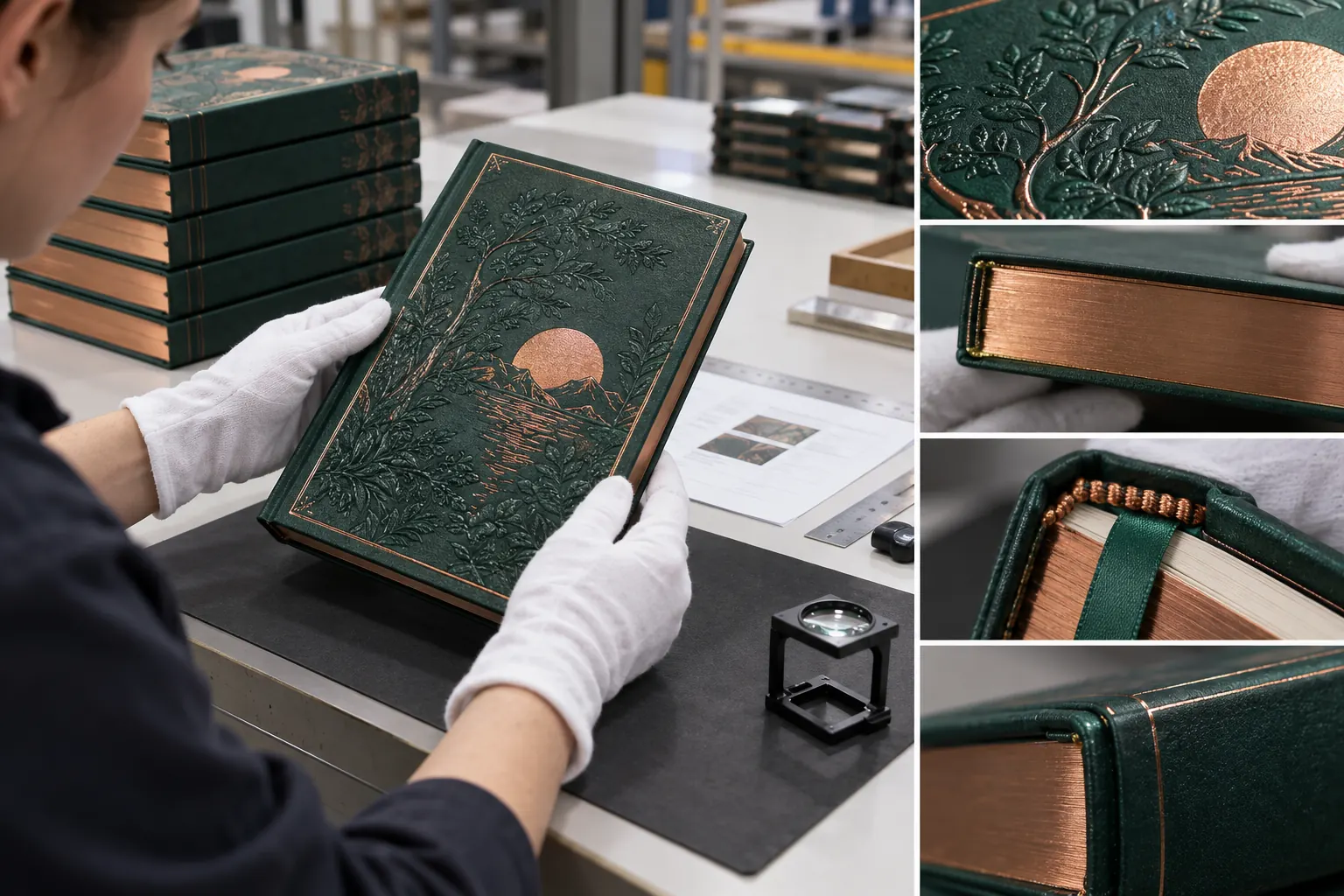
Quality control should cover the complete object: print, binding, foil, relief, page edges, ribbons, alignment, and protective packing.
Essential inspection points
- Foil is complete, clean, and registered to print or emboss within the agreed tolerance.
- Embossed details are consistent and do not crack the wrap.
- Page edges are even, dry, separable, correctly oriented, and resistant to normal handling.
- Case boards are square; spine and joints are centered; overhang is consistent.
- Endpapers are correctly positioned without wrinkles, bubbles, or exposed adhesive.
- Ribbons, headbands, inserts, and tip-ins match the approved sample and collation plan.
- Slipcases protect the book but allow removal without excessive friction.
- Individual wrapping and export cartons prevent foil scuffing, edge rub, and corner damage.
Documented Market Evidence and a Transparent Planning Scenario
What the market evidence actually shows
The Publishers Association’s survey and TikTok’s 2026 European sales statement demonstrate that BookTok can influence discovery and purchases. They do not isolate the sales effect of foil, painted edges, or endpapers. Therefore, publishers should avoid treating a viral aesthetic as a guaranteed return. Test the concept with readers, retailers, preorders, crowdfunding, or a controlled launch quantity.
Independent publisher and author Craig Mod provides another useful, documented signal about direct audience demand: he states that the first edition of Kissa by Kissa sold out in 48 hours and later reached multiple printings. His project is not proof that any particular finish caused sales. It illustrates how a clearly positioned physical book, a known audience, and direct communication can reduce demand uncertainty before reprinting.
Planning scenario: a 2,000-copy fantasy special edition
Consider an independent publisher planning 2,000 copies of a 6 × 9-inch, 384-page fantasy novel. This is a transparent specification exercise, not a claimed Prikoro customer case. The initial wish list includes cloth, two foils, embossing, digitally printed edges, illustrated endpapers, two ribbons, a signed tip-in, and a slipcase.
A disciplined review would first protect the sewn hardcover, one coordinated foil, endpapers, edge art, and shipping protection. The second foil, extra ribbon, and slipcase should remain only if the audience research and selling price support them. The publisher should build an undecorated binding dummy to verify bulk and opening, approve cover-material and foil swatches, then order one complete prototype. Matched quotes at 1,000, 2,000, and 3,000 copies would show whether additional volume lowers the unit price enough to offset inventory risk.
Before release, the team should film the physical prototype under ordinary phone lighting. If the foil, relief, edge art, and endpaper reveal remain legible without studio production, the design has genuine social-media utility. If not, changing contrast or simplifying the visual hierarchy may be more valuable than adding another finish.
How to Quote Special Edition Books Accurately
- Title, genre, audience, sales channel, planned release date, and delivery destination.
- Quantity options and whether later volumes or reprints must match.
- Finished trim size, orientation, final page count, and interior color specification.
- Text paper, endsheet stock, case wrap, board thickness, binding style, and spine preference.
- Exact foil colors and areas; emboss/deboss artwork; spot UV or laminate requirements.
- Solid sprayed, digitally printed, stenciled, or gilded edge requirements.
- Ribbon, headband, tip-in, signature page, map, gatefold, pocket, cards, or overlays.
- Dust jacket, belly band, slipcase, presentation box, individual wrap, and carton needs.
- Print-ready files or clear references showing which artwork belongs to each process.
- Required certifications, barcode/ISBN plan, inspection standard, Incoterm, and delivery postcode or port.
A complete brief allows the printer to flag incompatible materials, missing bleed, unrealistic registration, edge-art risks, and packing implications before tooling begins. To request a project review, use the Prikoro contact page.
Ready to develop the prototype? Send one representative interior PDF, the cover concept, finish layers, edge artwork, quantity, and target delivery date. A staged proof plan is the safest route to a repeatable special edition.
Frequently Asked Questions
What makes a book a special edition?
A special edition has a deliberately differentiated specification, such as exclusive cover art, premium case materials, foil, embossing, decorated edges, illustrated endpapers, signed or numbered pages, inserts, or a slipcase. The features should create meaningful value beyond a standard edition.
Which features work best for BookTok?
Features that reveal clearly through movement tend to communicate well: reflective foil, tactile embossing, sprayed or printed edges, illustrated endpapers, ribbons, overlays, and coordinated series spines. The design still needs contrast and a simple reveal order.
Are special edition books always hardcover?
No, but hardcover cases offer structure, durability, and several decoration surfaces. Premium paperbacks can use foils, flaps, textured laminates, sprayed edges, and inserts, although their structural and finishing options differ.
What is the difference between sprayed and printed edges?
Sprayed edges apply a controlled color to the closed page block. Digitally printed edges can reproduce detailed artwork, gradients, or symbols. Printed imagery requires more precise mapping to the final trim, page count, paper bulk, and orientation.
Can edge printing damage readability?
A properly controlled process should leave pages separable and readable. Excess coating, insufficient drying, unsuitable paper, or poor preparation can cause sticking, rub-off, or staining. A bound sample and page-separation test are essential.
How many premium finishes should one edition use?
Two or three coordinated hero features are often enough. Add more only when each creates a distinct reader benefit or reveal. Too many competing effects can weaken the design and increase tooling, spoilage, lead time, and inspection complexity.
Does a special edition need a separate ISBN?
Often, materially different formats or editions need distinct identification, but ISBN practice depends on how the product is published and distributed. IngramSpark notes that each book format needs its own ISBN. Confirm the plan with the publisher, ISBN agency, distributor, and retailer before printing barcodes.
How early should the printer be involved?
Involve the printer before final artwork. Board, cloth, foil, embossing, edge decoration, paper, spine width, endpaper construction, inserts, and packaging have different tolerances. Early review prevents expensive redesign after files are complete.
How do publishers keep later volumes consistent?
Maintain approved physical masters, material codes, foil references, color targets, die files, measurement drawings, edge-art baselines, and inspection records. Compare new production against retained samples under consistent lighting.
Are FSC-certified materials available for special editions?
They can be, depending on the selected stock and supply chain. FSC states that a label on a finished product indicates the materials met chain-of-custody requirements at each step. Confirm material availability and trademark approval before placing an FSC mark in artwork.
Final Recommendation
Design special edition books as complete products, not as ordinary books with a list of add-ons. Start with the audience, story, retail position, and release plan. Lock the book block and binding. Then choose a small number of finishes that create exterior, edge, and interior reveals. Finally, prove the exact materials, inspect measurable risks, and test the packed book in the real shipping environment.
For BookTok, visual impact matters. For repeat sales and collector trust, construction, consistency, and delivery condition matter more. The strongest edition achieves both.
Sources and Further Reading
- Publishers Association: How Social Media Is Transforming Gen Z Reading Habits — survey evidence on BookTok and reading discovery.
- TikTok Newsroom: BookTok Community Helps Sell More Than 50 Million Books — TikTok’s 2026 European sales statement.
- Forest Stewardship Council: Chain of Custody Certification — official explanation of FSC chain-of-custody claims.
- IngramSpark: ISBN Facts for Self-Publishing Companies — format-level ISBN guidance.
- Craig Mod: Special Projects — documented direct-publishing and reprint example.