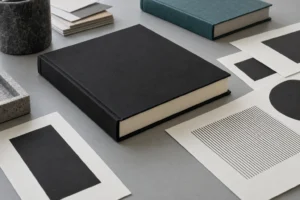
Hardcover books are systems, not flat covers. The page block, boards, spine piece, joint, hinge, endpapers, case wrap, jacket, headbands, ribbon, foil, lamination, and packing all affect the final result. Therefore, a design that looks perfect on a monitor can still produce a crooked spine, trapped text, weak hinge, scuffed surface, or poorly fitting dust jacket.
This guide explains 12 costly hardcover book design mistakes, why they happen, how to prevent them, and what publishers should send when requesting a production quote. It is written for independent publishers, brands, museums, photographers, authors, and crowdfunding teams ordering custom hardcover books.

Hardcover Book Design Mistakes: Quick Risk Check
Start by separating fixed product decisions from decorative decisions. First, confirm trim size, page count, paper, binding method, and print quantity. Next, let the printer calculate the book-block thickness and case dimensions. Then, design the cover on that approved template. Finally, proof the construction and finish on the real materials.
| Decision | Freeze before | Risk if changed late | Best control |
|---|---|---|---|
| Trim size | Interior layout | Reflow, changed margins, new cover template | Approve one finished size in millimeters and inches |
| Page count and paper | Spine and case art | Wrong spine width, jacket or slipcase misfit | Use the printer’s calculated bulk, not a generic calculator |
| Binding structure | Gutter and endpaper design | Lost content, poor opening, weak hinge | Confirm sewn or adhesive construction and endpaper attachment |
| Cover material | Foil, embossing, ink, or lamination | Poor adhesion, pinholes, weak contrast, scuffing | Test the actual material and finish combination |
| Packing format | Freight and fulfillment quote | Unexpected weight, damage, or dimensional cost | Approve a packed sample and carton plan |
12 Hardcover Book Design Mistakes to Avoid
1. Hardcover Book Design Mistakes: Designing Before the Book Block Is Final
The cover cannot be dimensioned accurately until trim, page count, paper thickness, binding, and board structure are confirmed. Even a small paper change can alter the spine, case, jacket, and slipcase. Therefore, treat an early cover as a concept only. Rebuild it on the printer’s final template before approval.
2. Hardcover Book Design Mistakes: Using a Paperback Spine Formula
A casebound cover includes more than the text-block thickness. It must account for boards, spine construction, joints, turn-ins, and the manufacturer’s casing-in method. Consequently, a paperback calculator is not a reliable hardcover template. Ask the printer to supply the complete flat size and marked structural zones.
3. Hardcover Book Design Mistakes: Ignoring Joints and Turn-Ins
The visible front, spine, and back are only part of the case wrap. Artwork continues around board edges, while joint areas flex and may visually distort details. Likewise, text placed close to the hinge can appear trapped. Keep logos, faces, borders, and small type away from uncertain construction zones.
4. Hardcover Book Design Mistakes: Fragile Spine Alignment
Mathematical centering can still look wrong after wrapping and casing because normal production tolerances affect the perceived center. Moreover, foil or narrow rules exaggerate small shifts. Use an adequate safe zone, avoid edge-dependent spine motifs, and assess the complete physical proof from the front, spine, and back.
5. Hardcover Book Design Mistakes: Borders Too Close to the Edge
Thin frames reveal every cutting, wrapping, and alignment variation. A border that is technically centered in the file may look uneven on the finished case. Instead, move it comfortably inward, make it intentionally bold, or remove it. As a result, normal manufacturing variation is less visible.
6. Treating the dust jacket as an enlarged paperback cover
A jacket has front and back panels, a spine, flaps, folds, bleed, and clearance around the case. In addition, coated stock, lamination, and fold direction affect cracking and fit. Build the jacket on a dedicated template after the case dimensions are fixed, and keep flap copy away from folds.

Hardcover Book Design Mistakes in Finishing and Materials
7. Choosing finishes from a screen mockup
Digital mockups cannot accurately show foil reflectivity, cloth texture, paper tooth, emboss depth, laminate softness, or color interaction. For example, the same gold foil can appear different on smooth coated paper and woven cloth. Therefore, review physical swatches and request a finish test on the selected material.
8. Sending foil, emboss, deboss, or spot UV as ordinary color art
Special operations need separate production layers, usually as clean vector shapes with unambiguous naming. Gradients, transparency, hairlines, raster edges, and tiny reversed gaps may not reproduce reliably. Accordingly, separate each operation, use solid spot colors for identification, and confirm minimum line and gap limits with the printer.
9. Ignoring grain direction and opening behavior
Paper grain should generally run parallel to the spine for stable folding and better opening. However, page size, sheet utilization, stock availability, and binding choices can complicate the plan. Ask how the proposed paper will be imposed and bound, particularly for landscape books, heavy coated stocks, and full-bleed crossovers.
10. Designing endpapers without understanding the hinge
Endpapers connect the text block to the case and participate in the opening structure. Thus, artwork near the hinge may disappear, stretch, or be interrupted by glue and folds. Keep critical content away from the attachment area and confirm left/right orientation, front/back sequence, and whether the endpapers are self-ended or separate stock.
11. Approving color only on an uncalibrated monitor
RGB screens emit light, while printed CMYK color depends on ink, paper, profiles, press conditions, and finishing. A monitor preview is useful for content but not a physical color contract. Instead, use an agreed proofing method, identify critical brand or artwork colors, and clarify whether any spot colors require separate ink or only a CMYK simulation.
12. Treating packaging as a logistics afterthought
Dark laminates, foil, cloth, corners, jackets, and slipcases can rub or crush during packing and delivery. Furthermore, a premium book may need tissue, individual wrapping, corner protection, a fitted mailer, or stronger export cartons. Test the complete pack-out before fixing the delivered cost.
Hardcover Book Design Mistakes in File Preparation
A reliable file package makes approvals traceable. First, export the interior as facing pages only if the printer specifically requests them; otherwise, print workflows commonly require single pages in reading order. Next, embed fonts, preserve sufficient image resolution, include the specified bleed, and remove unintended marks. Then, export the case, jacket, endpapers, and each special component from the printer’s templates.
| File | Must include | Common mistake | Preflight question |
|---|---|---|---|
| Interior PDF | Final page order, bleed where required, embedded fonts | Blank pages omitted or spreads exported incorrectly | Does the PDF page count equal the quoted page count? |
| Case wrap | Bleed, board panels, spine, joints, turn-ins | Built from estimated spine dimensions | Is this the latest printer-issued template? |
| Dust jacket | Panels, spine, flaps, fold guides, bleed | Flap copy too close to folds | Was the jacket sized from the confirmed case? |
| Finish layers | Separate vector art for each operation | Foil or emboss mixed into CMYK artwork | Are minimum detail and registration limits confirmed? |
| Endpapers | Correct orientation, hinge allowance, bleed | Front and rear sequences reversed | Has the attachment method been shown on a proof? |
Hardcover Book Design Mistakes with Materials and Finishes
Cover design and material selection must happen together. Cloth can soften fine detail. Uncoated paper can absorb ink and reduce contrast. Soft-touch lamination may show fingerprints or scuffing on dark solids. Meanwhile, foil may bridge tiny gaps or fail on coarse textures. Therefore, ask for compatible combinations rather than choosing every component independently.
| Design intention | Possible construction | Main risk | Proof to request |
|---|---|---|---|
| Minimal clothbound literary edition | Book cloth with one foil color | Fine foil fills or skips over texture | Foil strike on production cloth |
| Photographic hardcover | Printed paper case with protective lamination | Color shift, banding, surface rub | Contract color proof plus laminated sample |
| Dark luxury case | Anti-scuff matte film, foil, or deboss | Fingerprints, edge whitening, poor adhesion | Rub test and assembled case sample |
| Illustrated jacket and hidden case | Printed jacket over decorated case | Jacket misfit or rubbing | Complete book-and-jacket dummy |
| Collector set | Sewn hardcover with slipcase | Tight fit, scuffing, dimensional freight | Packed production sample |
For custom structures and finish combinations, review Prikoro’s hardcover book printing service. For broader production planning, visit the Prikoro printing blog.
Hardcover Book Design Mistakes in Proofing and Quality Control
Different proofs answer different questions. A digital PDF checks content and position. A contract or calibrated proof helps evaluate color. Material swatches show texture and finish. An unprinted dummy checks thickness, opening, and fit. Most importantly, an assembled production sample tests the combined result.
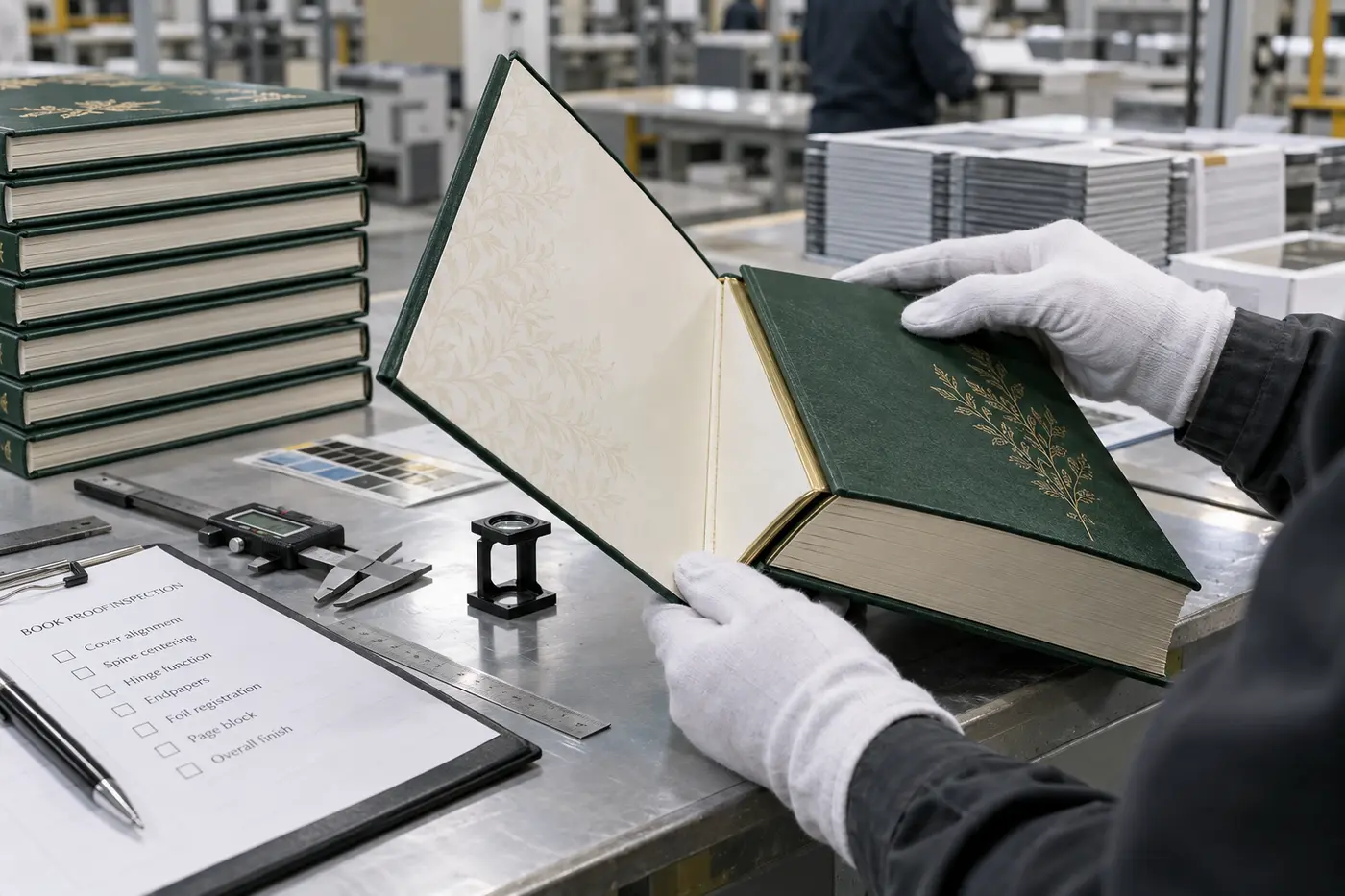
- Confirm trim, page count, bulk, spine, square, joints, and board overhang.
- Open the book repeatedly and inspect the hinge, endpapers, glue, and sewing.
- Check spine art from several copies rather than one ideal sample.
- Inspect foil coverage, registration, pinholes, edges, and fine reverses.
- Compare critical colors under consistent lighting.
- Rub-test dark covers, jackets, foil, and slipcase surfaces.
- Verify barcode size, quiet zone, contrast, placement, and scan performance.
- Pack, ship, and unpack a sample when presentation condition matters.
Moreover, write acceptance criteria before inspection begins. Consequently, the author, designer, printer, and fulfillment team can make consistent decisions rather than relying on subjective descriptions such as “perfect” or “premium.”
Hardcover Book Design Mistakes: Transparent Production Scenario
The lesson is not to remove every ambitious feature. Instead, identify where normal manufacturing variation will be most visible, then redesign those areas so the book remains attractive across the production run.
Hardcover Book Quote and Preflight Checklist
- Finished trim size and orientation
- Final page count, including intentional blanks
- Interior paper name, weight, coating, and color
- Color configuration and any spot inks
- Sewn or adhesive binding requirement
- Board thickness, spine type, and case material
- Printed case, cloth, dust jacket, or combination
- Foil, embossing, debossing, spot UV, labels, or edge decoration
- Endpaper stock and artwork
- Ribbon, headbands, slipcase, or presentation box
- Proof type and approval owner
- Quantity options, destination, delivery date, and Incoterm
- Individual wrapping, cartons, pallets, and fulfillment splits
Send the frozen specification and current files through the Prikoro contact page. A precise request allows the printer to quote the actual construction instead of filling gaps with assumptions.
Hardcover Book Design Mistakes: Frequently Asked Questions
When should I design the hardcover spine?
Design it after the final page count, paper, binding, and text-block thickness are confirmed and the printer supplies the case template.
How much bleed does a hardcover cover need?
Use the exact bleed and turn-in shown on the printer’s template. A hardcover case wrap is not governed only by the interior page bleed.
Can I use the same cover file for paperback and hardcover editions?
No. The structures, spine calculation, hinge or joint areas, wrap, and sometimes trim dimensions differ. Adapt the creative concept to separate production templates.
Why does centered spine text sometimes look off-center?
Wrapping, casing, board placement, and binding tolerances affect perceived alignment. Adequate safe zones and a physical proof reduce the visual impact.
Should I use CMYK or RGB files?
Follow the printer’s current specification and profile guidance. Do not convert blindly at the last step because color appearance depends on the images, paper, inks, and workflow.
Do foil and embossing need separate files?
Yes, they normally require separate, clearly named production layers or files. Use clean vector art and confirm the manufacturer’s minimum detail limits.
Is a digital proof enough for a premium hardcover?
No. It is useful for content, but it cannot prove materials, binding, texture, foil, emboss depth, opening behavior, or packaging fit.
How can I prevent dark hardcover surfaces from scuffing?
Select compatible paper, ink, film, or coating; request a rub test; inspect an assembled sample; and design protective packing around the finished surface.
What should I approve before mass production?
Approve final files, written specifications, paper and cover materials, finish tests, an appropriate physical sample, packing method, quantities, schedule, and delivery responsibilities.
Hardcover Book Design Mistakes: Final Recommendation
Prevent hardcover book design mistakes by designing in the right order. First, freeze the interior specification. Next, obtain the manufacturer’s template. Then, simplify vulnerable borders, spine details, and hinge-area content. Afterward, test every special finish on the actual material. Finally, approve the assembled book and pack-out before mass production. This workflow protects the design, reduces expensive revisions, and creates a hardcover that can be reproduced consistently.
Therefore, document every approval. Likewise, keep the approved sample available during inspection. Moreover, communicate later changes in writing. Consequently, revisions remain traceable. Furthermore, inspection decisions stay consistent. As a result, the finished run can be judged against clear evidence.
Sources and Further Reading
- IngramSpark File Creation Guide — practical principles for interior and cover file preparation.
- Adobe: PDF/X, PDF/A, and PDF/E standards — background on print-oriented PDF standards.
- Book Industry Study Group metadata resources — product metadata and book-industry guidance.
- Library of Congress: Care, Handling, and Storage of Books — preservation context for finished books.