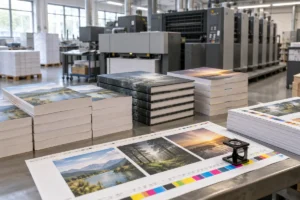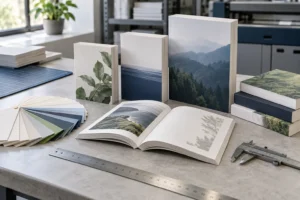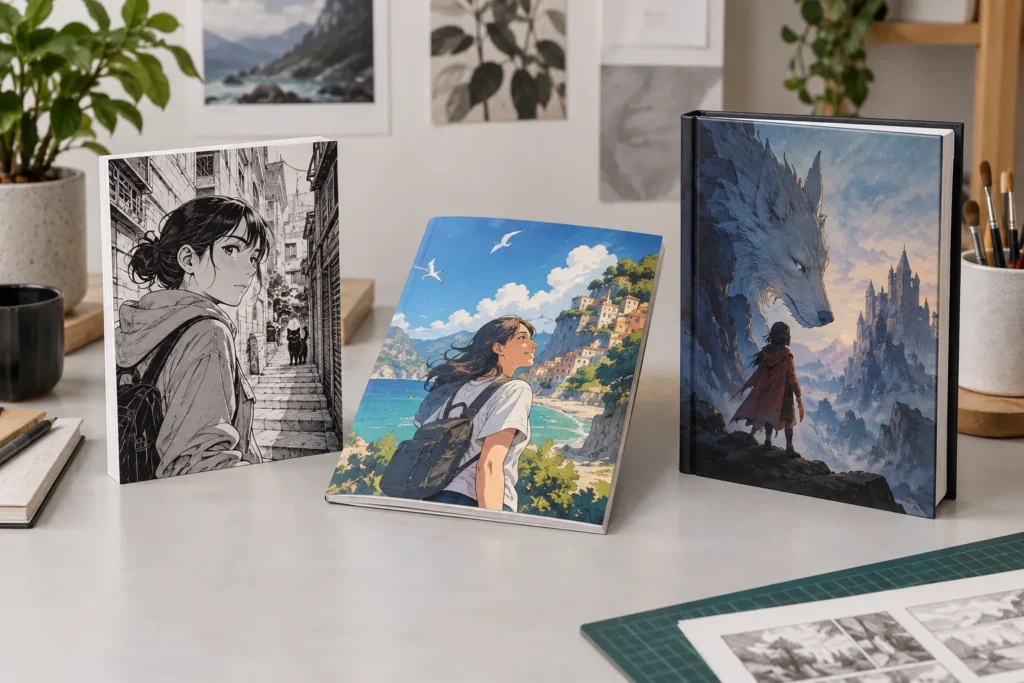
If you want to know how to print manga, comics, or graphic novels professionally, lock the trim size and binding first, prepare separate print-ready interior and cover PDFs, proof the files at final size, approve paper and color on a physical sample when risk justifies it, and only then release mass production. The best workflow connects artwork, manufacturing, packaging, and fulfillment instead of treating printing as the last isolated step.
Moreover, a reliable workflow begins with one approved specification. Consequently, every proof, quote, and shipment can be checked against the same production target. In addition, this guide explains the decisions in the order most publishing projects encounter them.
Manga, Comic, and Graphic Novel Printing Are Not Identical
All three combine sequential art and text, but their production conventions differ. Therefore, treat the labels as planning signals, not rigid rules. Above all, your actual specifications must follow the reading experience and sales channel.
| Format | Typical interior | Common construction | Production priority |
|---|---|---|---|
| Manga | Usually black and white; screen tones; may read right to left | Compact trim, often perfect bound | Clean tones, neutral grays, flexible opening, low weight |
| Single-issue comic | Often full color and lower page count | Commonly saddle stitched | Color consistency, creep allowance, retailer-compatible format |
| Graphic novel | Black and white or color; longer narrative | Perfect bound, sewn paperback, or hardcover | Durability, gutter behavior, spine design, shelf presence |
| Doujinshi / indie zine | Highly variable | Saddle stitch or perfect bound | Small-run economics, convention deadline, practical finishing |
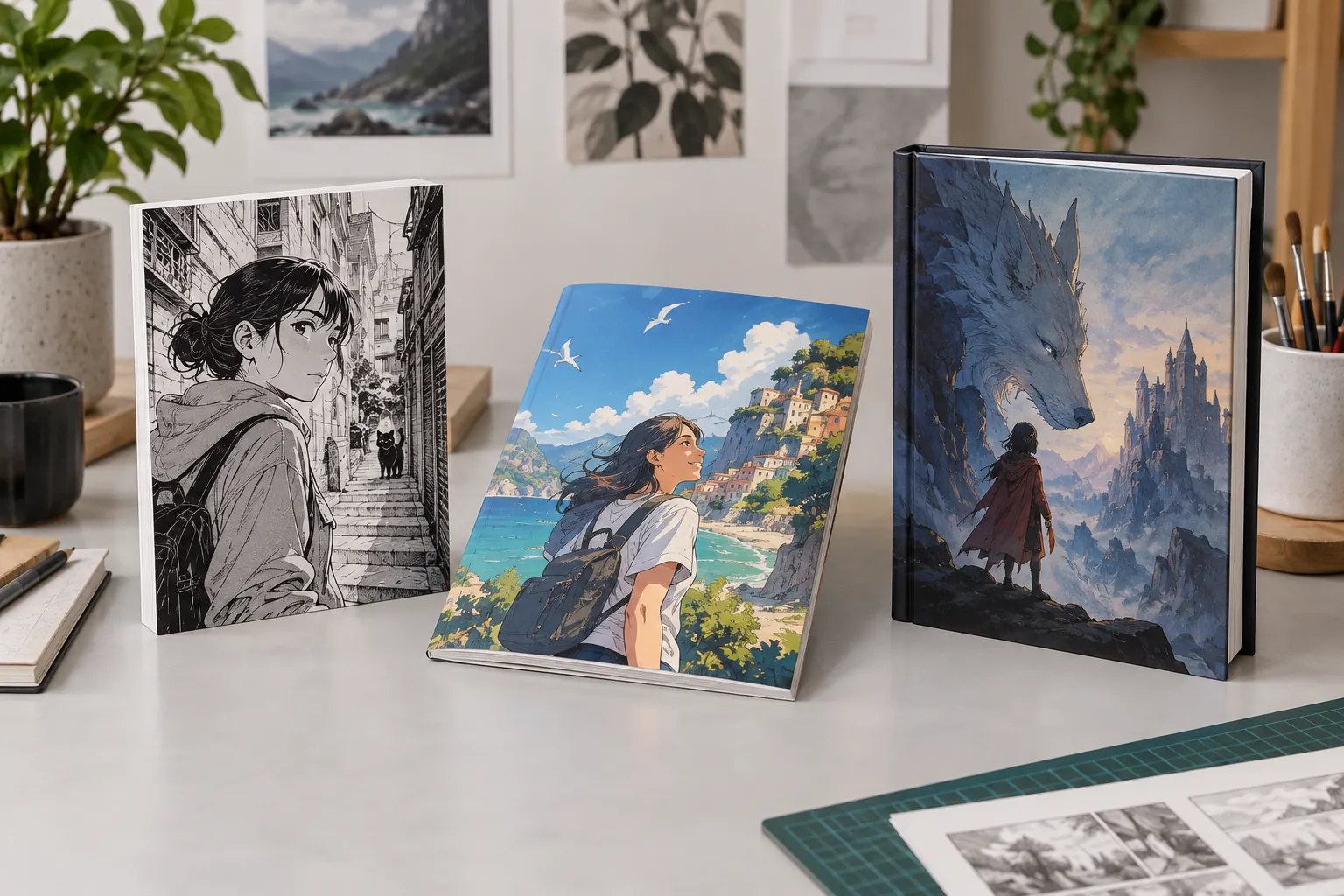
How to Print Manga, Comics, and Graphic Novels: 10 Steps
- Define the edition. Identify reader age, language, reading direction, sales channel, launch quantity, and retail price.
- Lock the physical format. Confirm trim, page count, color, paper, cover, binding, and finish together.
- Request templates. Obtain the printer’s exact interior, cover, spine, hinge, and special-finish guides.
- Prepare artwork. Build at final aspect ratio with adequate bleed, safe area, gutter, and effective resolution.
- Export separate PDFs. Supply the interior in reading order and the cover as the printer requests.
- Run preflight. Check dimensions, fonts, image resolution, color spaces, overprint, rich black, transparencies, and missing links.
- Approve proofs. Review a digital proof for content and imposition; use a physical proof for paper, color, binding, and finish decisions.
- Authorize production. Freeze files and specifications with written approval.
- Inspect mass production. Verify registration, density, trimming, pagination, binding, finishing, and packing.
- Ship and fulfill. Confirm carton marks, quantities per carton, palletization, freight terms, customs responsibility, and final delivery.
How to Print Manga: Choose Specifications Before Final Layout
| Decision | Practical starting point | Questions to resolve |
|---|---|---|
| Trim size | Manga: A5/B6 or a printer-defined compact size; US comic: around 6.625 × 10.25 in; graphic novel: often 6 × 9 or 7 × 10 in | Does it fit the artwork, retailer, mailer, and press sheet efficiently? |
| Page count | Saddle stitch normally uses multiples of four; longer books depend on signatures and binding | Are blanks, endpapers, covers, and inserts included in the count? |
| Interior color | Grayscale/black for manga; CMYK for color comics | Are spot colors, mixed color sections, or black-only pages required? |
| Paper | Uncoated for a traditional manga feel; coated for saturated color and sharp image reproduction | What opacity, bulk, gloss, whiteness, and show-through are acceptable? |
| Binding | Saddle stitch for thin issues; perfect bound for many paperbacks; sewn or hardcover for durable premium editions | How flat must spreads open? Is a printable spine required? |
| Cover finish | Matte or gloss lamination as protection; optional foil, spot UV, embossing, or edge treatment | Does the finish support the price tier and survive fulfillment? |
Use Prikoro’s comic book printing service to compare binding and finishing routes, and review the detailed book printing paper guide before approving stock.
How to Print Manga Files for Commercial Printing
File requirements differ by printer, so the production template has authority. Nevertheless, the following provides a reliable starting framework:
- Create pages at the exact final trim and orientation.
- Extend edge-to-edge artwork into the specified bleed. A common requirement is 0.125 inch (3 mm), but the required edges vary by workflow.
- Keep dialogue, faces, page numbers, and panel borders within the safe area.
- Increase inside clearance for thick perfect-bound or casebound books.
- Use sufficient effective resolution at final size—commonly 300 ppi for continuous-tone images and higher for 1-bit line art.
- Embed fonts or outline only when appropriate and approved; retain an editable master.
- Export one complete interior PDF in correct reading order and a separate cover PDF.
- Remove unintended printer marks unless the supplier explicitly asks for them.
IngramSpark’s current guide requires embedded fonts and publishes 300 ppi for grayscale continuous-tone images, 600 ppi for 1-bit black-and-white line art, and 0.125-inch bleed except at the bind side for its workflow. This is valuable evidence that “300 dpi for everything” is an oversimplification. Your commercial printer may use different presets, so follow its written specification.
How to Print Manga Screen Tones, Blacks, and Color
Black-and-white manga
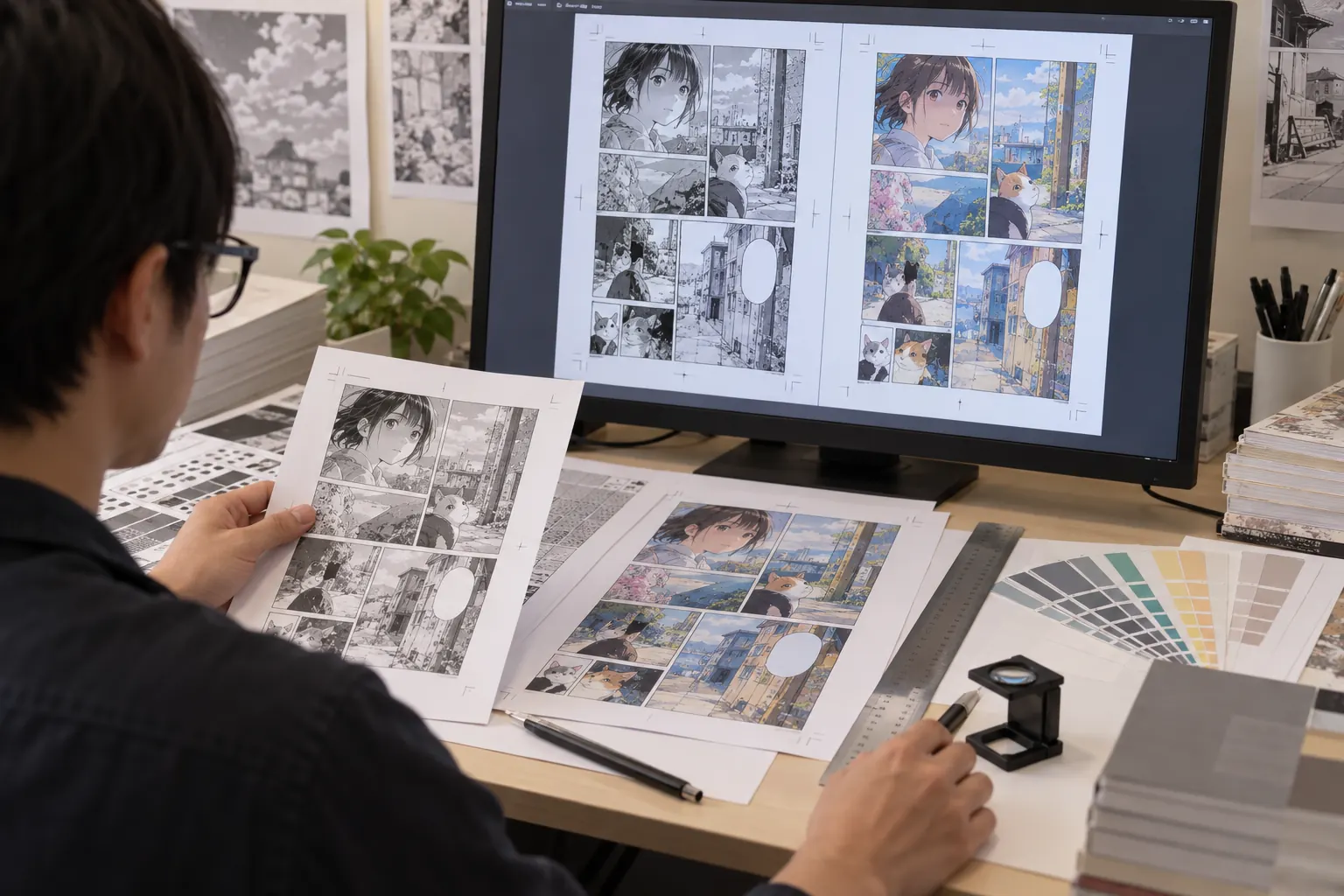
First, convert deliberately to the requested grayscale or 1-bit workflow. Otherwise, RGB-to-grayscale conversion at the printer can change tonal relationships. Next, inspect screen tones at 100% and in a printed-size proof: frequencies that look smooth on screen may interact with screening or resampling and create moiré. Finally, avoid accidental four-color black on pages quoted as black-only.
Full-color comics
By contrast, full-color comics need a color-managed process. For example, bright RGB colors may fall outside the printable CMYK gamut. Therefore, soft-proof with the agreed profile where possible, avoid assuming that every monitor is calibrated, and define black construction with the printer. In addition, small black text normally needs a simpler black build than large dark image areas.
Right-to-left editions
State reading direction in the quotation, file name, and approval email. Confirm the first page, binding edge, cover orientation, folios, and imposition. IngramSpark publishes separate right-to-left cover workflows, illustrating why direction is a manufacturing instruction—not just an editorial preference.
How to Print Manga Proofs and Control Quality
| Control | What it can verify | What it cannot fully guarantee |
|---|---|---|
| Preflight report | Dimensions, missing bleed, resolution, fonts, color spaces | Editorial accuracy and subjective art quality |
| Digital PDF proof | Pagination, content, crop, imposition, obvious file errors | Exact paper feel, binding behavior, and press color |
| Printed color proof | Closer color and tonal reference | Every variable of the final production press and stock |
| Bound dummy | Size, paper bulk, opening, spine, handling | Final printed appearance if made with blank pages |
| Production sample / inspection | Actual print, trim, binding, finish, and packing | Zero variation across every copy without statistical inspection |
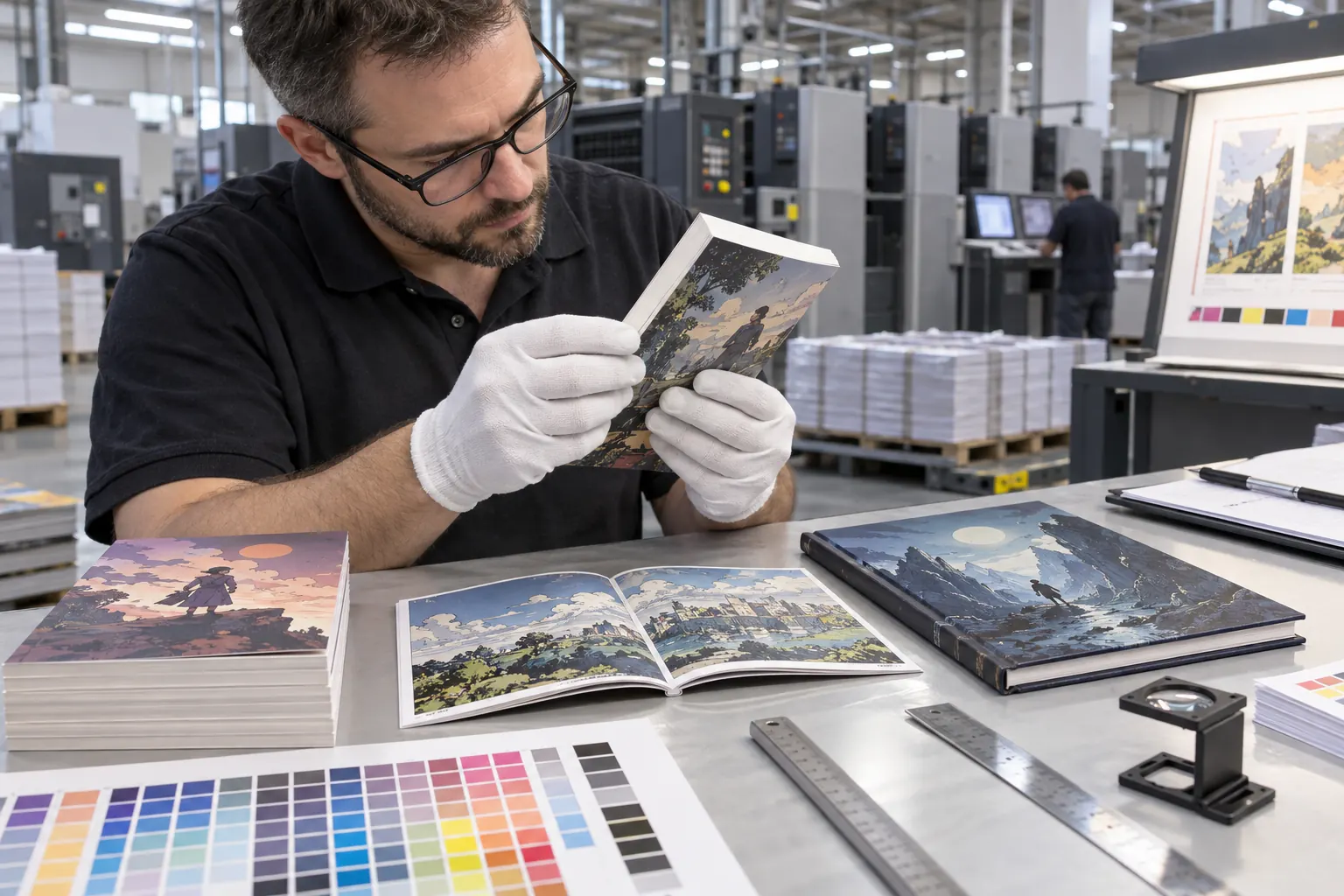
For substantial runs, define tolerances and inspection criteria before production. Check page sequence, registration, density consistency, screen-tone clarity, trimming, spine alignment, lamination adhesion, foil position, glue, stitch security, scuffing, carton strength, and count. Prikoro’s prepress artwork guidance explains how to reduce preventable file risk.
How to Print Manga Without Budget Surprises
Learning how to print manga commercially also means controlling its budget. Do not copy a competitor’s unit-price example into your plan. Printing prices change with date, country, quantity, specifications, exchange rates, freight, duties, and tariff treatment. Ask every supplier to quote the same specification and separate manufacturing from logistics.
| Cost driver | Why it changes price | Better buying decision |
|---|---|---|
| Quantity | Offset setup costs are spread across more copies | Compare required quantity plus realistic overage, not the lowest unit price alone |
| Page count and size | They determine paper consumption and press-sheet yield | Ask whether a nearby trim or signature count improves efficiency |
| Color | Black-only and CMYK require different plates, press time, and control | Keep unnecessary color pages out of a black-only section |
| Paper and binding | Stock price, thickness, waste, and labor interact | Approve equivalent samples rather than comparing gsm alone |
| Finishing | Foil, UV, embossing, and edges add tooling, passes, and spoilage | Use finishes where readers notice them most |
| Freight | Weight, volume, cartons, route, and Incoterm change delivered cost | Compare EXW/FOB and door-delivered totals with the same scope |
Moreover, a capable supplier should explain the production route, provide templates, flag file risks, disclose what the quote includes, offer proof options, and define packing and delivery responsibilities. Consequently, a low quote that omits proofing, tooling, freight, duty, or destination charges is not directly comparable.
How to Print Manga on Schedule: Plan Production Backward
Begin with the date readers must receive books. Then, reserve time for individual fulfillment, international freight and customs, production, proof approval, and file corrections. As a result, you should not advertise a fixed campaign delivery date based only on press time.
- Before launch: obtain manufacturing and freight estimates, choose specifications, test packaging, and order representative samples.
- During the campaign: finalize editorial content, collect variant quantities, prepare addresses, and maintain a change-control log.
- After funding: freeze quantity and variants, complete preflight, approve proofs, confirm shipping terms, and release production.
- Before dispatch: approve carton marks and packing list; collect inspection evidence and shipping documents.
- At fulfillment: retain replacement stock for transit damage, lost parcels, influencer copies, and customer service.
Transparent Planning Scenario: A 160-Page Indie Graphic Novel
The publisher first tests whether separating the color pages into one signature is practical. It requests matched quotes for an all-color interior and a mixed-color plan because short color sections do not automatically create proportional savings. The paperback uses a flexible uncoated interior, while the premium edition compares a sewn case with a perfect-bound case. Both variants share corrected interior pagination, but each receives its own cover template and proof.
Before approving mass production, the team reviews screen-tone pages, double-page spreads, small reversed text, the color signature, spine alignment, and the mailer. The production decision is based on landed cost, proof quality, opening behavior, and campaign margin—not unit printing price alone. This is the kind of controlled comparison that prevents expensive surprises.
Manga and Comic Printing Quote Checklist
- Title, edition, language, and left-to-right or right-to-left reading direction
- Finished trim size and orientation
- Total page count with clear cover/endpaper treatment
- Black, grayscale, CMYK, or mixed-color page breakdown
- Interior paper and cover material
- Binding and required opening behavior
- Cover lamination and each special finish with size/position
- Quantity by variant and acceptable over/under tolerance
- Proof requirements and approval sequence
- Packing, carton marks, pallet requirements, and replacement copies
- Destination, Incoterm, customs responsibility, and required arrival date
- Retail requirements: ISBN/barcode, legal page, distributor metadata, and packaging
Send the same checklist to shortlisted printers. For a specification review and comparable bulk quotation, contact Prikoro.
Frequently Asked Questions
What files do I need to print a manga or graphic novel?
Most printers need one print-ready interior PDF and one separate cover PDF made from the final spine template. Special finishes may require additional vector masks. Always request the supplier’s checklist before export.
Should manga interiors be grayscale or CMYK?
Black-and-white manga is usually supplied in the printer’s requested grayscale or 1-bit workflow, not as uncontrolled RGB or CMYK. Full-color pages normally use CMYK. Confirm mixed sections before quoting.
Is 300 ppi enough for manga line art?
It is often adequate for continuous-tone images, but pure 1-bit line art may require higher effective resolution. IngramSpark, for example, specifies 600 ppi for 1-bit black-and-white line art. Follow the selected printer’s specification.
How much bleed should comic artwork have?
A common value is 0.125 inch or 3 mm, but the edges included depend on the workflow. Use the actual template and extend artwork naturally instead of enlarging the finished page.
Which binding is best for a graphic novel?
Perfect binding is economical and familiar for paperbacks. Sewn paperback or casebound construction adds durability and can improve opening. Page count, paper thickness, budget, and spread design determine the best choice.
Can a manga be printed right to left?
Yes. Mark reading direction clearly and verify the first page, binding edge, cover orientation, page numbers, and proof. Right-to-left is a production instruction that must remain consistent across files and approvals.
Do I need a physical proof?
A digital proof is essential for content and pagination. A physical proof is especially valuable for large runs, premium editions, demanding screen tones, exact color, unfamiliar paper, or complex finishes.
Is offset or digital printing better?
Digital printing often suits very small quantities and rapid testing. Offset becomes attractive as quantities grow and offers strong control for bulk manufacturing and special finishing. Compare total cost, proof standard, quality target, and delivery.
How do I estimate a crowdfunding print quantity?
Start with paid backers by variant, then add replacements, review copies, events, retail stock, and a prudent contingency. Do not increase quantity solely because a higher tier has a lower unit price.
What causes comic printing delays?
Late editorial changes, incorrect bleed, missing fonts, unresolved color, changing page count, delayed proof approval, special-finish tooling, peak capacity, customs, and freight schedule changes are common causes.
Final Recommendation
The strongest way to print a manga, comic, or graphic novel is to make production decisions before artwork is locked. Confirm specifications, build from the printer’s templates, test vulnerable pages at final size, approve meaningful proofs, document tolerances, and budget using landed cost. That process protects the art, the campaign schedule, and the publisher’s margin.