Book printing costs for Kickstarter are not just the printer’s unit price. A reliable campaign budget must cover prepress, proofs, production, packaging, freight, import charges, fulfillment, last-mile postage, platform and payment fees, taxes, replacements, and a contingency reserve. The safest funding goal is built from the cost to deliver every promised reward—not from the factory quote alone.

A campaign budget should connect the book specification, production quantity and fulfillment plan before the funding goal is announced.
Book Printing Costs for Kickstarter: What Belongs in the Budget?
In practice, the factory quote is one line in a larger system. When estimating book printing costs for Kickstarter, a budget is credible only when every line has an owner, a calculation method, and a date at which it will be reconfirmed.
| Cost category | What it can include | How to estimate it |
|---|---|---|
| Editorial and design | Editing, proofreading, illustration, cover design, typesetting | Signed supplier scopes plus revision allowance |
| Prepress | File checks, color conversion, trapping, imposition | Ask what the printer includes |
| Proofs and samples | PDF proof, color proof, blank dummy, production sample, courier | Quote each required approval stage |
| Manufacturing | Printing, paper, binding, cover, finishing, packing | One locked specification at several quantities |
| Freight | Pickup, export handling, air/sea/rail freight, fuel and seasonal surcharges | Written quote with validity date and Incoterm |
| Import | Brokerage, duty if applicable, taxes, inspection or port charges | Confirm with a licensed broker for destination and HS classification |
| Fulfillment | Receiving, storage, pick-and-pack, packaging, address correction, returns | Price by SKU, parcel and storage duration |
| Last-mile delivery | Postage by country, zone, weight and service | Test packed samples and obtain current carrier rates |
| Campaign overhead | Video, ads, platform fee, payment processing, accounting and taxes | Official fee schedules and professional advice |
| Risk reserve | Damaged parcels, failed payments, reprints, exchange-rate or freight movement | Scenario-based contingency, not a guessed round number |
A Better Funding-Goal Formula
“Total reward costs” means the cost of the book, add-ons, protective packaging, fulfillment labor and shipping for the expected mix of backers. Because platform and processing fees are calculated on funds collected, use a spreadsheet that solves for the gross amount rather than simply adding a percentage once.
Kickstarter’s current US fee page states a 5% platform fee and payment processing fees generally between 3% and 5%. Rates and per-pledge components vary by country, so creators should use the official fee page for their launch country immediately before setting the goal. Taxes are project- and jurisdiction-specific; consult a qualified adviser rather than treating campaign revenue as automatically tax-free.
The Specifications That Drive Book Printing Cost
However, two books with the same page count can have very different manufacturing costs. To compare book printing costs for Kickstarter accurately, define these variables:
- Finished trim size and orientation
- Page count, including blanks and endpapers
- Interior color: black only, spot color, or full CMYK
- Interior paper type, grammage, opacity and finish
- Binding: perfect bound, sewn paperback, casebound, spiral or another format
- Cover board, wrap, jacket, endpapers and headbands
- Surface finishes such as lamination, foil, embossing, debossing or spot UV
- Quantity by edition, language and cover variant
- Packing method, carton limits and pallet requirements
- Delivery destination and Incoterm
Moreover, for visual books, paper choice affects both reproduction and parcel weight. Ask for physical samples, and use Prikoro’s prepress artwork guidance to prepare production-ready files. Compare softcover book printing with hardcover book printing before locking reward tiers.
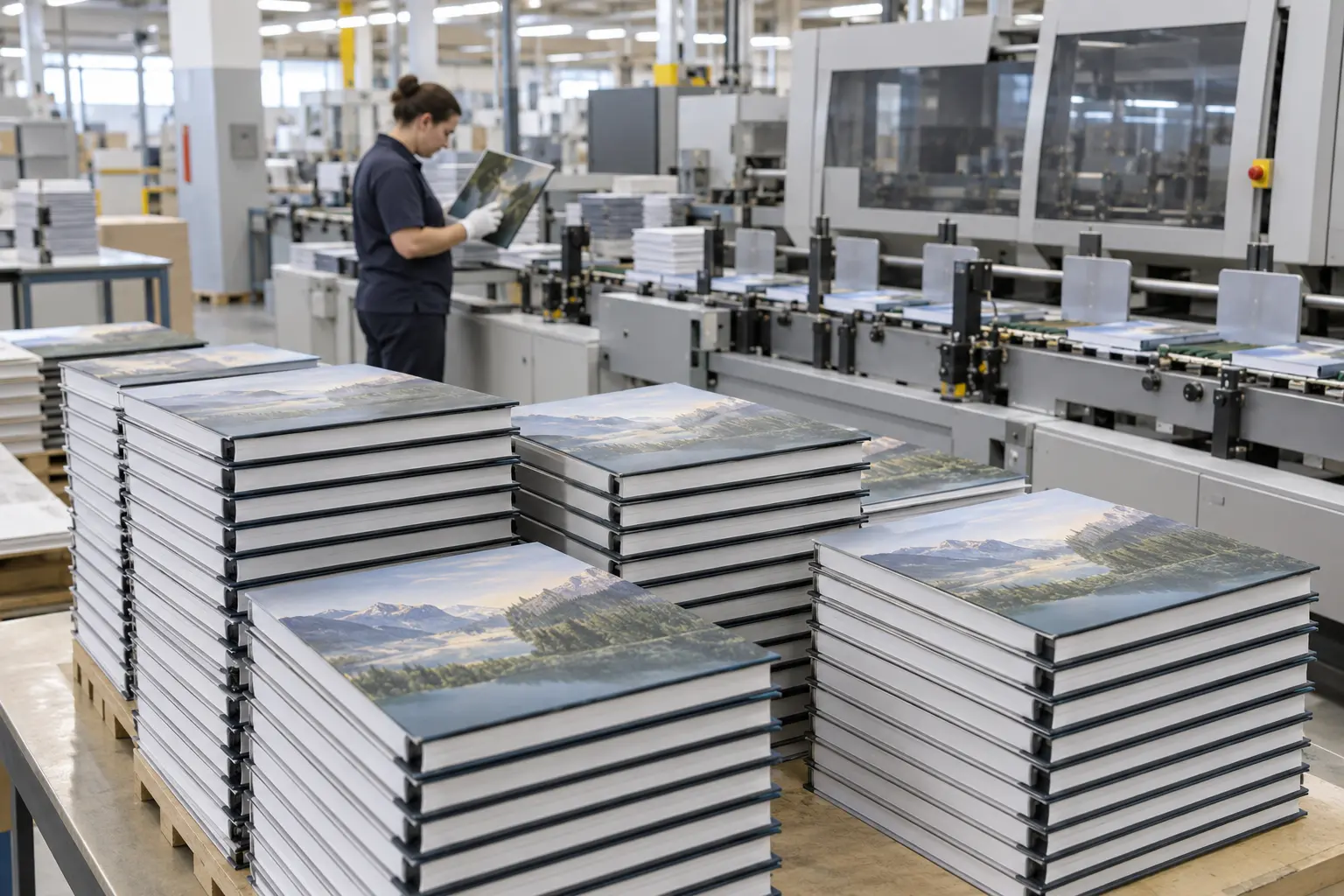
Quantity improves manufacturing efficiency, but inventory, freight and fulfillment costs still increase with every extra copy.
Budget for Proofs and Prototypes
| Approval tool | Best for | Limitation |
|---|---|---|
| Digital PDF proof | Pagination, text, trim and basic content checks | Cannot predict exact paper feel or press color |
| Contract/color proof | Color expectation and image correction | Usually not bound with final materials |
| Blank dummy | Thickness, weight, binding mechanics and packaging tests | No printed-image evaluation |
| Digitally printed prototype | Campaign photography and physical review | May not match offset ink, finishing or binding exactly |
| Production sample | Final approval after production setup | Late changes may add time and cost |
For example, a beautiful prototype can help explain the product to backers, but disclose when it is not made by the final production process. For color-critical projects, approve both appearance and construction before mass production.
Choose Quantity From Demand, Not From the Lowest Unit Price
Therefore, offset printing spreads setup costs across the run, so unit cost usually falls as quantity rises. Yet the cheapest unit is not always the cheapest campaign. Extra copies create cash tied up in stock, additional freight weight, storage fees and obsolescence risk.
Next, separate the quantity into: backer rewards, creator/retailer allocations, review and archive copies, and a controlled replacement reserve. When modeling book printing costs for Kickstarter, ask for several quantity breaks—such as 500, 1,000 and 2,000 copies—then compare landed total cost, not only ex-factory cost per book.
Reward Tiers: Control SKU Complexity
In addition, each cover version, signed edition, language, slipcase, print, bookmark or bundled object may become another SKU. More SKUs increase assembly time, picking errors, packaging sizes and inventory reconciliation.
| Reward design | Operational effect | Safer approach |
|---|---|---|
| One standard book | Simple packing and postage | Use as the core tier |
| Signed book | Requires transfer, signing, recounting and protection | Limit quantity and define signing workflow |
| Deluxe edition | Separate production and inventory | Lock specifications and minimum quantity early |
| Book plus mixed merchandise | May change parcel size, customs description and damage risk | Prototype the full packed reward |
| Multiple-book bundle | Higher weight but efficient per-book postage | Rate-test the exact packed bundle |
Freight, Customs and the Meaning of “Delivered”
Before comparing prices, ask every printer to state the Incoterm and named destination. EXW, FOB, CIF and DDP allocate costs and responsibilities differently; two quotes using different terms are not comparable. Clarify whether the price includes origin handling, destination charges, customs clearance, duties/taxes, unloading, appointment delivery and lift-gate service.
However, freight prices can change after a campaign launches. Obtain a current estimate, a validity period, estimated transit window and assumptions for carton dimensions, pallet count and chargeable weight. Confirm import treatment with a customs broker; classification and tax rules depend on the goods and destination.
Fulfillment and Last-Mile Postage
Meanwhile, Kickstarter defines fulfillment as completing the project and sending rewards to backers. For books, this stage deserves its own model because delivery often costs as much as—or more than—manufacturing a copy.
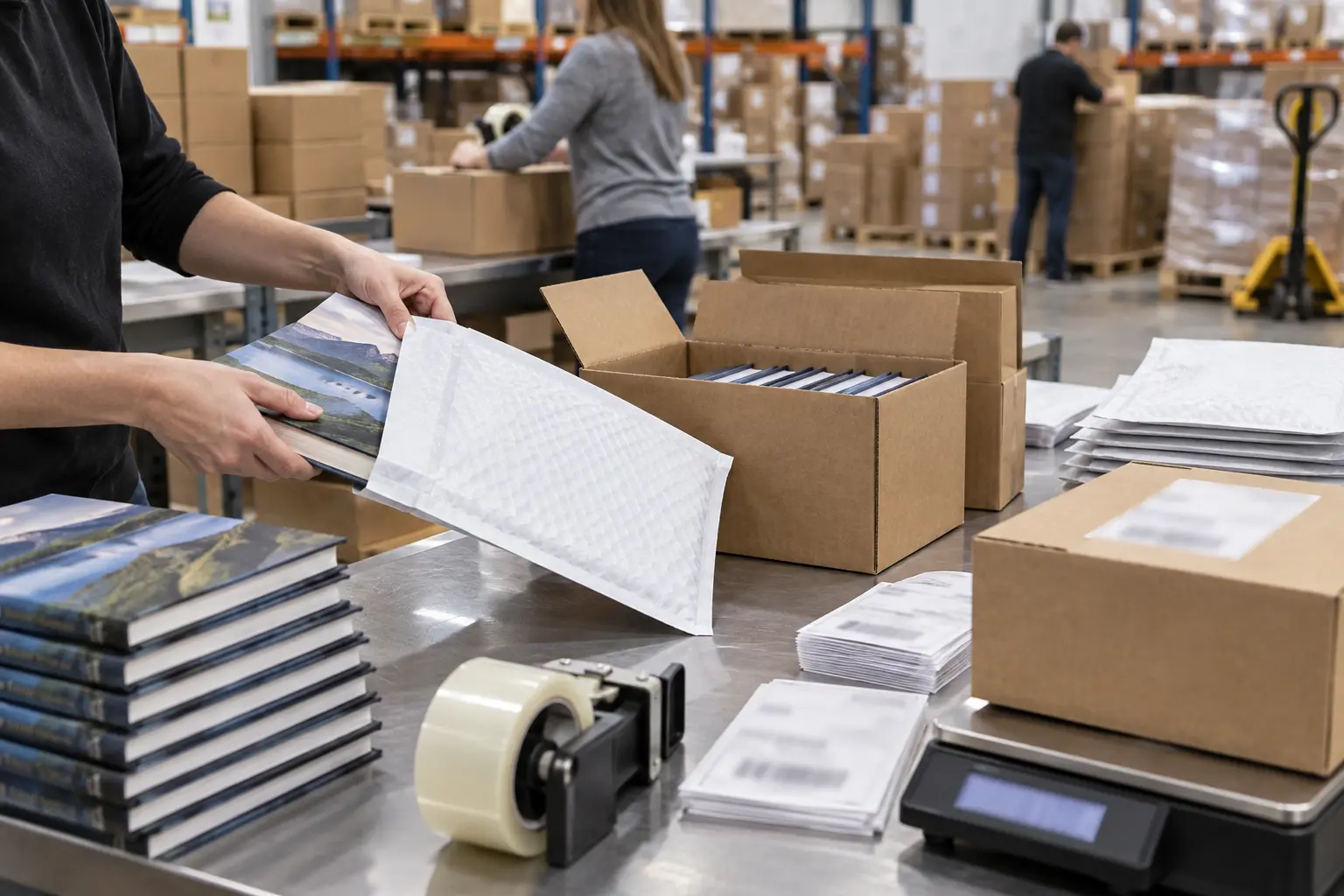
Test the exact packed reward: dimensions, weight, protection and label placement determine postage and damage risk.
For this reason, build a rate table by destination zone and reward tier. Include receiving, pallet breakdown, storage, mailer or carton, inserts, pick-and-pack, postage, tracking, address corrections, remote-area surcharges, returns and replacements. Decide whether backers pay shipping during the campaign, after the campaign through a pledge manager, or as part of the reward price—and communicate that choice clearly.
Illustrative Kickstarter Book Budget Model
This is a planning example, not a Prikoro client result or a price quotation. Imagine a creator expects 800 fulfilled rewards for a 6 × 9 inch, 192-page, full-color hardcover and plans 1,000 printed copies.
| Budget block | Illustrative share of project budget | Primary validation |
|---|---|---|
| Editorial, design and campaign assets | 12% | Contracted scopes |
| Proofs and book manufacturing | 34% | Locked printer quotation |
| Inbound freight and import | 12% | Forwarder and broker estimates |
| Fulfillment packaging and labor | 8% | Fulfillment center rate card |
| Backer postage | 18% | Zone/weight model |
| Platform and payment fees | 9% | Official country fee schedule |
| Contingency | 7% | Risk register and scenarios |
Importantly, the percentages are deliberately illustrative. Your mix may differ dramatically: a lightweight paperback shipped domestically may allocate less to delivery, while a large-format art book with international backers may allocate much more. Replace every percentage with a sourced number before launch.
Work Backward From the Promised Delivery Date
Therefore, a realistic schedule contains decision time, not just machine time:
- Finalize specification and request comparable quotes.
- Prepare files and complete preflight.
- Produce and courier proofs or prototypes.
- Allow creator review and correction time.
- Approve production and materials.
- Print, finish, bind, inspect and pack.
- Book freight and complete export/import formalities.
- Receive and count stock at the fulfillment center.
- Pick, pack and dispatch by region.
- Reserve time for address issues, delays and replacements.
In particular, do not promise the printer’s best-case completion date as the backer delivery date. Add buffers at approval, freight and fulfillment stages, where dependencies are outside a single supplier’s control.
How to Request a Comparable Book Printing Quote
First, send one specification sheet to every candidate supplier. Include trim size, page count, color, paper, binding, cover materials, finishes, quantity breaks, proof requirements, packing method, destination, required delivery window and requested trade term. Ask what is excluded, how long the price is valid, and which changes would trigger a requote.
Use the Prikoro order guide to organize your project, then contact Prikoro with the specification and target destination. Internal links open in a new tab so you can keep this budget guide visible.
How to Reduce Cost Without Weakening the Book
- For instance, use a standard or press-efficient trim size after checking imposition with the printer.
- Reduce unnecessary blank pages or signatures without compromising layout.
- Choose paper by opacity, print result and weight—not grammage alone.
- Likewise, limit specialty finishes to the element with the strongest visual impact.
- In addition, consolidate reward SKUs and packaging formats.
- Separate production savings from freight/storage consequences.
- Finally, lock files before the final proof to avoid remakes and schedule loss.
- Use regional fulfillment only when volume supports the extra inbound splits and administration.
Common Kickstarter Book Budgeting Mistakes
- Using the factory unit price as the reward cost. It excludes logistics and fulfillment.
- Quoting before files and specifications are stable. Page, paper and finish changes invalidate comparisons.
- Estimating postage from the naked book. Carriers charge for the packed parcel and may use dimensional weight.
- Offering too many variants. Complexity creates hidden labor and error costs.
- Ignoring damaged or lost deliveries. Keep both replacement stock and a service budget.
- Assuming fees are identical everywhere. Use the official schedule for the creator’s country.
- Presenting an untested prototype as final production. Explain material or process differences.
- Claiming environmental credentials without evidence. If FSC claims are important, confirm the certified chain of custody and permitted labeling for the specific job.
Frequently Asked Questions
How much does it cost to print a book for Kickstarter?
There is no responsible universal price. Trim size, pages, color, paper, binding, finish, quantity, packing and delivery terms all change the result. Request a specification-based quote and calculate landed and fulfilled cost per reward.
Is hardcover or paperback better for a campaign?
For example, hardcover can support a premium tier and stronger perceived value, but it is heavier and usually costs more to manufacture and ship. Paperback reduces weight and entry price. The best choice follows audience expectations and the complete fulfillment model.
Should shipping be included in the pledge price?
However, either method can work. The essential points are accurate zone-based estimates, transparent communication and a process for collecting addresses and handling later rate changes.
How many extra books should be printed?
Therefore, plan separately for replacements, review copies, archives, direct sales and retailer orders. Use expected damage/loss and sales plans rather than an arbitrary percentage.
Can I use one prototype for campaign photos?
In addition, identify differences if the prototype uses digital printing or substitute materials. Approve a production-representative proof before the full run.
What information does a printer need?
Trim size, page count, color, paper, binding, cover and finishes, quantity, files or sample references, packing, destination, timetable and delivery terms.
Final Planning Advice
Ultimately, a strong crowdfunding budget joins creative ambition to an auditable supply chain. Lock the book specification, prototype the packed reward, model each destination, clarify delivery terms and revisit time-sensitive rates before launch. The result is a funding goal that protects both the creator and the backer experience.