
Quick answer: A book ribbon marker is a fabric strip attached to a book during binding so readers can save a page. For a print run, specify the number, color, material and desired visible length, then ask your printer to confirm compatibility and provide a representative sample before production.
For publishers, independent authors and brands, a ribbon can be a useful feature in journals, reference books and special editions. Treat it as part of the book specification rather than a last-minute decoration: attachment, appearance and handling all need to work with the finished construction.
What is a book ribbon marker?
A book ribbon marker is a narrow length of ribbon secured to the book so it can lie between pages as a built-in bookmark. Unlike a loose paper bookmark, it stays with the book. The exact attachment method depends on the printer’s construction and should be confirmed for your project.
Do not confuse the marker with a headband or tailband: those are separate elements at the ends of a book’s spine. BookLogix lists ribbons and headbands separately among its hardcover options. If you need a removable promotional insert, consider printed bookmarks instead.
How do you specify a book ribbon marker?
Begin with how the reader will use the marker, then describe its visible appearance and the book it must fit. Give the printer the finished trim size and binding, the number of ribbons, preferred material and color, and where you want the ribbon to extend when the book is closed.
| Decision | Give the printer | Confirm on a sample |
|---|---|---|
| Quantity | One marker or multiple markers | Each ribbon can be used separately |
| Color | Physical reference or agreed color reference | Appearance with cover and endpapers |
| Material and width | Preferred texture and approximate width | Feel, flexibility and available options |
| Visible length | Desired extension beyond the closed page block | Reach across the open book and ease of use |
| End treatment | Desired cut or finish and reference image | Neatness and suitability for handling |
| Attachment | Book format and expected use | Construction and sample acceptance criteria |
Describe the desired visible length separately from the total ribbon length used in production. The attachment allowance and final cutting method are matters for the printer; do not assume a universal measurement. If the book size, page count or construction changes, reconfirm the sample specification.
Which material, color and width should you choose?
Choose a ribbon that complements the book and can be handled comfortably by its intended readers. Compare actual material samples, not screen colors alone. Width, texture and color availability vary by supplier; a wider or more elaborate ribbon is not automatically better for every book.
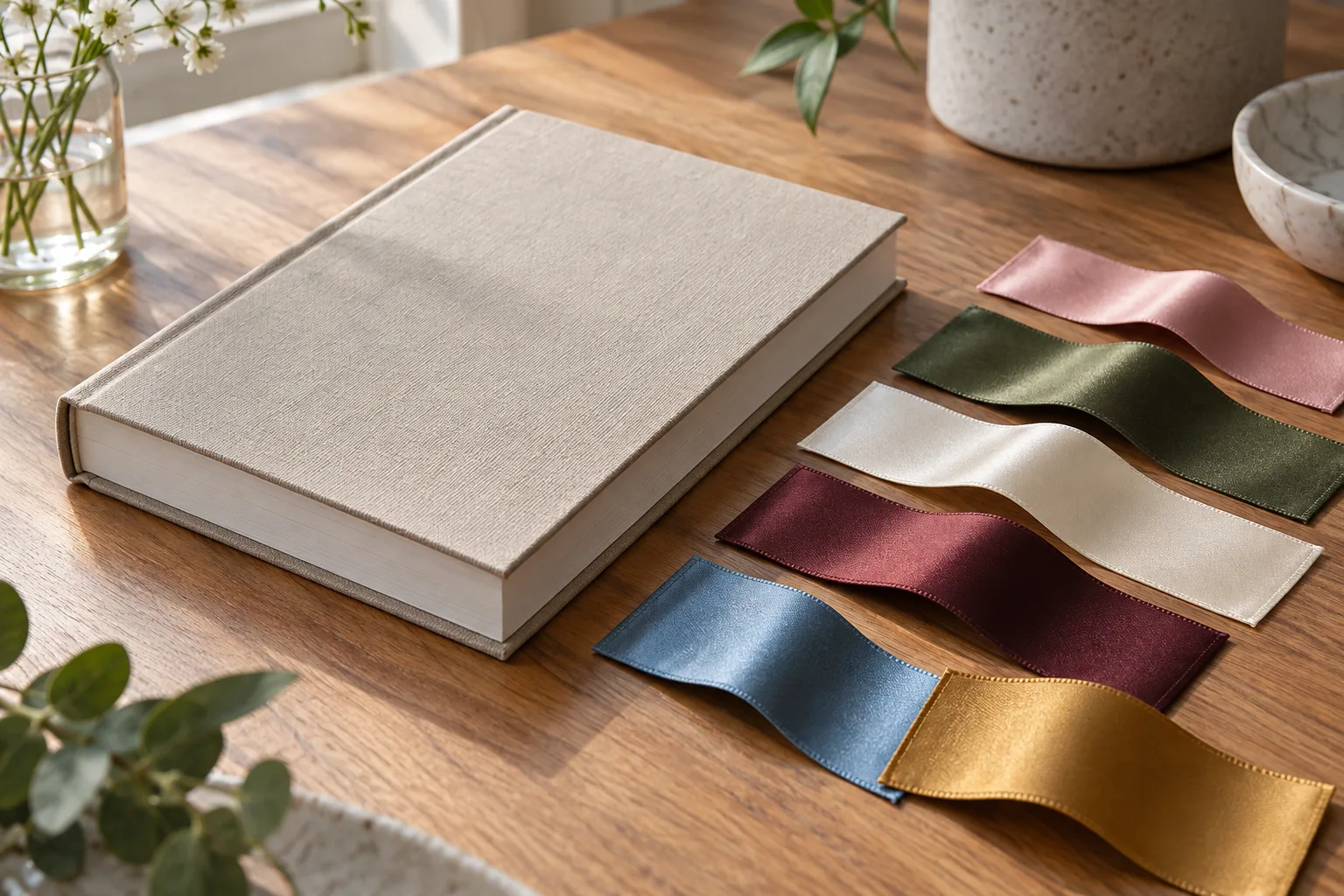
Ask to see the proposed material against the actual cover and endpaper colors. A sample also helps you judge whether the ribbon lies comfortably between pages. Ken the Book Printer, for example, lists multiple widths and notes that color availability varies by width. Its offer is not a guarantee of another supplier’s options.
For a special edition, coordinate the ribbon with other features without assuming they use the same materials or color process. Our special edition printing guide covers more choices to consider together.
Which bindings can include a ribbon marker?
Some casebound and flexible-cover constructions can accommodate an attached ribbon, but availability is determined by the supplier and the exact binding. Ask the printer to confirm the full format before ordering. Do not infer compatibility from a hardcover appearance alone: different binding structures may require different attachment methods.
For example, PufferPrint describes its own ribbon options and restrictions. Treat those as specific to its offering. Give your supplier the trim size, page count, paper, cover construction and expected use, and request a similar finished sample. The hardbound book checklist can help organize the rest of the specification.
How many ribbons does your book need?
One ribbon can mark a reader’s current page; multiple ribbons may help when a book has sections used repeatedly. A planner, cookbook or reference work may benefit from separate markers, but the usefulness depends on how the book is read and the supplier’s available construction.
Specify the number and color of each ribbon, and show how they should appear together. Ask whether the finished sample can demonstrate individual use without excessive bulk or tangling. PufferPrint describes multiple ribbons as an option for its own products; confirm your chosen printer’s capabilities rather than assuming the same offer.
What should you check on a physical ribbon sample?
Check the ribbon in a representative finished book before accepting the production specification. Compare it with the agreed material and color, open the book at different sections, and see whether the marker can reach and hold the intended page. Confirm what the sample does and does not represent.

- Confirm the number, color, texture and width against the approved reference.
- Check the visible extension when the book is closed and the reach when it is open.
- Examine the end treatment for neatness and any visible fraying.
- Use each ribbon in several positions and check for twisting, tangling or interference.
- Ask how attachment is secured and agree on suitable inspection criteria with the printer.
- Record any differences between the sample and final paper, binding or materials.
Do not pull aggressively or treat a single demonstration as a durability guarantee. Agree on the practical acceptance criteria and retain the approved sample or documented reference. For the complete project, use our book printing proof checklist.
What should be in your ribbon-marker printing quote?
Include the ribbon in the initial request for the whole book, and ask each supplier to quote the same specification. State the quantity of books and markers, trim size, page count, paper, binding, color reference, material preference and sample needs. Request confirmation of availability, cost and production implications.
- Describe the reader’s use and provide a photo or sketch of the desired appearance.
- Specify the visible length and any end-cut preference; ask the printer to determine the production length.
- List each ribbon separately if colors or materials differ.
- Ask whether the quote includes a representative finished sample and inspection criteria.
- Ask how substitutions, color matching, packing and schedule changes will be agreed.
Some customization is offered only under particular supplier conditions: Blurb’s customization page is one example. Do not apply another company’s quantities or prices to your own project; obtain a written quote.
Frequently asked questions
Is a ribbon marker the same as a headband?
No. A marker is used between pages; a headband is a separate feature at the top of the spine. Ask the printer how each feature is included in your construction.
Can every hardcover book have a ribbon?
Not necessarily. Hardcover constructions differ, and each printer has its own available methods. Confirm the specific binding and request a sample.
Can a book have more than one ribbon?
Some suppliers offer multiple markers. Confirm the number, colors, attachment and cost for the chosen book before approving the order.
How long should the ribbon be?
There is no universal length. Specify the desired visible reach and extension, then let the printer determine production length for the book and attachment method.
Can the ribbon match a cover color?
Often a close color can be selected, but available materials and color matching depend on the supplier. Compare a physical ribbon with the cover before approval.
Can the ribbon be added after the books are finished?
That depends on the construction and supplier. Plan the marker before binding and ask the printer about alternatives if the book is already complete.
How much does a book ribbon marker cost?
Cost depends on the supplier, order quantity, materials, number of ribbons and any special sourcing or sampling. Ask for a project-specific quote rather than relying on a generic price.
Plan the marker with the whole book
A book ribbon marker should be easy to use and suited to the finished edition. Share the intended appearance, confirm compatibility with the printer, and approve a representative physical sample with clear acceptance criteria. Verify the supplier’s actual materials, capacity and commercial terms for your project.
Sources
- Ken the Book Printer: Ribbon markers — supplier-specific materials, colors and widths.
- PufferPrint: Ribbon bookmark — supplier-specific construction and limitations.
- BookLogix: Hardcover printing — hardcover options including ribbons and headbands.
- Blurb: Book customization — example of supplier-specific customization conditions.