
Book packaging for shipping should protect the corners, keep the books from moving, and withstand the handling on the actual delivery route. For individual orders, start with a fitted corrugated book mailer or a rigid carton with suitable internal protection. For bulk deliveries, specify both the packed carton and the pallet arrangement. A retail slipcase or shrink wrap alone is not a complete shipping package.
The right design changes with book weight, binding, surface finish, order size, and destination. A paperback sent to a reader faces different risks from a pallet of hardcover art books delivered to a warehouse.
This guide explains how to choose materials, compare packaging quotes, and approve a repeatable packing specification before the print run leaves the factory.
Start with the Delivery Route
Choose packaging for every stage between the printer and the final recipient. First determine whether cartons remain on a pallet, are handled individually, or are opened and repacked by a fulfillment warehouse.
A factory carton can be suitable for pallet transport yet unsuitable for direct parcel delivery. Once a warehouse breaks the pallet down, an individual carton loses the support of adjacent cartons and the load restraint. Similarly, a carton containing multiple copies does not establish how one copy will be mailed to a customer.
Map the handoffs: printer, freight carrier, destination warehouse, fulfillment operator, parcel carrier, and reader. Agree who supplies the final customer mailer and who checks its fit. If your project includes crowdfunding rewards, coordinate packaging with the quantities and fulfillment assumptions in your Kickstarter book printing budget.
Use the receiving warehouse’s requirements for pallet dimensions, labels, carton weights, and appointment procedures. These are project requirements, not universal book-industry specifications.
Compare Book Packaging for Shipping
A fitted corrugated mailer is a useful starting point for a single book. A carton with engineered inserts offers more flexibility for heavier books or sets. Neither option should be approved from its appearance alone: check the actual book fit and the route-specific performance.
| Option | Useful starting point | What to check | Main limitation |
|---|---|---|---|
| Fitted corrugated book mailer | Single-copy paperback or hardcover orders | Book thickness range, corner buffers, closure, and movement | A poor fit can press on corners or leave the book loose |
| Rigid carton with fitted inserts | Heavy art books, premium editions, or multi-book sets | Insert fit, cover contact, carton strength, and packed dimensions | More components and assembly time |
| Flexible padded envelope | Only products and routes validated for this format | Bending, corner impacts, and abrasion on the actual book | Limited structural resistance to crushing or bending |
| Master carton on a secured pallet | Bulk delivery to a distributor or warehouse | Copy count, packed weight, stacking, pallet footprint, and restraint | May require separate packaging after the load is broken down |
| Slipcase or presentation box inside a shipper | Gift editions and collectible sets | Protection of both the book and the presentation package | The decorative box remains part of the product being protected |
For hardcover book printing, evaluate the projecting cover corners and any dust jacket. For softcover books, evaluate bending and cover creasing as well as impacts. Select the least complex package that meets the agreed protection criteria.
Protect Corners, Covers, and Page Edges
Internal packaging needs to restrain the book and manage contact with the outer package. Filling a large empty space with loose material does not automatically produce reliable corner protection.
Corner protection and movement
Inspect all four corners after closing a sample package. Look for clearance, appropriately fitted buffers, and areas where the book can slide into an unprotected carton wall. Inserts must hold the product without bending its boards or forcing the spine against a hard edge.
Ask the packer to demonstrate the assembly sequence. A design that works only when one experienced operator places each cushion precisely may be difficult to reproduce throughout a print run. Record insert orientation and placement in the packing instructions.
Surface protection
Use a clean, compatible protective layer when cover abrasion is a concern. Review it against the actual laminate, foil, dust jacket, or printed edges. Avoid direct adhesive contact with the finished book unless it has been specifically approved.
A decorated edge or jacket can make an otherwise small cosmetic defect unacceptable. Establish those criteria before choosing packaging. The dust jacket decision affects what needs protection as well as the finished appearance.
Moisture protection
Identify likely exposure during loading, storage, and delivery. A protective bag can provide a barrier against incidental contact, but it is not a substitute for dry books, dry packaging, and suitable storage. Do not specify desiccants or sealed moisture barriers without reviewing the route, materials, and packing conditions with the supplier.
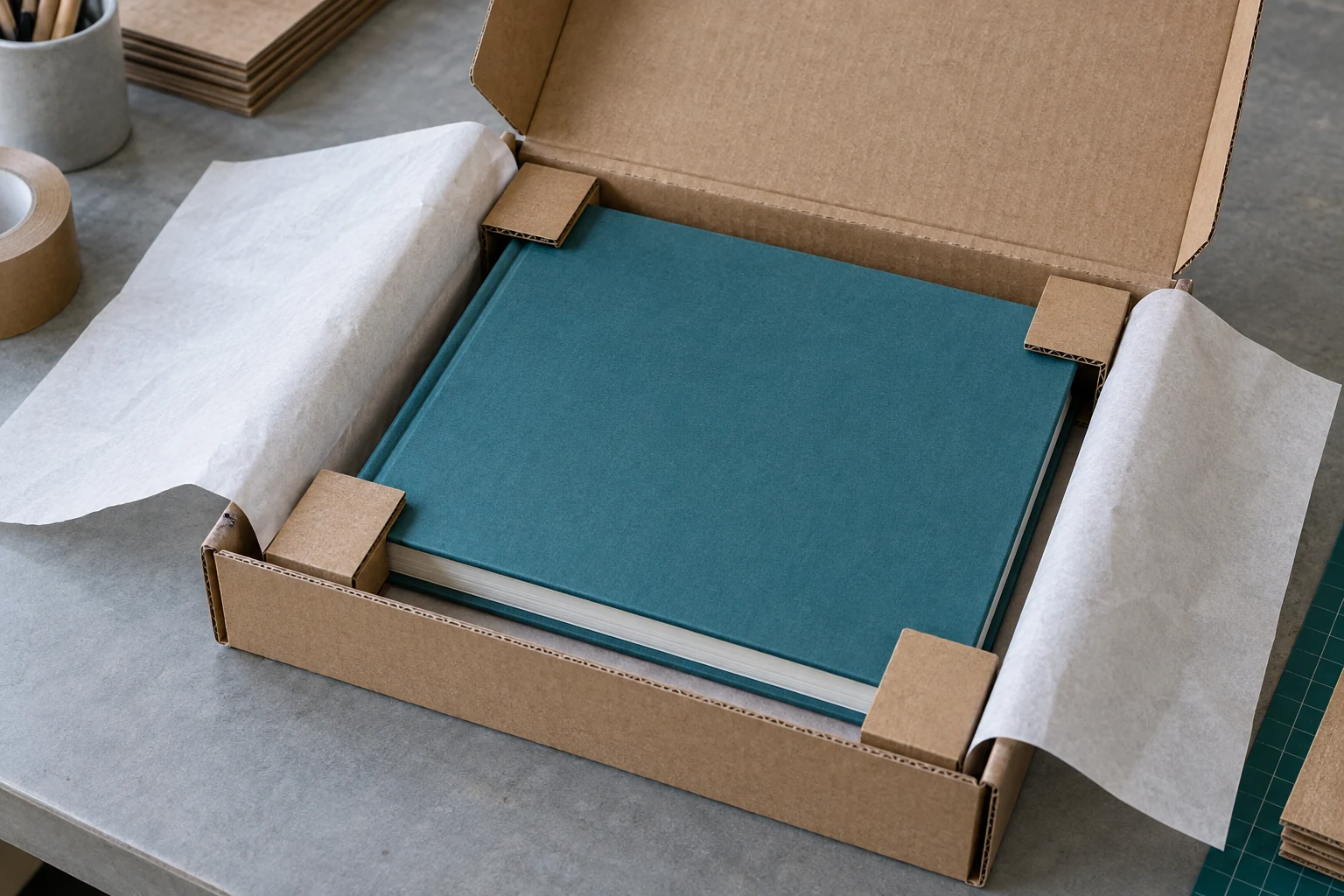
Specify Cartons and Pallet Loads
A useful carton specification includes the construction, internal arrangement, copy count, packed dimensions, and gross weight. “Export carton” is too vague to compare competing quotations.
UPS advises using a rigid box with attached flaps and respecting the box’s marked weight limit. Its current packaging guidance also covers suitable cushioning and secure closures. Follow the requirements of the carrier and service actually selected; generic guidance does not validate a particular book package.
| Specify | Ask the supplier to record | Why it matters |
|---|---|---|
| Carton construction | Board construction, grade or strength specification, and box style | Allows the approved construction to be reproduced |
| Internal packing | Book orientation, copies per layer, dividers, wraps, and inserts | Controls movement and contact between copies |
| Carton measurements | Internal dimensions, packed external dimensions, and gross weight | Separates fit requirements from freight measurements |
| Closure | Tape material, application pattern, and any approved strapping | Reduces variation in assembly and sealing |
| Pallet plan | Footprint, layer pattern, load height, weight, and restraint | Matches warehouse handling and transport requirements |
| Identification | Title or SKU, edition, carton count, copy count, and required labels | Supports receiving and inventory checks |
Approve copies per carton using the real packed weight, safe handling requirements, and the warehouse’s limit. Do not force every title into the same carton quantity: different page counts and paper stocks change weight and bulk.
For pallet delivery, keep cartons within the agreed footprint and confirm how edge protection, wrapping, or strapping is applied. Excess restraint can deform cartons; insufficient restraint can allow the load to shift. Review the complete load rather than a photograph of one empty carton.

Compare the Full Packaging Cost
Compare packaging using the total cost of preparing and delivering a saleable book, not just the price of an empty carton. Include materials, assembly, freight measurements, receiving labor, and any repacking stage.
A larger carton may reduce the number of cartons but increase handling difficulty. An oversized customer mailer may add freight volume. A complex insert can protect a premium edition yet slow fulfillment. Ask each supplier to quote the same approved book dimensions and packing arrangement.
A practical comparison is: materials + packing labor + freight effect + receiving or repacking cost + expected replacement cost. Treat replacement cost as a scenario until you have actual damage data; do not invent a damage percentage to make one option look cheaper.
Request the packed external dimensions and gross weight for each option so your freight provider can compare the charges. Confirm whether a quote covers only bulk factory packaging or also individual reader orders.
Approve Samples and Transport Testing
Approve a representative packed sample and define acceptable condition on arrival before committing to production. The sample should use the actual book or a closely representative equivalent, along with the proposed carton, inserts, protective layers, and closure.
Agree what counts as damage: crushed cover corners, torn jackets, scuffed foil, bent pages, opened closures, or a presentation box that no longer meets the saleable standard. Distinguish damage to the shipping carton from unacceptable damage to the product.
| Check | Evidence to request | Decision |
|---|---|---|
| Product fit | Open and closed sample photos; inspection of movement and contact points | Revise inserts or dimensions if the book shifts or is compressed |
| Packing repeatability | Assembly sequence and component list | Approve instructions that operators can reproduce |
| Distribution performance | Applicable test plan, documented sample specification, and results | Accept only against agreed product damage criteria |
| Production consistency | Checks of materials, copy count, weight, closure, and pallet arrangement | Hold deviations for review before dispatch |
| Destination receiving | Warehouse feedback from a planned trial shipment, when appropriate | Resolve unloading, labeling, or repacking problems |
Choose a transport test with a qualified packaging laboratory based on the actual route. ISTA’s test procedure descriptions distinguish early design screening from simulations of distribution hazards. A simple informal drop check should not be presented as a completed ISTA procedure.
ISTA’s selection guidance identifies different procedures for parcel delivery, less-than-truckload transport, and manufacturing-to-distribution-center loads. Confirm the current procedure, its scope, and any customer requirements with the laboratory. A test on one configuration does not establish performance for a different book, carton quantity, or packing method.
Keep the report with the approved packing specification and review relevant changes before repeating an order. Packaging approval complements the production approvals described in the book printing proofs guide; it does not replace them.
Example Packing Specification
Illustrative example: A publisher plans a 1,000-copy run of a 210 × 280 mm hardcover art book with a dust jacket, bulk delivery to a fulfillment warehouse, and subsequent single-copy parcel orders. These details are hypothetical, not a completed Prikoro order or a tested packaging recommendation.
The publisher requests two approvals. First, the printer proposes a master carton using the measured finished-book thickness and weight, with protective layers between copies as needed. Copies per carton remain provisional until the packed sample satisfies the warehouse’s handling and weight requirements.
Second, the fulfillment operator proposes a fitted single-copy shipper. It must protect the jacket and cover corners and accommodate the finished book without excessive movement. The publisher approves a separate sample for this stage rather than assuming the bulk packing method will work.
The approval record lists the book specification, carton and insert components, assembly photos, packed measurements, damage criteria, and agreed testing. Any change to those components triggers a review. This approach separates the two delivery environments and makes both responsibilities explicit.
Prepare a Packaging Quote Request
Send the supplier the finished trim size, thickness and weight if available, binding, cover finish, jacket or slipcase details, total quantity, delivery route, and receiving requirements. Identify whether the request includes single-copy fulfillment or only bulk delivery.
Ask for the proposed protection materials, packing labor, carton quantity, packed dimensions, gross weight, pallet plan, sample cost, and testing arrangements as separate items. If the finished book is still being developed, identify which measurements are provisional and when they will be confirmed.
You can send Prikoro your book and delivery requirements to discuss the printing specification and proposed packing plan. For related production decisions, browse the book manufacturing guides.
Effective book packaging for shipping starts with the route, then combines product protection, repeatable assembly, and a documented approval. Confirm both the bulk delivery package and the final reader package when the project uses more than one distribution stage.
Frequently Asked Questions
Is shrink wrapping enough to ship a book?
No. Shrink wrap can help keep a book together and provide surface protection, but it does not supply the structural protection of a suitable shipping carton or mailer. Review it as one component of the packing system.
Can I ship a hardcover book in a padded envelope?
Only if that book and package have been validated for the intended route and acceptable condition on arrival. For valuable editions or vulnerable corners, evaluate a rigid mailer or carton with internal protection first.
Should books be packed flat or upright?
Approve the orientation that works with the book, carton, inserts, and transport conditions. Flat stacking can be practical, but copy weight and contact surfaces still need review. Avoid using orientation alone as evidence of protection.
How many books should go in one carton?
Use the actual finished-book weight, packing weight, carton capacity, and receiving limits to decide. Confirm the quantity with a packed sample rather than choosing a fixed number for every title.
Does a slipcase replace a shipping box?
Usually it should be treated as part of the product that needs protection. A decorative slipcase may be damaged during handling even if the book remains intact. Approve an outer shipper unless the presentation package itself has been validated for shipping.
Do all book shipments need ISTA testing?
The testing requirement depends on customer specifications, carrier requirements, route, and risk. Discuss the appropriate level of evaluation with the buyer and packaging laboratory. Do not claim ISTA-tested performance without a relevant documented test.
Can one packaging sample cover every book size?
No. Changes to book dimensions, weight, surface finish, carton quantity, or protective components can change package performance. Review the variation and obtain additional samples or testing where necessary.
Who should approve packaging before dispatch?
The buyer should approve the specification with the printer and any fulfillment or receiving partner whose requirements affect it. Assign responsibility for final customer packaging explicitly when a warehouse repacks the books.
Sources and Further Reading
The official references linked above support general carrier guidance and test selection. The book-specific checklists and illustrative specification are procurement recommendations, not claims of completed testing or certification.
- UPS — How to Pack Your Shipments.
- International Safe Transit Association — Test Procedures.
- International Safe Transit Association — Getting Started with Design & Testing.