Quick answer: A useful book printing paper specification states more than GSM. Define the book component, finish, grammage, shade, opacity expectation, bulk or caliper reference, grain-direction question, artwork coverage, and proof/sample needed for approval. Then ask each printer to quote the same written specification, including any acceptable equivalent, so the proposals can be compared fairly.
For a novel, catalogue, illustrated title, workbook, or children’s book, paper changes the reading experience as well as the physical dimensions of the finished object. This guide explains what each paper term means, which questions to put in a quote request, and what a sample or proof should answer. It does not promise a particular Prikoro stock, price, minimum order, production method, or delivery date.
Start with the job the paper must do
Choose book printing paper by the reader’s task before choosing a number on a swatch. A text-heavy book may prioritize comfortable reading and controlled show-through; a colour-led title may prioritize image reproduction; a workbook may need a surface suitable for writing. State the use, ink coverage, format, binding, and desired feel before asking for a recommendation.
The same nominal weight can produce different results in different grades. A paper description should therefore connect an observable need to a property a supplier can identify. For example, “avoid distracting show-through on text pages with occasional solid black illustrations” is more actionable than simply asking for “thicker paper.”
| Reader or content need | Questions to state in the brief | What to compare between proposals |
|---|---|---|
| Long-form text | Reading comfort, desired shade, reverse-side visibility, final page count | Named grade, finish, grammage, opacity information, bulk/caliper and proof method |
| Full-colour illustration or photography | Image coverage, desired surface, glare tolerance, colour-critical pages | Coating/finish description, sample sheets, colour-proof scope and proposed equivalent |
| Workbook or activity content | Writing/erasing expectations, repeated handling, inks and marks likely to be used | Surface suitability confirmed for the intended use, show-through test and page construction |
| Premium or gift edition | Hand feel, perceived thickness, opening behaviour, cover and binding route | Bulk/caliper, grain direction discussion, sample or dummy, and the confirmed spine process |
When the physical size is still being planned, use the same trim size and page count in every request. The finished page block and spine also depend on paper thickness and construction, so defer final cover-spine artwork until the paper and binding specification are confirmed. See our guides to book paper thickness and paper grain direction for the terms behind those questions.
Specify finish, shade, opacity, bulk and caliper separately
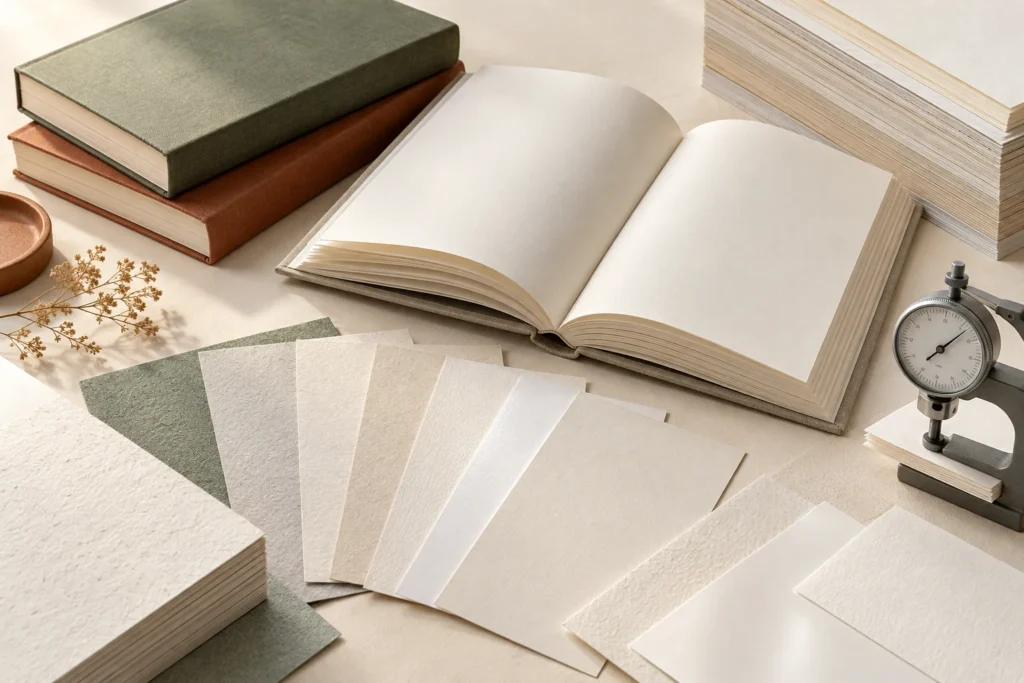
A complete book printing paper description separates properties that are often blended together. Finish affects surface appearance and how the sheet feels; shade affects the page colour; opacity concerns reverse-side visibility; and bulk or caliper contributes to page-block thickness. Grammage measures mass per area, so it is useful, but it does not stand in for all of those other properties.
Finish. Describe whether the intended reading experience calls for an uncoated, coated, matte, silk-like, gloss, or another named surface. Do not assume two similarly named finishes will behave identically. Ask the supplier to name the proposed grade and provide a sample or technical description relevant to your artwork.
Shade. State whether the target is white, natural, cream, or a named reference. Shade is not merely decorative: it changes how pages feel to read and how printed colour is perceived. For colour-critical books, identify which pages matter most and include them in the proofing discussion.
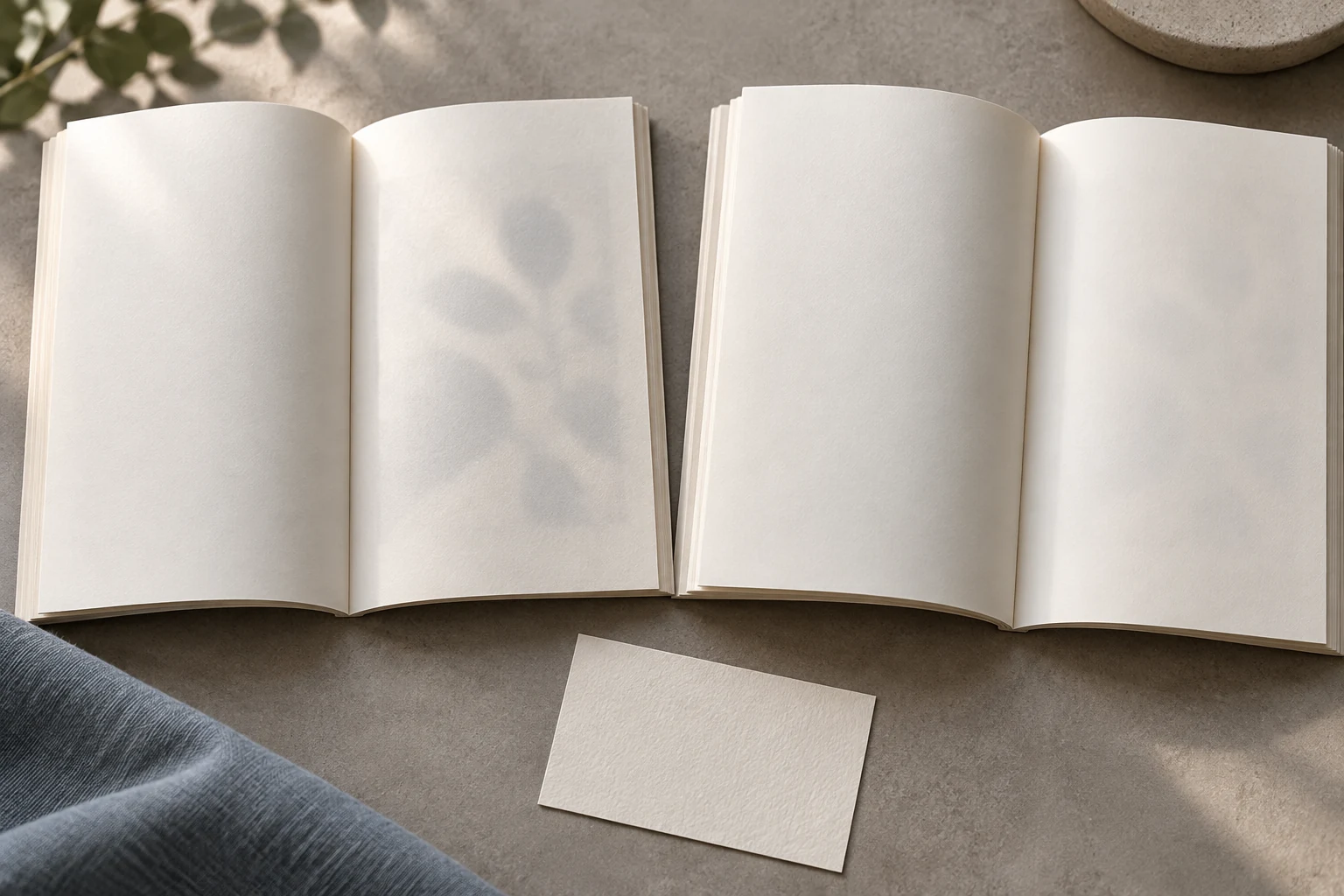
Opacity. Opacity addresses how much printing from the reverse side can be seen through a sheet. Heavy coverage, fine reversed type, paper formation, coating, and the print process can all affect the result. Rather than treating one published percentage as a universal rule, evaluate representative pages printed on both sides in their intended reading sequence.
Bulk and caliper. Bulk is commonly used to describe how much thickness a paper grade builds for its weight, while caliper is a thickness measurement. They matter when a book’s hand feel or spine planning matters. They are planning inputs, not a substitute for a supplier-confirmed spine width after the final paper and binding route are set.
For terminology and a technical procurement perspective, consult the World Bank reading-book technical specifications and the UPM Book creamy 2.2 technical values. Published supplier data is informative; it does not confirm what is available for an individual project.
Use the artwork to decide what must be tested
Artwork changes the book printing paper questions. A mostly black-text interior, a book with pale illustrations, and a dense full-bleed image book can put very different demands on the same sheet. Identify the pages with the most coverage, darkest solids, fine reversed type, skin tones, or subtle gradients, then use those pages to define the sample or proof you need.
Send final or representative files when possible. If files are still in development, label every assumption—trim size, page count, colour coverage, paper preference, binding, quantity, and destination—so a later change can be traced to a revised quote rather than mistaken for a price discrepancy.
- Show-through: assess reverse-side interference while reading a two-sided sequence, not one loose sheet in isolation.
- Image reproduction: identify critical images or colour areas and ask what the chosen proof is intended to verify.
- File setup: confirm trim, bleed, resolution, colour setup, and cover requirements before final export.
- Spine: request the final spine measurement only after the confirmed paper and binding specification are in place.
Use our book printing file requirements, bleed guide, image-resolution guide, and rich-black guide to prepare focused questions. For approval planning, see what to approve on a book proof.
Put the paper specification into a quote request
A quote is comparable only when each supplier is pricing the same paper decision. Give the proposed paper enough detail to be identifiable, but allow a supplier to state a genuinely equivalent alternative separately. That keeps an alternative stock, finish, or thickness from being mistaken for the requested specification when you compare totals.
Copy this structure into your request and complete only the fields you can confirm. Unknowns should be marked as open decisions rather than silently assumed.
| Field | What to provide | Why it matters |
|---|---|---|
| Component | Interior, cover, endpaper, jacket, insert, or another clearly named part | Different components can have different paper requirements. |
| Project format | Finished trim size, orientation, final page count, binding and cover construction | Lets the printer assess the complete physical book. |
| Paper preference | Named grade if known; otherwise finish, grammage, shade, bulk/caliper need and opacity expectation | Avoids comparing an unspecified stock with a named alternative. |
| Artwork coverage | Text-only, spot colour, full colour, full bleed, high-coverage pages, or critical images | Defines the pages that should inform the paper and proofing conversation. |
| Grain and spine question | Ask whether grain direction is relevant and request final spine guidance after materials are fixed | Keeps construction questions visible before cover approval. |
| Proof or sample | What you want to verify, which pages to use, and whether a swatch, printed sheet, dummy, or proof is needed | Matches the approval step to the uncertainty being tested. |
| Equivalent alternatives | Ask the supplier to identify every proposed substitution clearly | Preserves an apples-to-apples baseline. |
For the wider quotation comparison, use the same brief for paper, binding, proofing, packing, quantity, and delivery scope. Our book-printer evaluation guide explains how to assess the written response, not simply the headline price.
Approve the paper and process together
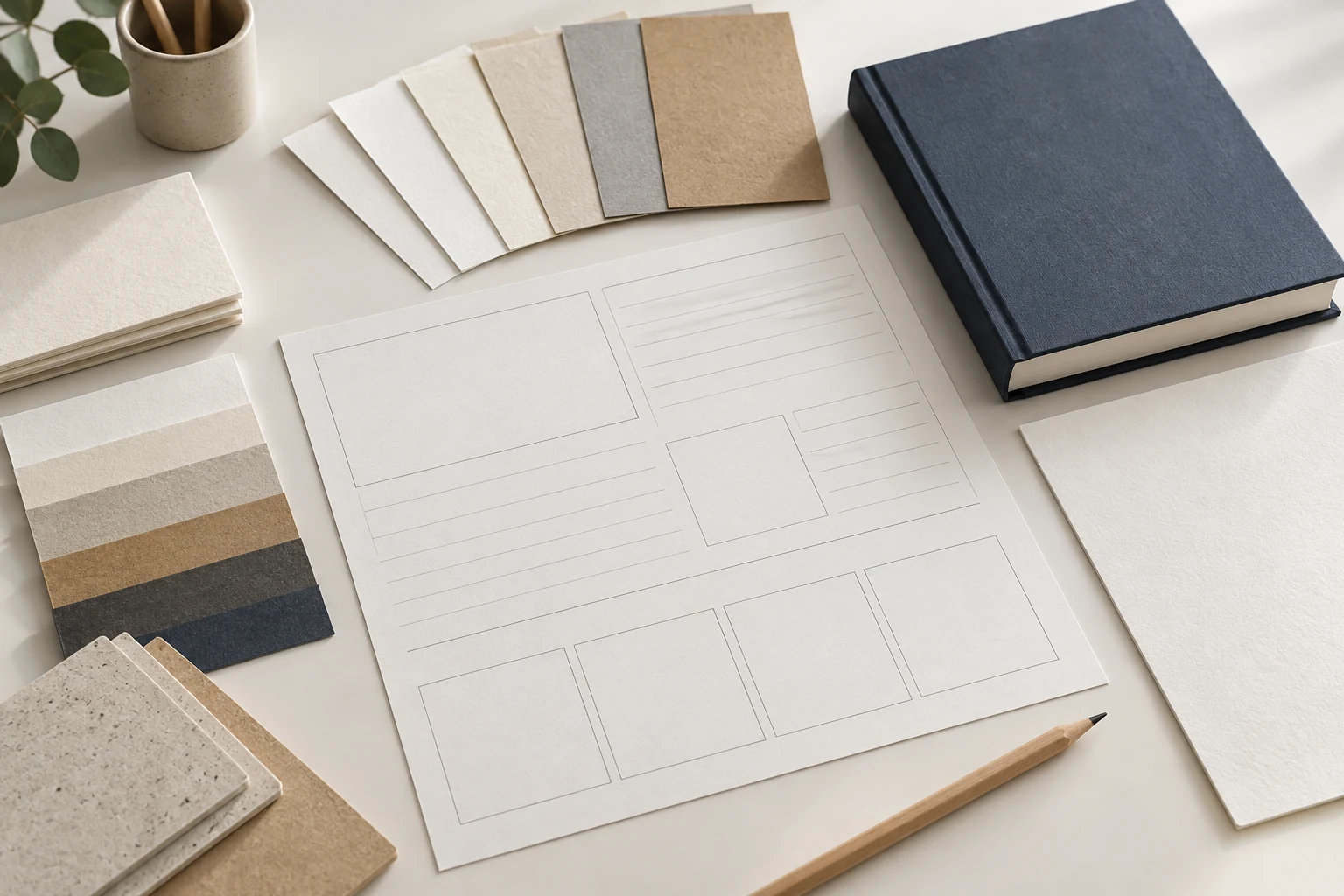
A swatch, printed sheet, bound dummy, and final proof do not answer exactly the same question. Select the approval item that tests the risk you are managing: a swatch can help with feel and shade, representative printed pages can reveal show-through and image behaviour, and a bound sample can clarify construction and opening behaviour. Confirm the proposed purpose before approving.
Keep a dated record of the approved sample, named paper description, files used, and any approved alternatives. If the project changes, ask whether the change affects the quoted paper, spine, proof requirement, or delivery assumptions. This creates a traceable production decision without pretending that an early planning estimate is a final production specification.
Frequently asked questions about book printing paper
Is GSM enough to specify book printing paper?
No. GSM states mass per area, but it does not fully state finish, shade, opacity, bulk, caliper, or how a particular grade will behave with your artwork. Use it as one field in a fuller specification.
What does opacity mean in book paper?
Opacity describes resistance to reverse-side visibility. It should be assessed with representative two-sided pages because artwork coverage, ink, surface, and viewing conditions affect the reading result.
Is coated or uncoated paper better for a book?
Neither is universally better. Choose based on the intended reading and visual outcome, the artwork, the desired surface, and the approval evidence you need. Ask for a named proposed grade rather than relying only on a generic category.
How does paper affect spine width?
Paper thickness, bulk, page count, compression, and binding construction all affect the page block. Use early calculations for planning, but obtain the final spine measurement from the supplier after the material and binding are fixed.
Should I request a paper sample before printing?
Yes when feel, shade, surface, or opacity is a meaningful decision. A sample alone may not predict printed performance, so define whether you also need representative printed pages, a proof, or a bound dummy.
Can a printer substitute an equivalent paper?
It can propose an alternative, but the alternative should be identified separately with its relevant properties and effect on the book. That lets you compare it with the requested specification rather than treating two different papers as the same quote.
What should I include when requesting a book-paper quote?
Include the component, trim size, page count, binding, cover construction, paper preference or performance need, artwork coverage, proof requirement, quantity, and delivery scope. Label unresolved items as assumptions.
Next step: turn a paper preference into a reviewable brief
Start with the reader, identify the pages that carry the greatest technical risk, and put the requested book printing paper properties in writing. A supplier can then respond to a clear paper question, propose alternatives transparently, and explain which sample or proof will verify the remaining uncertainty for your particular book project.