
Perfect binding quality should be assessed through page retention, cover attachment, normal opening and consistent finishing. A straight spine and clean trim are useful visual checks, but they do not establish bond strength. Agree the adhesive, conditioning period, inspection method and acceptance criteria before the production sample is approved.
For paperbacks, catalogs and manuals, the relevant question is whether the specified construction performs as intended. PUR or EVA is an adhesive description, not a complete quality result. This guide explains which evidence a buyer should request, when freshly bound books can be assessed and how to document a meaningful acceptance decision.
Perfect Binding Quality: What to Inspect
Separate appearance, functional handling and measured performance. Each check answers a different question. A well-presented sample can still contain a weak area of adhesion, while a strong page bond does not excuse missing pages or an incorrectly attached cover.
| Quality area | Buyer-visible check | Evidence beyond appearance |
|---|---|---|
| Page retention | No leaves loosen during agreed normal handling | Documented retention testing where required |
| Cover attachment | Cover remains attached without unintended separation | Inspection of the specified hinge and side-glue construction |
| Opening behavior | Pages can be read at the intended opening position | A representative bound sample using the proposed materials |
| Spine and trim | Aligned block, appropriate cover fit and clean edges | Agreed dimensional and workmanship criteria |
| Content integrity | Correct sequence with no missing or duplicate pages | Collation checks and the approved file/page map |
Specify how the book will be used. A display catalog, a regularly consulted manual and a disposable event paperback can have different handling demands. If the buyer needs an opening behavior closer to a lay-flat product, resolve the binding choice before production instead of assuming all glue-bound books provide it.
Review Spine Preparation and Material Compatibility
A reliable adhesive bond depends on the prepared spine and the selected materials, as well as the adhesive grade and application. Ask the supplier to confirm the binding route for the actual paper, print process and book-block thickness.
HEIDELBERG’s C.P. Bourg binder description identifies milling and roughening as spine preparation operations and describes adjustments related to book-block thickness. It illustrates why adhesive selection is only part of the process. It does not establish which equipment Prikoro uses.
Milling, roughening and dust removal should be appropriate for the proposed construction. If a problem develops, the supplier should investigate the prepared paper surface, adhesive application and process settings rather than simply switch adhesive labels and declare the issue resolved.
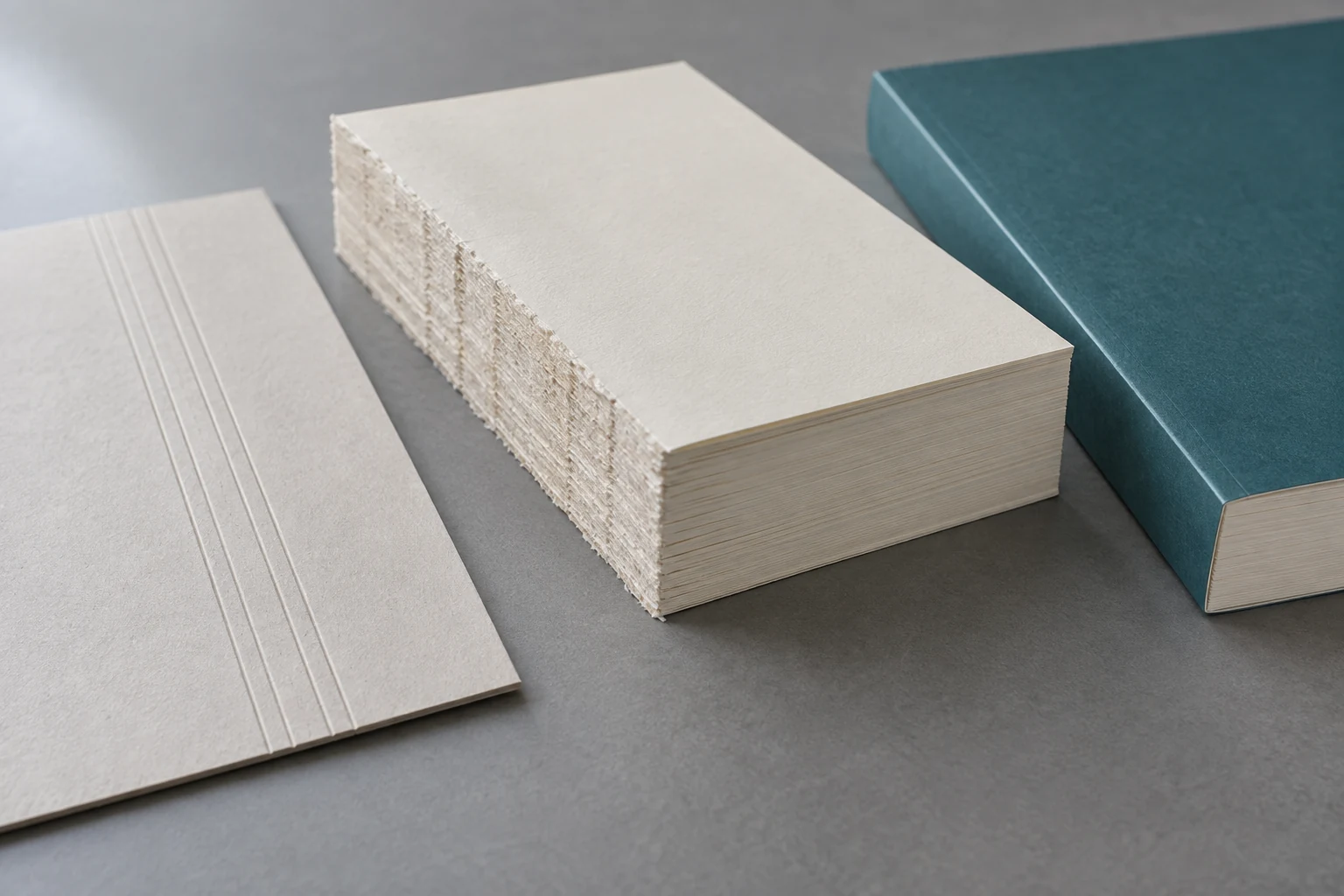
Paper coatings, printed surfaces, inserts and mixed stocks can change the bonding challenge. Give the printer a complete specification, including unusual interior materials. A sample made from an easier substitute stock is not equivalent evidence for the production book.
Henkel’s bookbinding application overview discusses page pull, flex performance and solutions matched to machine, substrate and application. Use those categories to ask precise supplier questions rather than treating “premium glue” as a measurable specification.
Paper orientation also affects handling. Review the book paper grain direction guide when defining the production materials. Adhesive performance and comfortable opening should be evaluated together on the intended construction.
Allow the Correct Cooling and Curing Period
Do not compare books tested at different stages of adhesive development as though they represent identical conditions. Record when binding occurred, how the sample was conditioned and when inspection or testing took place.
H.B. Fuller’s technical guidance on freshly bound books distinguishes conventional hot-melt cooling from PUR’s additional moisture-assisted curing. Its 2018 article gives a one-hour rule of thumb for the described hot-melt systems and recommends 24 hours for PUR checks, while noting some PUR grades can be checked sooner.
Those figures are contextual manufacturer guidance, not a universal release schedule. Follow the selected adhesive’s current technical instructions and the binder’s confirmed process. Ask whether the timing applies to initial handling, trimming, strength testing, packing or shipment; these are different decisions.
A book that feels set is not necessarily ready for a meaningful strength comparison. Conversely, a weak result from a prematurely tested sample should not be used to dismiss the entire production run without reviewing the timing and method.
| Timing question | Information to record | Why it matters |
|---|---|---|
| Which adhesive was used? | Grade or traceable reference, not just PUR/EVA | Technical requirements vary within an adhesive family |
| When was the sample bound? | Production date and time | Establishes elapsed time before assessment |
| How was it conditioned? | Relevant storage/environment details and manufacturer instructions | Cooling and reactive curing depend on the actual conditions |
| Which operation is being authorized? | Handling, testing, trimming, packing or shipping | A timing rule for one stage may not authorize another |
| Was anything changed? | Paper, adhesive or process revision | Earlier approval may no longer describe the new sample |
Distinguish Visual Checks, Page Pull and Flex Testing
Visual inspection looks for observable defects. Normal handling evaluates whether the book behaves appropriately in use. Instrumented retention and flex testing provide evidence under a defined method. None should be described as interchangeable.
Use a defined page-retention method
A page-pull assessment measures resistance to removal under specified test conditions. If the contract calls for numerical results, agree the apparatus, specimen preparation, pull procedure, tested locations, conditioning and reporting units before comparing numbers.
A force reading and a result normalized by binding length are different quantities. Do not compare them without knowing the method and calculation. Ask for the underlying records and the agreed acceptance criterion; this guide does not prescribe a universal pass value.
Describe repeated-flex requirements clearly
Flex assessment can address performance under repeated movement using an agreed procedure. The opening angle, movement sequence and number of cycles should be specified if results are used for acceptance. An informal demonstration of one book opening comfortably is not a quantified endurance result.
Record the failure, not just the number
If a tested leaf separates, describe what happened. Paper tearing, separation at an interface and failure within the adhesive layer can support different investigations. Include photographs of the failure location and ask the supplier to interpret them with the material and process information.
Destructive tests consume sample copies. Agree this allowance in advance and keep the test specimens separate from saleable inventory. Do not repeatedly yank pages from the only approval sample and then judge its normal opening as though it were untouched.
Check Opening and Cover Attachment
Open the booklet or paperback in a way that reflects its intended use. Inspect the beginning, middle and end, and look for unwanted cracking, loose leaves, gaps or cover separation. Avoid forcing a conventional perfect-bound book flat as an improvised strength test.

Review the cover’s spine width, score placement and hinge behavior. A cover that resists opening or pulls away can need investigation of its fit and attachment, even when the internal page bond appears satisfactory.
Keep essential artwork away from the binding area according to the agreed layout specification. An unreadable crossover may be a composition or binding-choice problem rather than an adhesive defect. Compare the finished sample with the reading experience originally requested.
If the opening requirement cannot be met by the proposed construction, revisit the options in the commercial binding guide. Do this before authorizing a full run.
Define Sample Selection and Acceptance Records
A specially selected sample does not prove consistency across an entire batch. Agree how production samples will be selected and how many are needed for each inspection or test. The plan should reflect run size, material changes and the consequences of failure.
| Approval record | Minimum useful content | Question it resolves |
|---|---|---|
| Construction specification | Paper, cover, binding route, page count and adhesive reference | Does the sample represent the ordered book? |
| Sample identification | Batch, copy reference and selection location or stage | Where did the tested book come from? |
| Conditioning record | Binding time, assessment time and relevant conditions | Was it assessed at the agreed stage? |
| Method and results | Procedure, units, locations, observations and criteria | What evidence supports acceptance? |
| Disposition | Approved revision, investigation or corrective action | Which production condition is authorized? |
Separate sample appearance approval from production-release approval. A blank dummy confirms aspects of structure, but it does not automatically establish adhesion with the printed production materials. A finished proof may provide more relevant evidence; document its limits as well.
Use the book printing proof approval guide to define the approval scope. If the materials or process change after approval, ask which checks must be repeated.
Example Approval and Supplier Questions
Illustrative example: a publisher plans 2,000 copies of a 160-page perfect-bound catalog on coated paper. The opening requirement is regular reference use, with a separate cover stock. This is a hypothetical sourcing scenario, not a completed Prikoro project or a price quotation.
The buyer requests a sample using the proposed materials and asks the supplier to identify the adhesive and testing schedule. Instead of approving a photograph of the spine, the buyer reviews normal opening and cover attachment, then agrees the evidence needed for page retention.
If a sample fails, the team records its age, test method and failure location before deciding on corrective action. The supplier investigates spine preparation, adhesive application and material compatibility. A revised sample is assessed under the same agreed conditions before release.
For a useful quotation, provide trim size, page count, paper grades, cover treatment, printing process, quantity, delivery destination and expected use. Ask which binding route, conditioning requirements, sample plan and retention evidence are included. Testing, proofing and revisions can affect both schedule and cost.
Include these requirements with your perfect-bound book printing specifications. You can send Prikoro the proposed materials and quality expectations for a project discussion. Confirm the acceptance plan before ordering rather than adding an undefined “strong binding” requirement after production.
Final Recommendation
Evaluate perfect binding quality with evidence that matches the actual book construction. Confirm material compatibility, spine preparation and adhesive conditioning; assess normal opening and cover attachment; and use defined tests where the contract requires measured performance. Record the approved sample, method and production revision before shipment.
Frequently Asked Questions
Does PUR binding guarantee that pages will not fall out?
No adhesive label guarantees the complete binding result. Paper, spine preparation, application, curing and cover construction also matter. Request evidence for the actual production materials and agreed use rather than accepting the adhesive name as the quality check.
When should freshly bound books be tested?
Use the selected adhesive’s technical requirements and the agreed test method. Conventional hot melts need appropriate cooling, while reactive PUR also develops through curing. Record elapsed time and conditioning so results can be compared meaningfully.
Can I judge strength by opening one sample?
Opening a sample can reveal handling problems, loose leaves or cover separation, but it does not provide a standardized retention measurement or prove batch consistency. Use a defined sample plan and testing procedure when measured evidence is required.
Is there one universal page-pull pass value?
This guide does not prescribe one. Acceptance depends on the agreed method, reporting units, construction and specification. Confirm whether a reported result is force or force normalized by binding length before comparing it with another result.
Should a perfect-bound book open completely flat?
Do not assume that it will. Opening behavior depends on construction and materials, and conventional perfect binding may resist lying flat. Specify the intended use and approve a representative sample; choose another construction when the required behavior demands it.
What should I record if a page separates?
Record the sample identity, materials, adhesive reference, binding and assessment times, procedure and failure location. Photograph the affected area. The supplier needs those details to distinguish possible paper, preparation, application and adhesive issues.
Is a blank dummy enough to approve adhesion?
It can help assess size and structure, but it may not represent adhesion with the printed production materials. Clarify which paper and process it uses, then request additional evidence for any bonding conditions it does not establish.
Do paper or adhesive changes require another quality review?
Yes, they can change the binding conditions and relevant performance. Update the specification and ask which samples, conditioning steps and tests must be repeated. Approval of one material combination should not silently authorize another.
Sources and Further Reading
Official technical references linked above are HEIDELBERG’s binder description, Henkel’s bookbinding application overview and H.B. Fuller’s guidance on assessment timing. The checklists and catalog scenario are planning recommendations. No universal numerical test threshold, factory test result or guaranteed service life is claimed.